

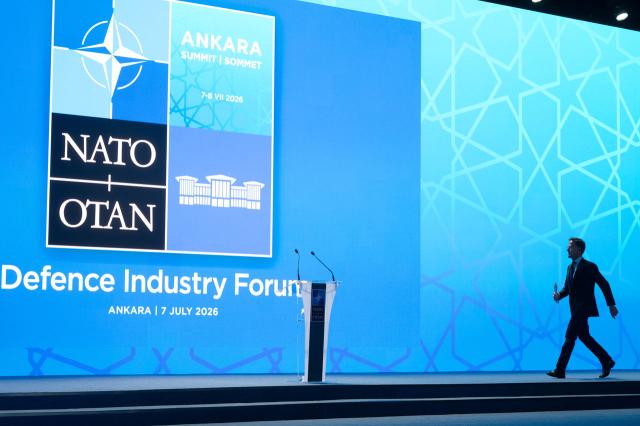
SEOUL, July 08 (AJP) -South Korea and the North Atlantic Treaty Organization (NATO) agreed Tuesday to launch negotiations on a procurement framework agreement, positioning Korean defense companies to participate in the alliance's expanding industrial and joint procurement network as NATO unveiled sweeping initiatives to accelerate defense production across Europe and North America.
The agreement was reached during President Lee Jae Myung's meeting with NATO Secretary General Mark Rutte on the sidelines of the NATO summit in Ankara, with Seoul describing it as a major step toward integrating South Korea into the world's largest defense procurement ecosystem.
National Security Adviser Wi Sung-lac said the proposed Korea-NATO Procurement Framework Agreement would establish the legal and administrative basis for South Korean companies to participate in NATO's joint procurement market, estimated at about 15 trillion won ($9.9 billion) annually.
"The agreement will provide the institutional foundation for our companies to participate in NATO's joint procurement market," Wi told reporters.
The framework agreement governs the legal and administrative procedures required for procurement contracts and broader military logistics cooperation between NATO and partner countries.
The announcement came as NATO launched a series of initiatives aimed at dramatically expanding defense production following last year's agreement by allies to sharply increase military spending.
Speaking at the NATO Summit Defence Industry Forum, Rutte unveiled the NATO Front Door for Industry, a new platform designed to give companies a single point of access to NATO procurement opportunities, innovation programs and industrial partnerships.
NATO will also publish, for the first time, a consolidated unclassified "demand signal" outlining the alliance's future capability requirements to help companies align investment with procurement needs.
Rutte also introduced the NATO Engine, an initiative intended to expand manufacturing capacity by linking defense and civilian production facilities across Europe, Canada and the United States.
"No one nation has the industrial capacity required to meet the large and growing demand," Rutte said, calling for governments and industry to produce "more, faster, together."
South Korea also broadened its participation in NATO's multinational capability cooperation programs.
In addition to its existing observer role in ammunition cooperation, Seoul will newly participate as an observer in defense-related raw materials projects while continuing cooperation in NATO's space initiatives.
Wi said the expanded participation would strengthen interoperability between South Korean and NATO weapons systems while helping establish more stable supply chains for military equipment.
Beyond procurement, Seoul plans to deepen cooperation in emerging defense technologies.
South Korea will seek participation in NATO's Innovation Range, where civilian technologies such as drones and artificial intelligence are evaluated under battlefield conditions using lessons drawn from the war in Ukraine.
Participation would allow Korean companies to test technologies in operational environments and potentially qualify for future NATO procurement and joint development programs.
Seoul also plans to join NATO's SpaceNet, the alliance's network linking member countries' space industries, enabling Korean companies to participate in information sharing, technology cooperation and future NATO-led space projects while broadening opportunities to utilize allied launch infrastructure.
Speaking at the NATO Defense Industry Forum, Lee called for greater standardization across allied defense industries.
"Each country has different standards, manufacturing methods and production practices," Lee said. "Standardization will be an important task."
Lee proposed elevating bilateral cooperation into what he called a "Korea-NATO Defense Industry Partnership 2.0," shifting the relationship beyond arms sales toward joint research, co-production and joint operation of defense systems.
The presidential office emphasized that the closer defense cooperation would not alter South Korea's diplomatic posture toward countries outside the alliance.
"This does not mean South Korea is entering NATO," a senior presidential official said. "We remain a partner country. We do not expect this to have any significant impact on our relations with countries such as China or Russia."
As part of Seoul's broader contribution to international security, South Korea also pledged an additional $100 million in assistance for Ukraine. Presidential officials said the package would remain non-lethal, maintaining Seoul's longstanding policy against supplying lethal weapons.
Earlier Tuesday, Lee held a brief meeting with Canadian Prime Minister Mark Carney following Canada's decision to award its multibillion-dollar submarine procurement program to Germany's TKMS instead of South Korea.
According to Wi, the two leaders agreed to continue expanding cooperation under the countries' Comprehensive Strategic Partnership, identifying defense, artificial intelligence, energy and critical minerals as key areas for future collaboration despite the submarine outcome.
Lee is scheduled to hold bilateral meetings Wednesday with the leaders of Norway, the Netherlands and Romania to discuss cooperation in renewable energy, semiconductors, artificial intelligence, batteries, nuclear power, infrastructure and defense industries. The NATO summit concludes Wednesday.
Lee heads to Mongolia for two-day visit.
Copyright ⓒ Aju Press All rights reserved.
