SEOUL, July 08 (AJP) - South Korea, the United States and Japan signed an agreement on Tuesday to jointly export small modular reactors, turning three countries that have long competed for the same nuclear contracts into a coordinated bloc aimed at the fastest-growing corner of the global energy market.
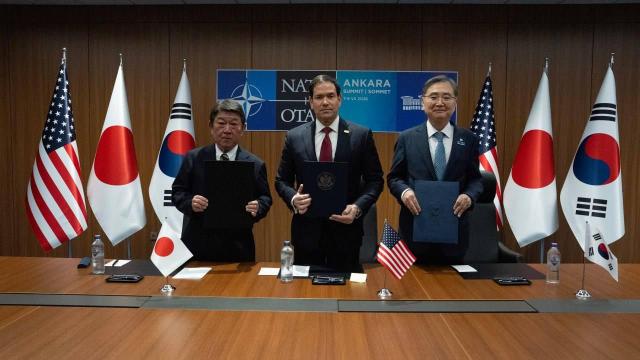
South Korea's Ministry of Foreign Affairs said in a statement on Wednesday that Foreign Minister Cho Hyun, U.S. Secretary of State Marco Rubio and Japanese Foreign Minister Motegi Toshimitsu signed the memorandum of cooperation (MOC) on the sidelines of the NATO summit in Ankara, Türkiye. The framework targets reactor deployments in third countries, starting with the Indo-Pacific region, and Washington is backing it with more than $10 million in new funding for a State Department program that provides technical support to Indo-Pacific countries adopting nuclear power, according to the department.
For South Korea's nuclear industry, the deal formalizes something that has been taking shape for months, a division of labor with American reactor designers and Japanese industrial partners rather than a head-to-head fight against them.
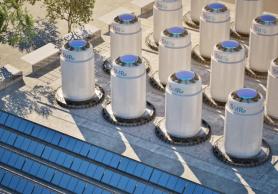
Small modular reactors are nuclear plants shrunk to a fraction of conventional size, typically generating up to 300 megawatts compared with more than 1,000 megawatts for a standard large reactor. Their components are built in factories and assembled on site, which developers say cuts construction time and the enormous upfront cost that has stalled large nuclear projects across the West. The technology remains largely unproven commercially. No small modular reactor is yet operating in a Western country, though the first is under construction in Canada.
What has transformed the sector from a niche engineering project into a strategic priority is artificial intelligence. Training and running AI models require vast server farms that draw power around the clock, and the International Energy Agency (IEA) projects that electricity consumption by data centers will roughly double from 485 terawatt-hours in 2025 to 950 terawatt-hours in 2030, around three percent of global electricity demand. A single hyperscale AI data center can consume as much electricity as 100,000 homes. Wind and solar energy sources cannot supply that load alone because it never stops, and grid connections for new gas plants now face multi-year waits. Nuclear power, which runs continuously and emits no carbon, fits the profile, and small reactors can be placed near the data centers themselves.
Technology companies have moved first. Google signed the first commercial SMR power purchase agreement with the American developer Kairos Power in October 2024, and Amazon and Microsoft have made their own nuclear commitments. The pipeline of conditional power purchase agreements between data center operators and small modular reactor projects has grown from 25 gigawatts at the end of 2024 to 45 gigawatts today, according to the International Energy Agency. IEA Executive Director Fatih Birol has said "there is no AI without energy" and that countries providing secure, affordable electricity will hold the advantage.
The Ankara agreement is designed to capture that market as a bloc. According to South Korea's Ministry of Foreign Affairs, the framework aims to reduce project development risk, achieve economies of scale, attract private investment, streamline licensing and optimize supply chains, while holding partner countries to the highest standards of nuclear safety and nonproliferation. The unstated competitors are Russia's Rosatom and China's state nuclear companies, which have dominated reactor exports to developing countries by bundling state financing with construction.
The three allies bring complementary pieces. American firms lead in reactor design, Japanese conglomerates supply heavy components and reactor technology through ventures such as GE Vernova Hitachi Nuclear Energy, and South Korean companies bring a construction record that delivered the United Arab Emirates' Barakah plant and a domestic supply chain anchored by Doosan Enerbility, which manufactures forgings and modules for American SMR developers including NuScale Power.
The industrial side of the arrangement is already visible. Alongside the ministers' signing, the State Department announced an industry initiative among GE Vernova, Hitachi, Samsung C&T and SGE to deploy the BWRX-300 small modular reactor across Europe. Samsung C&T, the construction arm of the Samsung group, formed a strategic alliance with GE Vernova Hitachi Nuclear Energy in October 2025 to deploy the 300-megawatt reactor in global markets outside North America. Last week that partnership widened again when SGE, a Polish-led developer, unveiled plans for 14 BWRX-300 reactors across three sites in the United Kingdom with a team including Samsung C&T and Google Cloud, a project worth about $47 billion.
The cooperative turn follows years of costly rivalry. Korea Hydro & Nuclear Power spent much of the past decade locked in an intellectual property dispute with Westinghouse Electric Company, the American firm whose technology underpins South Korea's flagship APR1400 reactor. The fight shadowed Seoul's export campaigns until the two sides reached a global settlement in January 2025. The terms were steep. Korea Hydro & Nuclear Power (KHNP) agreed to purchase $650 million in Westinghouse goods and services and pay $175 million in licensing fees for each reactor it exports, and accepted restrictions on bidding in North America, most of the European Union, the United Kingdom, Japan and Ukraine, according to the Korea Herald. The 50-year deal also gives Westinghouse the right to verify the technical independence of South Korean companies before they bid on overseas projects, including small modular reactors.
That settlement cleared the way for KHNP to sign its $18.6 billion contract in June 2025 to build two large reactors in the Czech Republic, South Korea's first overseas nuclear plant order since 2009, but it also drew fierce domestic criticism as a lopsided concession. The new trilateral framework offers a different logic. If South Korean, American and Japanese firms bid together rather than against each other, the licensing restrictions that hem in solo Korean bids matter less, and the combined offer becomes harder for customers to refuse.
KHNP is meanwhile developing its own domestic design, the i-SMR, with a target of completing standard design approval in the late 2020s, giving South Korea a technology of its own to feed into future consortium bids.
At the signing ceremony, Rubio tied the agreement directly to energy security, pointing to instability around the Strait of Hormuz, the shipping chokepoint for Middle Eastern oil. He said the deal allows the three countries to move forward on joint work on small modular reactors, calling the technology "in many ways the future of energy generation." Cho said the SMR sector is one of many areas where the three countries can work together on shared challenges.
The first BWRX-300 is under construction at Ontario Power Generation's Darlington site in Canada, with completion expected by the end of the decade.
Copyright ⓒ Aju Press All rights reserved.