

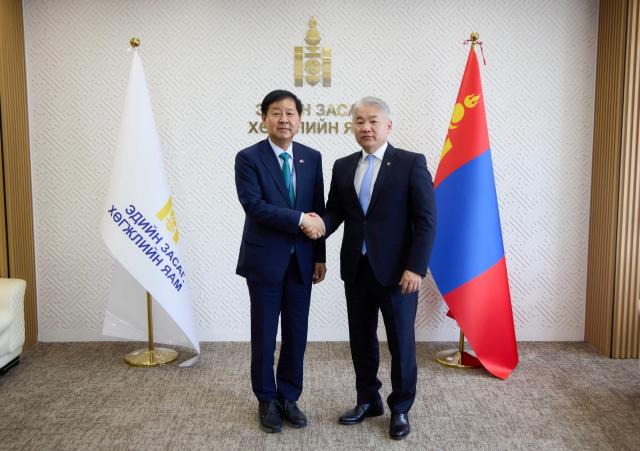
Deputy Prime Minister and Minister of Economy and Finance Koo Yun-cheol held separate meetings Thursday with Mongolian First Deputy Prime Minister and Economy and Development Minister Jadamba Enkhbayar and Finance Minister Zagdjav Mendsaikhan during President Lee Jae Myung’s state visit to Mongolia.
The two sides agreed to advance bilateral economic cooperation following the first state visit by a South Korean president to Mongolia in 15 years.
They identified AI applications, data center construction, critical mineral supply chains, renewable energy development and healthcare as areas with strong potential and agreed to establish a hotline between the two deputy prime ministers.
Koo said Mongolia’s mineral and renewable energy resources could be combined with South Korea’s technology to develop mutually beneficial projects.
Mongolia is estimated to rank seventh globally in copper reserves, ninth in molybdenum production and second in rare earth reserves, while its solar and wind power potential is estimated at 2,600 gigawatts.
The two countries also welcomed the preliminary conclusion of negotiations on a bilateral Comprehensive Economic Partnership Agreement.
They plan to use the agreement to expand cooperation beyond trade and investment into critical mineral development, AI and digital infrastructure.
Mendsaikhan expressed interest in South Korea’s development experience and technology and pledged to improve Mongolia’s investment environment for Korean companies.
The two finance ministries also signed a memorandum of understanding on cooperation in building Mongolia’s second national cancer center.
The proposed 400-bed hospital, estimated to cost about $230 million, would provide cancer prevention, diagnosis, treatment, education and research services.
The governments plan to accelerate a feasibility study and examine how AI-based diagnostic systems and other advanced medical technologies could be introduced under Mongolia’s healthcare conditions.
South Korea will decide whether to approve financing through its Economic Development Cooperation Fund after completing the study.
The feasibility study will be the first launched since Seoul announced a new EDCF strategy in April.
The Export-Import Bank of Korea and the Trade and Development Bank of Mongolia also signed an agreement on a $30 million interbank export credit facility.
The Korean policy lender will provide funds to the Mongolian bank, which will lend to local companies importing Korean products, including food, beverages and cosmetics.
The Bank of Korea and the Bank of Mongolia also revised a bilateral cooperation agreement first signed in August 2011.
The updated memorandum specifies cooperation and technical assistance in monetary policy, financial stability and payment systems.
It also adds working-level meetings to exchange programs previously centered on workshops and seminars.
The BOK said the revision reflects progress in financial cooperation and provides a more concrete framework for exchanges between the two central banks.
The central bank added that closer ties with resource-rich Mongolia could strengthen strategic cooperation with a country linking Central and Northeast Asia.

Copyright ⓒ Aju Press All rights reserved.
