

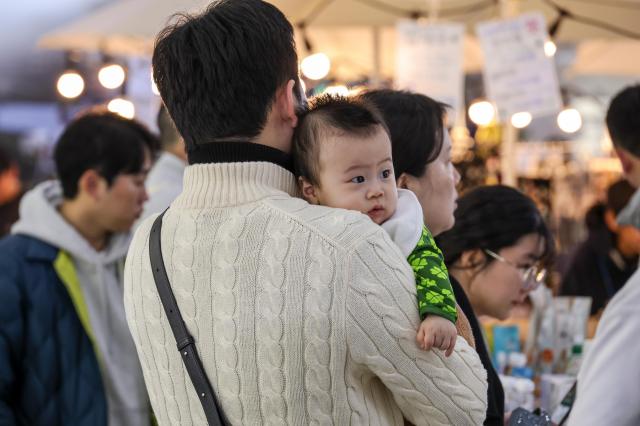
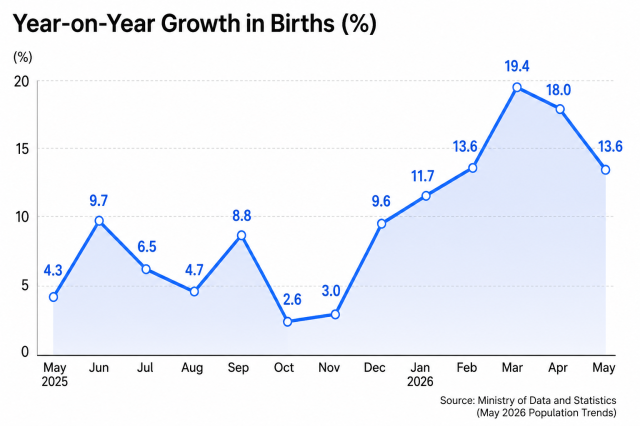
Some 23,160 babies were born in May, up 13.6 percent from a year earlier. The country’s total fertility rate, which measures the average number of children a woman is expected to have over her lifetime, also rose to 0.85 from 0.75 a year earlier, while the number of marriages declined from a year earlier.
The latest figures extended a steady recovery that has been underway since July 2024. During the first five months of this year, the number of newborns reached 122,694, up 15.2 percent from the same period last year.
The increase was led by women in their 30s, the country's largest childbearing age group. The birth rate for women aged 30 to 34 rose to 78.0 births per 1,000 women from 69.7 a year earlier, while that for those aged 35 to 39 increased to 58.0 from 48.1.
Among women aged 25 to 29, the rate edged up to 20.6 from 20.1, and for those aged 40 and older it increased to 4.7 from 4.2. By contrast, the rate for women aged 24 and younger fell to 1.9 from 2.3.
First-born children accounted for 63.0 percent of all births, up 1.3 percentage points from a year earlier. However, the share of second-born children edged down 0.2 percentage points to 31.7 percent, while that of third-or-later children fell 1.1 percentage points to 5.3 percent.
Births rose across the country, with Jeju the only region to record a decline. Seoul recorded 4,227 births, up 17.7 percent, while Gyeonggi Province saw births rise 13.8 percent to 7,075, compared with a 3.1 percent decline in Jeju.
The total number of divorces stood at 36,240 over the same period, up 0.2 percent on-year. In May, divorces totaled 7,122, down 3.9 percent from a year earlier.
Despite the recovery in births, South Korea's population continued to decline naturally. The number of deaths rose 3.8 percent from a year earlier to 29,573 in May.
However, the natural population decline, calculated as the difference between births and deaths, narrowed to 6,413 from 8,103 a year earlier, as births grew faster than deaths. Ulsan, Sejong and Gyeonggi Province were the only regions where births exceeded deaths, while all other regions recorded natural population declines.

Copyright ⓒ Aju Press All rights reserved.
