

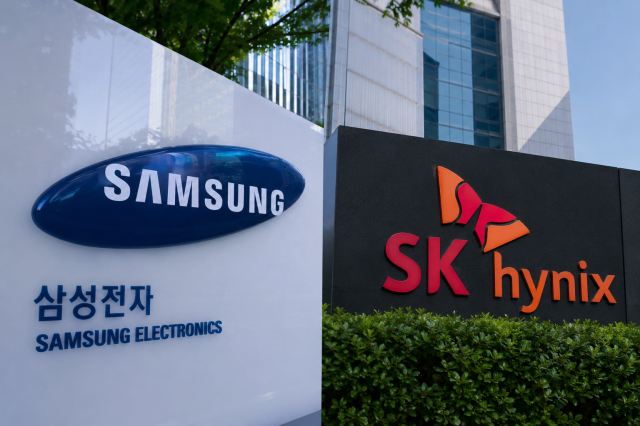
SEOUL, August 03 (AJP) - SK hynix remained the clear leader in the game-changing high-bandwidth memory (HBM) market through the first half, but the second half could mark the beginning of a new phase as Samsung Electronics pushes aggressively to close the gap with next-generation HBM4.
The rivalry came into sharper focus following the two companies' second-quarter earnings calls on July 29 and July 30, when South Korea's two memory giants used their outlook presentations to lay out competing visions for the next stage of the AI memory race.
Samsung said third-quarter HBM4 revenue is expected to more than triple from the previous quarter and projected that its HBM market share would eventually approach its overall DRAM market position. The company also highlighted long-term supply agreements with major hyperscale cloud operators and a diversified customer base, signaling confidence that it can steadily narrow the gap with the market leader.
SK hynix countered that leadership in HBM depends on far more than bringing the newest product to market.
The company argued that its edge stems from manufacturing know-how accumulated across multiple HBM generations, pointing to production yields, product quality and customer trust as competitive advantages that cannot be replicated overnight.
It said it had already begun mass shipments of HBM4 and secured long-term supply agreements with about 10 customers, including leading AI chipmakers.
The exchange comes as the world's largest cloud service providers continue to ramp up spending on AI infrastructure, reinforcing expectations that demand for advanced memory will remain robust for years.
Amazon, Microsoft, Alphabet and Meta all raised capital expenditure plans following second-quarter earnings, while Amazon warned supply constraints are likely to persist into next year despite record investment. Samsung has separately forecast that the AI-driven memory shortage could extend through 2028.
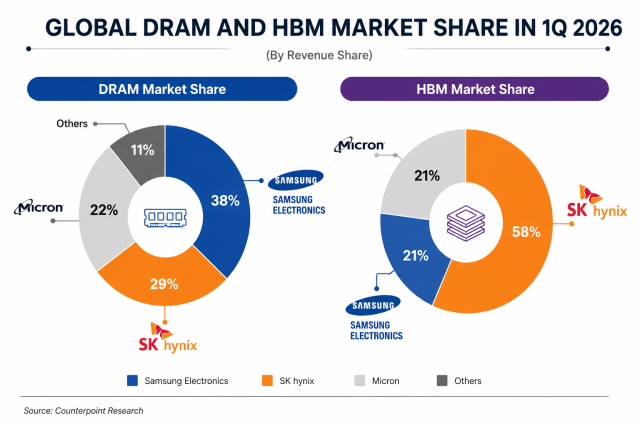
The market data illustrate two distinct competitive landscapes.
According to Counterpoint Research, Samsung held a 38 percent share of the global DRAM market by revenue in the first quarter, a modest lead over SK hynix's 29 percent.
The picture is markedly different in AI memory.
SK hynix commanded a 58 percent share of the HBM market, nearly three times Samsung's 21 percent, underscoring its dominant position in the industry's fastest-growing and most profitable segment.
Industry pricing trends suggest the favorable environment is unlikely to fade anytime soon.
TrendForce expects PC DRAM contract prices to rise another 15 percent to 20 percent in the third quarter as memory makers shift more production capacity toward higher-margin server chips to meet AI demand from hyperscale cloud providers. NAND flash prices have also continued climbing, indicating that tight supply conditions are extending beyond HBM into the broader memory market.
Nvidia's supplier decisions are now doing as much to shape the rivalry as either company's own roadmap. On June 5, Nvidia CEO Jensen Huang confirmed that Samsung, SK hynix, and Micron had all passed certification to supply HBM4 for the Vera Rubin AI accelerator platform, ending months of speculation over which suppliers would qualify. Certification hasn't meant equal allocation: supply-chain analysts estimate SK hynix holds roughly 60–70 percent of Vera Rubin HBM4 volume, with Samsung capturing about 25–30 percent and Micron supplying the remainder. TrendForce separately projects SK hynix will still lead global HBM bit output with a 50 percent share in 2026, down from 59 percent in 2025, while Samsung's share climbs from 20 percent to 28 percent — a trajectory that lines up with the narrowing-gap narrative Samsung pressed in its earnings call.
Samsung and SK hynix are also making different capacity bets to back up those claims. SK hynix is aggressively ramping its 1c DRAM node from roughly 20,000 to 160,000–190,000 monthly wafers by the end of 2026, while Samsung is targeting about 50 percent HBM production capacity growth over the same period — though Samsung's binding constraint remains qualification and yield rather than installed capacity.
As AI infrastructure investment accelerates, analysts increasingly see the contest between Samsung and SK hynix shifting beyond technology leadership alone. The next battle will be fought over manufacturing execution, production yields, customer qualification and, above all, the ability to lock in multi-year supply agreements with hyperscalers and AI chip designers investing hundreds of billions of dollars in next-generation data centers.
Samsung enters the second half as the challenger seeking to convert its leadership in conventional DRAM into gains in premium AI memory. SK hynix, meanwhile, is betting that years of manufacturing experience, execution and customer relationships will prove just as difficult to catch as the technology itself.

Copyright ⓒ Aju Press All rights reserved.
