

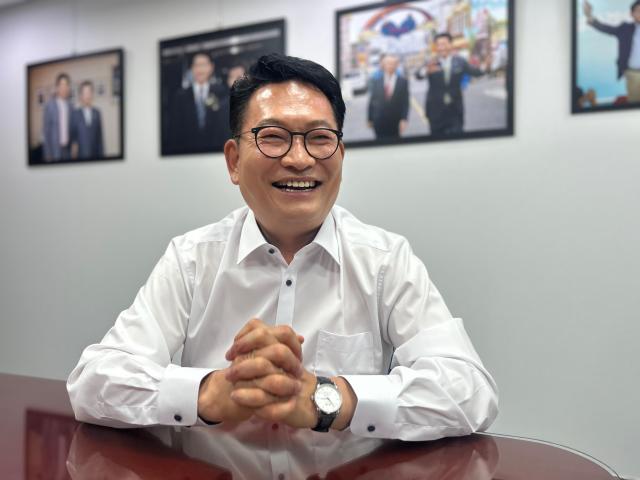
SEOUL, August 03 (AJP) - Six-term lawmaker Song Young-gil vowed to stay in the South Korean ruling Democratic Party leadership race until the end despite finishing a distant third in the opening weekend of regional voting, rejecting speculation that he would join forces with rival Kim Min-seok and arguing that his experience makes him the strongest candidate to lead the party.
Although the Aug. 17 leadership contest is increasingly shaping up as a two-way race between former party leader Jung Chung-rae and former Prime Minister Kim Min-seok, Song insisted the newly adopted preferential voting system gives him a path to victory and said his experience leading both the Democratic Party and Incheon Metropolitan Government sets him apart from his rivals.
"There is no need for unification," Song said in an interview with AJP at the National Assembly on July 31. "Because the runoff system has effectively been replaced by preferential voting, a candidate would put himself at a disadvantage by failing to remain in the race until the end. I will complete the race without unification."
Under the preferential voting system introduced for the Aug. 17 convention, voters rank the three leadership candidates in order of preference. If no candidate wins a majority of first-choice votes, the third-place candidate is eliminated and the second-choice votes cast by that candidate's supporters are redistributed between the two remaining contenders.
Song said he offers a combination of experience unmatched by the other candidates, having served as both Democratic Party chairman and mayor of Incheon.
"The person best equipped among the three candidates to perform the role of ruling party leader is Song Young-gil," he said. "I have led a metropolitan government, studied economics and supported a national administration as the leader of the ruling party."
Why him over the two who have served in leadership under President Lee Jae Myung? Song said the next party leader must be more than a political ally of the president.
"A ruling party leader must work in step with the president and provide legislative support for the administration," Song said. "At the same time, the leader must accurately convey public sentiment, compensate for the president's shortcomings and present alternatives."
"I believe I am more capable of performing that role," he added. "I have already demonstrated it while serving as party leader."
Although he led the Democratic Party under former President Moon Jae-in, Song stressed his long relationship with Lee.
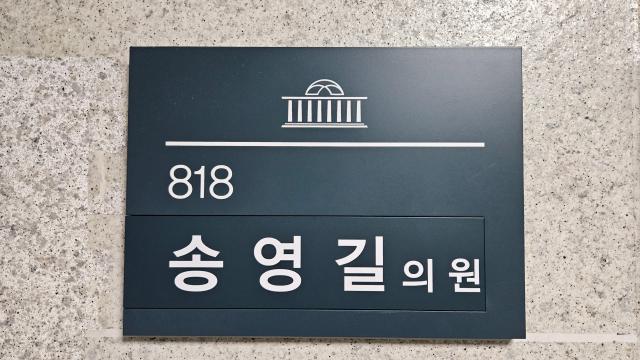
While representing Incheon's Gyeyang B constituency, Song occupied the parliamentary office that Lee later inherited after winning the 2022 by-election following Song's unsuccessful Seoul mayoral bid. After returning to the National Assembly in the June 3 by-election in Incheon's Yeonsu A district, Song chose to move back into the same office, Room 818, for the first time in four years.
Song also sharply criticized Jung Chung-rae's proposal to suspend trading in single-stock leveraged exchange-traded funds, arguing that political leaders should avoid making market-moving remarks without sufficient economic understanding.
"Had trading been suspended as Jung proposed, investors might have been denied even the chance to recover their principal," Song said.
"The episode demonstrated that the leader of the ruling party must not make remarks capable of moving the market without sufficient economic understanding and careful review."
Jung proposed during a televised debate on July 29 that the government consider temporarily suspending trading in leveraged ETFs tracking individual stocks, including Samsung Electronics and SK hynix, as volatility swept through the Korean stock market.
"Stopping the trading of products that have already been listed would go too far," Song said.
Financial authorities subsequently announced plans to temporarily halt new listings of single-stock leveraged products, raise the required cash deposit from 10 million won to 30 million won and eventually increase the minimum trading unit to 20 shares. The market capitalization of 16 single-stock leveraged ETFs had surged from 4.4 trillion won when they debuted on May 27 to 11.9 trillion won as of July 15.
Song said his opposition to suspending trading also reflected his confidence in South Korea's semiconductor industry.
"Unless the AI era goes into reverse, demand for memory chips will continue to increase," he said. "I believed that the share prices of Samsung Electronics and SK hynix would eventually recover."
Despite his brave words. Song faces an uphill battle after finishing a distant third in the opening regional contests.
Kim and Jung remain locked in a razor-thin contest. Kim narrowly won the Chungcheong regional vote announced Saturday with 45.05 percent to Jung's 44.61 percent. Jung rebounded to win Sunday's Busan, Ulsan and South Gyeongsang contest with 46.65 percent, ahead of Kim's 43.84 percent and Song's 9.49 percent.
As of Monday, the cumulative first-choice vote among eligible party members stood at 45.51 percent for Jung, 44.52 percent for Kim and 9.97 percent for Song. Jung's lead over Kim was just 1,211 votes, leaving Song's supporters and their second-preference choices with the potential to determine the eventual winner.
Song also pledged to apply transparent and consistent standards when selecting candidates for the 2028 general election, one of the most consequential powers of the next party leader.
"I will build a Democratic Party in which opportunities are equal, the process is fair and the outcome is just," he said.
Song accused Jung of using candidate nominations in the recent local elections and parliamentary by-elections to strengthen his own political faction ahead of his leadership campaign.
"The nominations were criticized as an attempt to plant his own people for Jung Chung-rae's reelection," Song said.
"I will make fair nominations in accordance with transparent principles. Candidates will be selected according to their competitiveness and the public's evaluation, not their faction or personal relationship with the party leader."
Song said his ultimate goal was to help the party secure another parliamentary majority in the 2028 general election, calling the June 3 local elections as "a defeat wearing the outer appearance of victory," arguing that the leadership had failed to present a coherent nationwide message despite retaining political dominance.
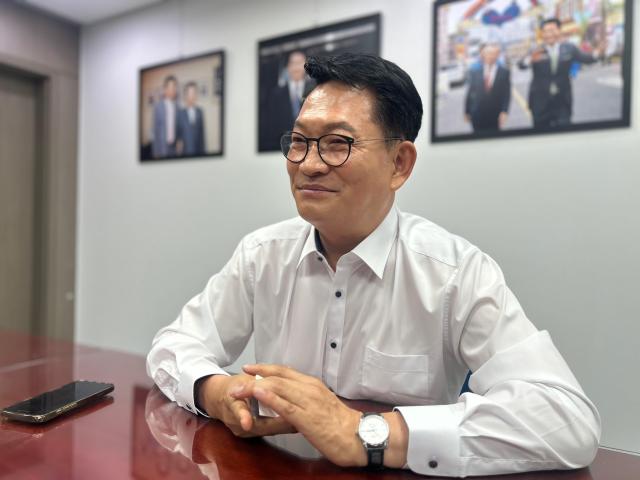
Born in Goheung, South Jeolla Province, in 1963, Song graduated from Yonsei University with a degree in business administration before passing Korea's 36th national bar examination. He entered the National Assembly in 2000, served five terms representing Incheon's Gyeyang district, was mayor of Incheon from 2010 to 2014 and chaired the Democratic Party in 2021. Readmitted to the party in February, he returned to parliament by winning the June 3 by-election in Incheon's Yeonsu A district, becoming the city's first six-term lawmaker.
Voting by party members in Jeju and Incheon will take place from Aug. 4 to 7, with results announced Aug. 8. Voting in Gangwon, Daegu and North Gyeongsang will run from Aug. 5 to 8, followed by regional speeches and results on Aug. 9. The Honam contest will be held on Aug. 15, before the final regional round in Seoul and Gyeonggi Province on Aug. 16. The Democratic Party will elect its new leader at its national convention in Daejeon on Aug. 17, with votes from party members and delegates accounting for 70 percent of the result and a public opinion survey making up the remaining 30 percent.
Copyright ⓒ Aju Press All rights reserved.
