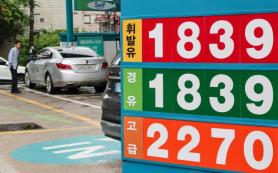
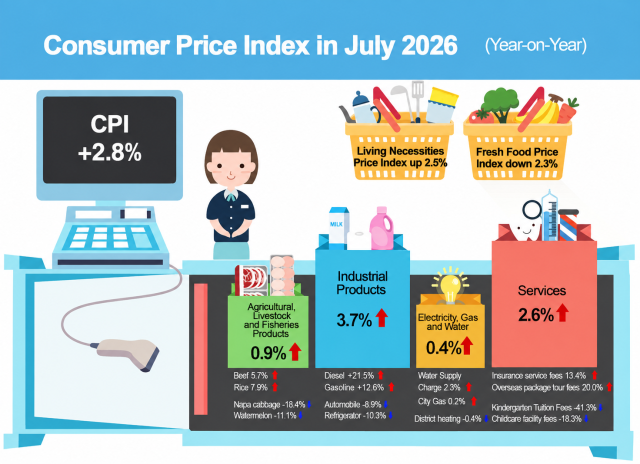
Consumer prices rose 2.8 percent from a year earlier in July, slowing from 3.2 percent in June and falling below the 3 percent mark for the first time in three months.
Core inflation, which Bank of Korea Gov. Shin Hyun-song has repeatedly highlighted as a better gauge of underlying price pressures because it excludes volatile food and energy prices, crept up to 2.6 percent from 2.5 percent - highest level since December 2023 -, albeit at a measured pace.
The Bank of Korea estimated that lower petroleum prices and agricultural, livestock and fisheries goods reduced annual headline inflation by 0.33 percentage point and 0.17 percentage point, respectively.
By contrast, core goods and services together added 0.11 percentage point, underscoring that domestic price pressures have yet to fully dissipate.
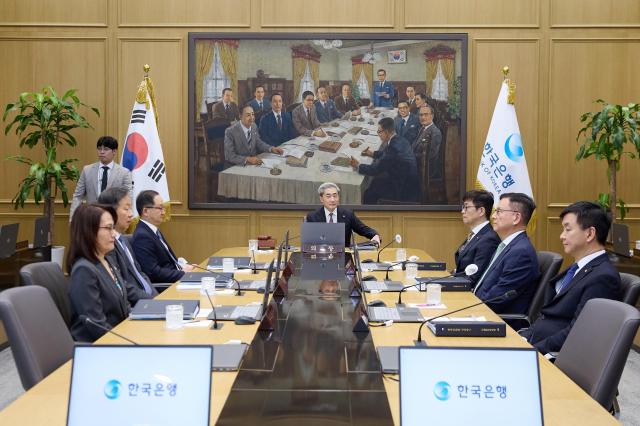
Lee Ji-ho, a BOK deputy governor, said the central bank would "monitor inflation with vigilance," warning that the pass-through of earlier cost increases and strengthening demand-side pressures could keep core inflation elevated.
Financial markets modestly pared expectations for a second consecutive rate increase at the Aug. 27 policy meeting, although market pricing continued to suggest investors still see a meaningful chance of another hike.
At around 1:50 p.m., the won traded near 1,431.9 per dollar, about 2.9 won weaker than the previous close.
The three-year Korean government bond yield fell 1.1 basis points to 3.731 percent by midday, while the benchmark 10-year yield edged down just 0.1 basis point to 4.252 percent.
The sharper decline in the policy-sensitive three-year yield suggested investors had scaled back expectations for an August increase, while the muted moves in the currency and longer-term bonds indicated markets had yet to fully price in a pause.
The Bank of Korea raised its benchmark interest rate by 25 basis points to 2.75 percent on July 16, citing stronger export- and investment-led growth, inflation expected to remain above target and persistent financial stability risks.
While signaling that further policy tightening would likely be needed, the central bank stressed that the timing and pace of additional increases would depend on incoming data on inflation, economic growth and financial stability, leaving an Aug. 27 move far from certain.
The government estimates that the statistical effect alone could add about 0.8 percentage point to the annual inflation rate.
Ahn Jae-kyun, an economist at Korea Investment & Securities, said markets had lowered the probability of an August rate increase following the inflation data but were still assigning odds of more than 50 percent, while maintaining a rate hike as his base-case scenario.
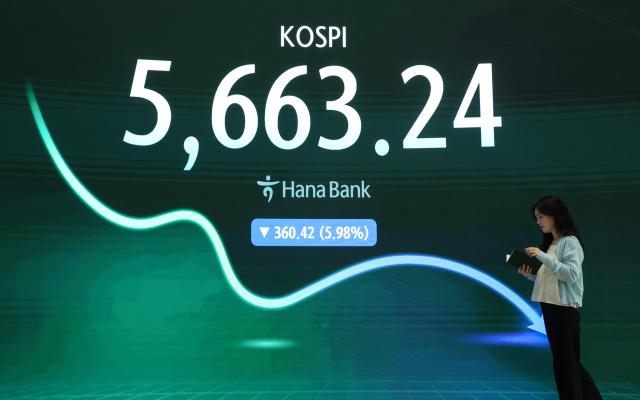
The equity-market correction entering the second half has strengthened the argument for a cautious policy approach, as falling stock prices could curb household spending through a negative wealth effect and ease demand-driven inflationary pressure.
NH Investment & Securities projected private consumption growth could slow by about 0.15 percentage point if the stock market turns bearish in the latter half.
Barclays estimated that households have suffered roughly 600 trillion won in valuation losses from the recent market sell-off.
Pressure on household budgets remains intact. The living necessities index rose 2.5 percent from a year earlier in July, while its non-food component climbed 3.2 percent, indicating that consumers continue to face elevated costs for everyday purchases even as headline inflation moderates.
Housing remains the clearest obstacle to an extended pause. Seoul apartment prices rose 0.25 percent in the fourth week of July, extending their gains to a 77th consecutive week despite easing slightly from the previous week's 0.27 percent increase, keeping financial stability concerns firmly on the Bank of Korea's radar.
The latest data strengthen the case for a hawkish hold rather than an outright pause in August.
The BOK will likely to decide to resume tightening on economic and stock performance in the second half amid mixed views on the strength and duration of the chip-led growth.

Copyright ⓒ Aju Press All rights reserved.