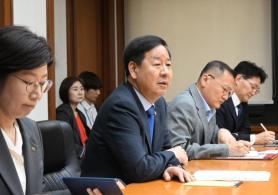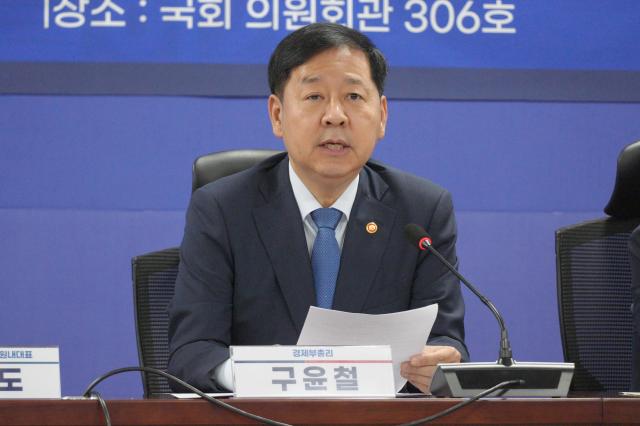
The Ministry of Economy and Finance unveiled the blueprint Thursday at an emergency economic ministers' meeting chaired by Finance Minister Koo Yun-cheol, setting out legal, governance and digital infrastructure for what it calls the K-Asset Innovation Project.
At the center of the overhaul is a proposed Framework Act on National Assets, which would replace the current State Property Act, enacted in 1950, with legislation built around the broader concept of managing national wealth rather than simply owning and disposing of government property.
State-owned assets have expanded more than sevenfold to 1,402.7 trillion won from 188.3 trillion won in 2001, but management remains fragmented across ministries, special accounts and public funds and is still largely geared toward land and buildings.
The government argues that the existing property-based framework no longer reflects the changing composition of public wealth.
While securities and intellectual property are already covered under existing law, officials say they lack management systems tailored to valuation, shareholder rights, licensing and disposal. Cryptocurrencies, meanwhile, have no explicit statutory framework.
The government stressed that the 1,402.7 trillion won figure does not represent a sovereign investment portfolio or assets readily available for sale, as much of it consists of administrative property and infrastructure needed to provide public services. Instead, the new framework would distinguish assets requiring direct operational management from those held primarily for accounting or statistical purposes.
One of the earliest legal changes would cover about 78 billion won worth of cryptocurrencies held by the central government as of April, most of them acquired through confiscation, forfeiture or donations.
The government is considering auctioning digital assets soon after acquisition as the default disposal method while allowing sales to be split into smaller tranches when immediate liquidation could disrupt relatively thin markets or unnecessarily depress prices.
The proposed legislation would also authorize the government to use private cryptocurrency exchanges for custody and disposal and establish legal grounds for recovering assets held in overseas exchanges and digital wallets.
Government-owned intellectual property, valued at 2.3 trillion won at the end of last year, would shift toward a "use-first" model that emphasizes commercialization over disposal. Licensing periods could be extended beyond the current five-year limit, while contracts, royalties and revenue-sharing arrangements would be managed through a proposed national intellectual property bank.
The overhaul also seeks to establish common standards for acquiring, valuing and disposing of the government's 328.7 trillion won portfolio of securities and equity holdings, including unified rules governing voting rights and shareholder engagement, which are currently exercised differently across ministries, public funds and special accounts.
Management of the government's 711.1 trillion won in land and buildings would also be integrated under common development guidelines, supported by an annual matching process designed to reallocate underused properties among ministries, local governments and public institutions.
A new National Asset Management Committee, comprising government officials and private-sector experts, would oversee broad policy, while each ministry would appoint a senior national asset officer responsible for compliance and stewardship of its holdings.
The Korea Asset Management Corp., or Kamco, would receive an expanded mandate to manage and dispose of government assets on behalf of ministries, although officials have yet to determine how much authority should ultimately be centralized.
By the end of this year, the government plans to integrate asset information from central and local governments and public institutions into its dBrain digital budget and accounting system before beginning work in 2027 on an artificial intelligence-powered database tentatively named K-Asset Cloud.
Officials say the platform will identify idle assets and match them with public-sector demand, replacing today's fragmented coordination with a standardized annual process covering asset classification, demand surveys, site selection and development planning.
A public-private task force led by the finance ministry and supported by the Korea Development Institute will prepare a draft of the framework act by year-end. Key details—including valuation methodologies, disposal rules, exemptions and the division of authority among government agencies—remain under negotiation.
AJP Takeaways
- South Korea is redefining state property as national wealth through its biggest public asset overhaul in more than 70 years.
- The reform brings crypto, intellectual property and financial assets into the same management framework as land and buildings.
- The government aims to extract greater value from 1,402.7 trillion won in public assets through AI-driven management and unified governance.

Copyright ⓒ Aju Press All rights reserved.