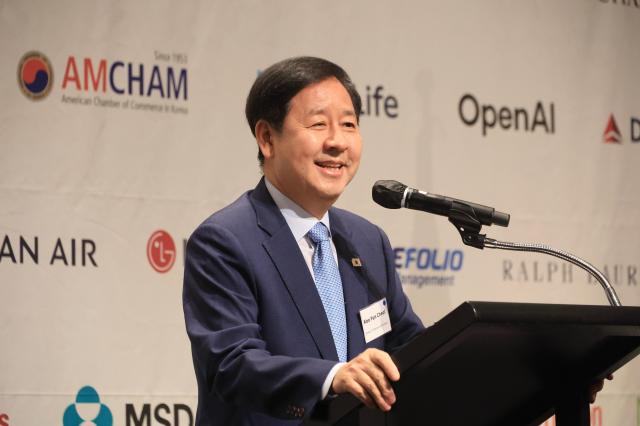
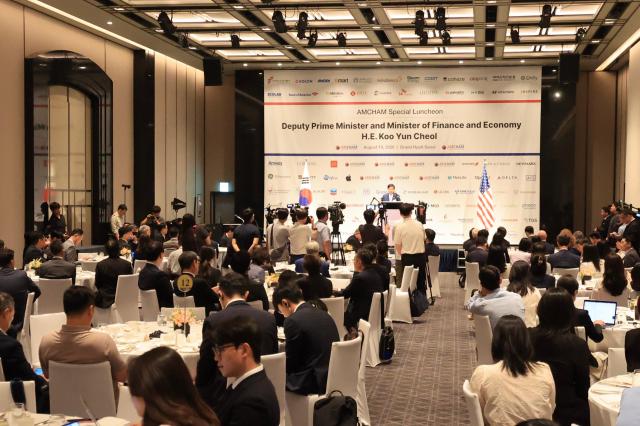
At a luncheon meeting in central Seoul hosted by the American Chamber of Commerce in Korea (AMCHAM) in central Seoul, Koo made the remarks amid ongoing concerns in Washington over alleged "discriminatory treatment" of U.S. companies in South Korea including scrutiny of e-commerce giant Coupang and broader complaints involving major tech firms such as Apple, Google and Meta.
U.S. lawmakers have argued that the country's regulatory actions may unfairly target American firms, while Seoul has consistently rejected the claims, saying all investigations are conducted in accordance with relevant laws regardless of nationality.
Koo repeatedly emphasized the point throughout his speech, thanking foreign investors for their contributions to the South Korean economy. "We absolutely do not discriminate against companies," he said, adding that investors should be seen as "true Korean patriots."
He also joked that AMCHAM "should be KOCHAM," arguing that companies operating in South Korea should be considered part of the domestic economy regardless of origin.
Koo also outlined the government's so-called "3-4-5 Vision," which aims to raise the country's potential growth rate to 3 percent, make it one of the world's top four exporters and increase per capita income to US$50,000. The strategy is backed by three major initiatives focused on semiconductors, artificial intelligence (AI) data centers and physical AI.
Koo also rejected concerns that Seoul was deliberately delaying its investment commitments to the U.S., saying there was "absolutely no intention" of doing so.
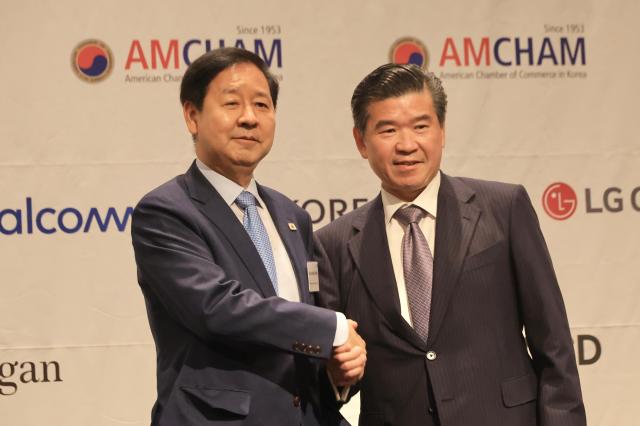
Kim said realizing that potential would require continued efforts to address South Korea-specific regulatory barriers and bring its rules more closely in line with global standards.
He also said AMCHAM's recent meetings in Washington showed that the next phase of the U.S.-Korea economic partnership should be built on tangible investment in strategic sectors, deeper technology cooperation and greater regulatory alignment, particularly in the digital economy.
He added the bilateral relationship was increasingly being defined not only by the security alliance but also by investment, innovation, technology and public-private cooperation.
Koo reiterated that foreign companies would continue to be treated equally. "The South Korean government views AMCHAM member companies not as foreign companies, but as members of the South Korean economy," he said.
Copyright ⓒ Aju Press All rights reserved.