

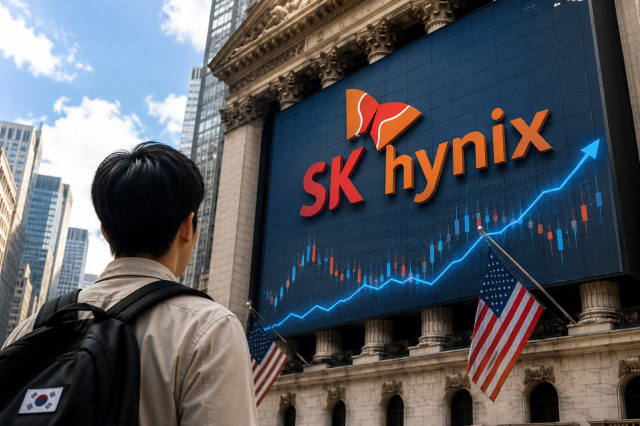
South Korean investors made US$3.79 billion in net purchases of the Direxion Daily Semiconductor Bull 3X Shares (SOXL) in July, making the triple-leveraged semiconductor ETF their top U.S. investment for the month.
SK hynix's ADRs came second, with domestic investors buying $1.01 billion and selling $166.5 million of the U.S.-listed securities between July 1 and 31, resulting in net purchases of $843.7 million.
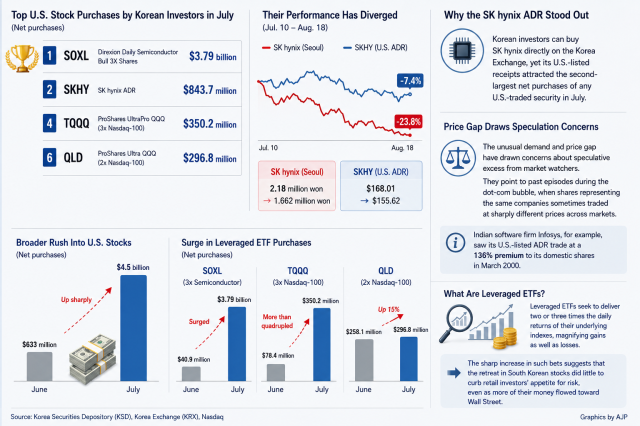
The concentration was part of a much broader move into U.S. equities. South Korean investors made about $4.5 billion in net purchases of U.S. stocks in July, up sharply from the previous month.
The SK hynix purchases stood out for another reason. Although investors can buy the chipmaker's shares directly on the Korea Exchange, its U.S.-listed ADRs drew the second-largest net purchases among U.S.-traded securities in July.
Their performance has also diverged since the ADR's U.S. debut. SK hynix's Seoul-listed shares fell 23.8 percent from 2.18 million won on July 10 to 1.66 million won on Aug. 18. Over the same period, SKHY declined just 7.4 percent, from $168.01 to $155.62.
The unusual demand and price gap have drawn concerns about speculative excess. Owen Lamont, a senior vice president at Acadian Asset Management, told CNBC that South Korean investors were buying the U.S.-listed security even though they could invest in the same company at home, calling the behavior "absolutely crazy."
He compared the discrepancy with pricing distortions seen around the dot-com bubble, when shares representing the same companies sometimes traded at sharply different prices across markets. Indian software firm Infosys, for example, saw its U.S.-listed ADR trade at a 136 percent premium to its domestic shares in March 2000.
Beyond SK hynix, relevant data also show that the broader rush into U.S. stocks accelerated sharply in July, with leveraged funds drawing some of the biggest inflows. South Korean investors' net purchases of U.S. equities jumped to about $4.5 billion from $633 million in June.
The increase was particularly striking in leveraged products. Net buying of SOXL surged to $3.79 billion from just $40.9 million in June, while purchases of TQQQ more than quadrupled to $350.2 million from $78.4 million. QLD buying rose 15 percent to $296.8 million from $258.1 million.
The figures show that July's surge was not simply a broader move into U.S. stocks. Some of the strongest buying was concentrated in products designed to magnify moves in semiconductors and technology.
Leveraged ETFs such as SOXL and TQQQ seek three times the daily returns of their underlying indexes, magnifying gains as well as losses. The sharp increase in such bets suggests that the retreat in domestic stocks did little to curb retail investors' appetite for risk, even as more of their money flowed toward Wall Street.
AJP Takeaways
• South Korean retail investors sharply increased purchases of U.S. stocks in July 2026, with net buying rising to about $4.5 billion from $633 million in June.
• The Direxion Daily Semiconductor Bull 3X Shares (SOXL) ranked as Korean investors' most-purchased U.S.-listed security in July, with $3.79 billion in net purchases, up from $40.9 million in June.
• SK hynix's American depositary receipts (SKHY) ranked second, drawing $843.7 million in net purchases between July 1 and July 31 despite the chipmaker's shares being directly available in South Korea.
• Korean buying also increased in other leveraged technology ETFs, with ProShares UltraPro QQQ (TQQQ) net purchases more than quadrupling to $350.2 million in July and ProShares Ultra QQQ (QLD) rising 15 percent to $296.8 million.

Copyright ⓒ Aju Press All rights reserved.
