

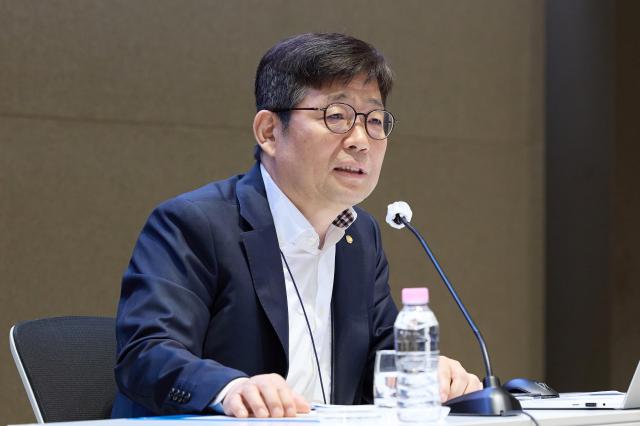
Senior Deputy Governor Ryoo Sang-dai said further rate lifting remained necessary, although the timing and pace of additional moves should be determined by incoming data.
“We need to maintain the rate-hike stance, while deciding the timing and pace of further increases based on the data,” Ryoo told reporters.
The presentation stated that the assessment represented Ryoo’s personal views rather than the BOK’s official position, limiting the extent to which it can be treated as formal guidance for the central bank’s next policy decision.
The remarks nevertheless amount to a parting assessment from a sitting member of the seven-member Monetary Policy Board, with Ryoo’s three-year term set to expire on Aug. 20.
The BOK raised its benchmark rate by 25 basis points to 2.75 percent in July, its first increase since November 2022, after holding it steady in April and May amid uncertainty generated by the Middle East conflict.
Ryoo said the calculus shifted as higher oil prices lifted inflation while the semiconductor boom strengthened economic growth faster than expected.
Recent second-quarter gross domestic product and July inflation data confirmed that the combination of solid growth and above-target price pressures remained intact, he said.
The current tightening cycle differs from Korea’s previous four rate-hike periods since 2000 because an improvement in the terms of trade has produced an unusually large expansion in nominal income and the current account, according to Ryoo.
Korea posted a current-account surplus of $191 billion in the first half, already 1.6 times the $123.1 billion recorded for all of last year.
The BOK’s May forecast placed the full-year surplus at about $250 billion, while nominal GDP expanded 17.1 percent from a year earlier in the first quarter.
Ryoo said the resulting income windfall was likely to spread gradually from exporters into consumption and investment, strengthening domestic demand even as higher interest rates weighed on borrowers.
That transmission makes the inflation outlook more complicated.
Oil prices are raising costs both directly and through supply chains, while the semiconductor boom is lifting wages and feeding demand for domestic services, Ryoo said.
The increase in headline inflation may be smaller than the surge that followed Russia’s invasion of Ukraine, but it could prove more persistent as supply-side pressure is reinforced by stronger demand.
Financial stability provides another reason to retain a tightening stance.
Expectations of further housing gains and instability in rental markets have kept home prices rising rapidly in Seoul and parts of the surrounding capital region, while higher asset prices have encouraged renewed household borrowing.
Seoul’s price-to-income ratio stood at 17 in the first quarter, compared with a nationwide ratio of seven, highlighting the affordability gap between the capital and the rest of the country.
BOK model estimates showed that a 25-basis-point rate increase could lower household debt growth by 0.16 percentage point and housing-price growth by 0.27 percentage point.
Ryoo acknowledged that further increases could raise debt-servicing burdens, particularly for vulnerable borrowers, although strong income growth should cushion the effect at the aggregate level.
Monetary policy alone, however, would not be sufficient to contain housing risks, he said.
Interest-rate decisions need to be aligned with macroprudential measures, housing supply and tax policies and efforts to ease Korea’s concentration of population and economic activity in the Seoul metropolitan area.
Selective fiscal and financial support should meanwhile address the widening burden across industries and income groups, while the BOK’s lending programs could strengthen the transmission of monetary policy to targeted sectors.
Ryoo also called for continued reform of Korea’s foreign-exchange market, saying its depth had failed to keep pace with the rapid growth in residents’ overseas investment and the expansion of domestic capital markets.
The BOK should continue efforts including round-the-clock foreign-exchange trading and offshore won settlement, he said, while policymakers should use Korea’s AI-driven income gains to finance productivity-enhancing investment and prepare for longer-term structural change.
________________________________________________________________________________
AJP Takeaways
Deputy Governor Ryoo Sang-dai, whose tenure ends next week, said the BOK should retain its rate-hike stance, with the timing and pace of further moves determined by incoming data.
Korea’s semiconductor boom has generated record external surpluses and income growth, but the gains are increasingly feeding domestic demand and inflation.
A 25-basis-point increase is estimated to reduce household debt growth by 0.16 percentage point and housing-price growth by 0.27 percentage point.
Copyright ⓒ Aju Press All rights reserved.
