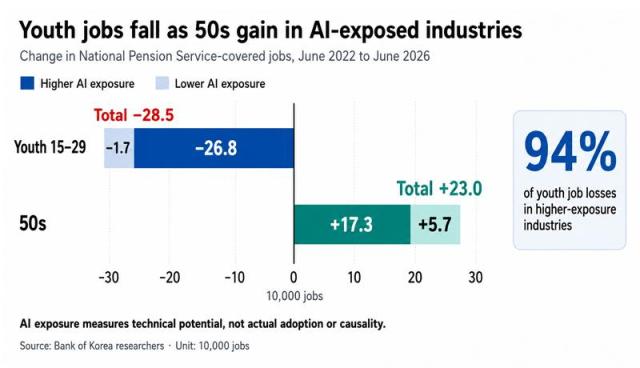
The number of jobs held by people aged 15 to 29 fell by 285,000 between June 2022 and June 2026. About 268,000 of those lost jobs were in industries with high exposure to AI.
Over the same period, the number of jobs held by people in their 50s increased by 230,000 with 173,000 or 75.2 percent, of the new jobs in industries with high exposure to AI.
BOK researchers said the trend shows that technology may be making it harder for younger workers to find jobs, while experienced workers are more likely to remain in demand because they can manage or work with AI.
The pattern points to a possible hollowing-out of the first rung of Korea's career ladder even though AI has yet to produce a clear economy-wide deterioration in employment.
The findings were based on data from about 16 million workers covered by the NPS, along with employment and unemployment data from the country's economically active population.
AI exposure was calculated by assessing the technical potential for generative AI to perform or accelerate occupational tasks and then weighting those estimates according to the occupational composition of each industry.
The measure therefore captures jobs' potential exposure to AI rather than companies' actual use of the technology, while the findings represent the researchers' analysis rather than the central bank’s official policy position.
The losses were larger in industries where generative AI was used primarily to automate tasks, while no comparable pattern emerged in industries where the technology was used mainly to augment human work.
Youth employment declines were relatively mild in the highest quartile of augmentation-oriented industries, suggesting that how companies deploy AI may matter more for employment than adoption alone.
The deterioration was also visible among educated job seekers, with unemployment among college-educated young people averaging 7.0 percent since November 2022, compared with 5.4 percent among those with junior-college education or less.
A broader measure of labor underutilization averaged 9.6 percent among young college graduates, against 8.5 percent for the less-educated group, although BOK researchers cautioned that education is only an indirect proxy for exposure to AI.
Average monthly entries by young workers into regular jobs in highly exposed industries fell to 29,100 from July 2022 through June 2026, compared with 32,600 between January 2016 and December 2019.
Average monthly exits from those industries into non-employment, meanwhile, rose by about 32 percent to 4,900 from 3,700.
The share of young people among newly hired workers also dropped to 29.3 percent from 2024 to 2026 - from 36.9 percent during the six years through 2019, reinforcing evidence that entry into stable employment is narrowing.
Despite the concentrated pressure, aggregate employment and unemployment have not yet departed decisively from their longer-term trends, suggesting that the impact of AI is being distributed unevenly across industries, age groups and career stages.
An estimated 51.8 percent of Korean workers used generative AI at work in 2025, nearly double the 26.5 percent recorded in the United States.
AI is unlikely to be the sole explanation for the decline in youth employment, as companies have also unwound pandemic-era overhiring, shifted toward experienced recruits and reduced their reliance on long-term internal training, BOK researchers said.
The spread of remote and hybrid work may have further weakened the informal mentoring through which junior employees traditionally acquired skills from senior colleagues.
The findings suggest that AI may be accelerating an erosion of the conventional career ladder that had already begun rather than independently creating the problem.
BOK researchers called for AI-era apprenticeship programs combining real workplace assignments, the use of AI tools and structured guidance from experienced employees.
They also proposed support for companies' mentoring and training costs, potentially through a "career formation subsidy," rather than relying solely on wage subsidies for young recruits.
Tax and financial incentives should remain neutral between investment in technology and investment in human capital so that companies are not encouraged to adopt low-quality automation merely because it is cheaper than training workers, the researchers said.
The longer-term outcome remains uncertain, however, as young workers' high rates of AI adoption and adaptability could eventually make them some of the biggest beneficiaries once new tasks and occupations emerge.
AJP Takeaways:
- AI-exposed industries accounted for 268,000, or 94 percent, of the 285,000 decline in pension-covered youth jobs between June 2022 and June 2026.
- Jobs held by people in their 50s rose by 230,000, pointing to what BOK researchers describe as seniority-biased technological change.
-Youth job losses were deeper where AI automated tasks but milder where the technology augmented human work.

Copyright ⓒ Aju Press All rights reserved.