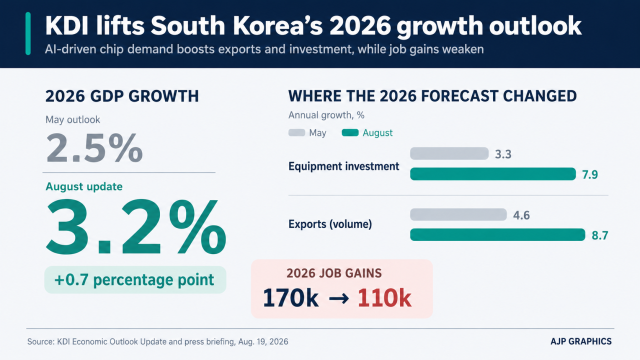
The state-run think tank attributed the stronger outlook to the global artificial intelligence (AI)-led boom, which has boosted semiconductor exports and facility investment, while giving the BOK more room to tighten monetary policy despite an uneven domestic recovery.
KDI also raised its growth forecast for next year to 2.2 percent from 1.7 percent, expecting some of the semiconductor windfall to eventually boost household consumption and employment.
It said semiconductors accounted for about 0.6 percentage point of the 0.7-point increase in this year's growth forecast, driven by higher exports, related equipment investment and income effects. More than half of projected growth was linked to the chip sector.
KDI also raised its forecast for export volumes to 8.7 percent from 4.6 percent and its equipment investment forecast to 7.9 percent from 3.3 percent.
Its current-account surplus forecast surged to $359.7 billion from $239.0 billion as higher semiconductor export prices delivered a sharp improvement in South Korea's terms of trade.
Private consumption is projected to expand 2.3 percent, only 0.1 percentage point above KDI's May estimate, while construction investment is expected to edge up just 0.1 percent amid a prolonged regional housing slump and elevated building costs.
KDI cut its forecast for employment growth to 110,000 from 170,000, reflecting the semiconductor sector's limited capacity to generate jobs and continued weakness in construction and non-chip manufacturing.
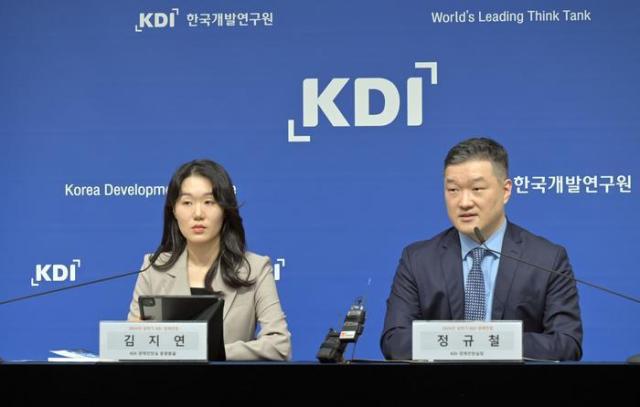
Kim Meeroo, head of KDI's macroeconomic and financial policy division, said the 3.2 percent expansion was strong relative to South Korea's potential growth rate but would feel considerably weaker to households because its benefits were concentrated in a narrow part of the economy.
KDI kept its overall and core inflation forecasts at 2.7 percent and 2.5 percent and said the policy rate should stay slightly above the nominal neutral rate, which is estimated to be in the mid-2 percent range, though it did not call for a rate hike at any specific BOK meeting.
KDI identified a sudden reversal in global AI investment as the principal downside risk because South Korea's rising dependence on semiconductors has made its broader outlook increasingly sensitive to the global chip cycle.
Separately, BOK data released earlier in the day showed household debt rose by 25.9 trillion won ($17.4 billion) to a record 2,019.8 trillion won ($1.36 trillion) in the second quarter, surpassing 2,000 trillion won for the first time and marking the largest quarterly increase since the third quarter of 2021.
The combination of above-potential growth, persistent underlying inflation and renewed household borrowing has prompted several economists to retain additional rate-hike forecasts even as consumption, construction and employment remain subdued.
Park Jeong-woo, an economist at Nomura Securities, said that average retail sales contracted in the second quarter and that labor conditions remained weak, but put the probability of an Aug. 27 rate hike at 60 percent.
Others remain more cautious, with Woori Financial Research Institute and KB Securities expecting the BOK to hold at 2.75 percent this month while delivering a hawkish signal, potentially accompanied by one or two dissenting votes for an increase.
The latest data therefore reinforce expectations that the BOK's tightening cycle has further to run, but the weakness beneath South Korea's chip-led growth continues to divide economists over whether the next increase comes on Aug. 27 or later in the year.
AJP Takeaways
• KDI raised South Korea’s 2026 growth forecast to 3.2 percent from 2.5 percent, attributing 0.6 percentage point of the upgrade to semiconductors and their spillover effects.
• Export volume is forecast to rise 8.7 percent and equipment investment 7.9 percent, while private consumption grows 2.3 percent, construction investment 0.1 percent and employment by just 110,000.
• KDI's outlook and record household credit have kept Bank of Korea rate-hike calls alive ahead of Aug. 27, although economists remain divided between a back-to-back increase and a hawkish hold.
Copyright ⓒ Aju Press All rights reserved.