SEOUL, August 23 (AJP) - South Korea's alcohol shipments fell below 3 million kiloliters for the first time since the Asian financial crisis, as declining consumption and changing drinking habits continue to reshape a market long dominated by beer, soju and company gatherings.
Domestic alcohol shipments totaled 2.988 million kiloliters last year, according to data from the National Tax Service's Tax Statistics Information Service, or TASIS.
It marked the first time shipments fell below 3 million kiloliters since 1998, when the country was reeling from the Asian financial crisis and shipments stood at 2.922 million kiloliters.
The latest figure represents a 21.5 percent decline from 3.804 million kiloliters in 2015.
The contraction was particularly pronounced in Korea's two dominant alcohol categories.
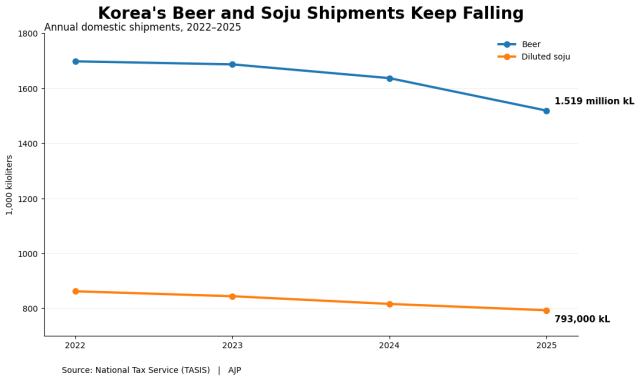
Beer shipments fell 7.2 percent from a year earlier to 1.519 million kiloliters, dropping below 1.6 million for the first time, while shipments of diluted soju fell below 800,000 kiloliters for the first time to 793,000 kiloliters.
Takju, a category that includes the traditional Korean rice wine makgeolli, also declined for a fifth consecutive year to 318,000 kiloliters.
The figures come as surveys point to a gradual shift in how Koreans consume alcohol.
According to a 2025 alcohol industry survey by the Ministry of Agriculture, Food and Rural Affairs and the Korea Agro-Fisheries & Food Trade Corp., consumers drank on an average 8.8 days per month, down from 9.0 days a year earlier. Average consumption per drinking day edged down to 6.6 glasses from 6.7.
At the same time, drinking is increasingly moving away from traditional group occasions toward more individualized consumption.
Convenience-store purchases were cited by 85.5 percent of respondents as a major alcohol trend, followed by drinking at home at 54.2 percent, drinking alone at 52.2 percent and seeking a wider variety of flavors at 49.1 percent.
That shift is creating pockets of growth even as the overall market contracts.
Fruit wine shipments recovered to 17,000 kiloliters last year, while general distilled spirits reached 4,000 kiloliters, their highest level since 2015. Brandy shipments rose to 31 kiloliters, the highest since 2017.
The diverging trends suggest South Korea's alcohol market is not simply shrinking, but becoming more fragmented as consumers drink less frequently while showing greater interest in where, how and what they drink.
- South Korean alcohol shipments fell to 2.988 million kiloliters last year, slipping below 3 million for the first time since 1998.
- Beer and diluted soju both fell through historic shipment thresholds, while overall alcohol shipments have dropped 21.5 percent from 2015.
- Consumption is shifting toward home and solo drinking and a wider variety of products, with some categories such as distilled spirits growing despite the broader market decline.

Copyright ⓒ Aju Press All rights reserved.