The Bank of Korea enters this week's rate-setting meeting with an almost opposite financial-market picture.
The won is at its strongest since September 2025. Bond yields have surged. The once-steamy KOSPI has become considerably more volatile.
For the BOK, the change should matter.
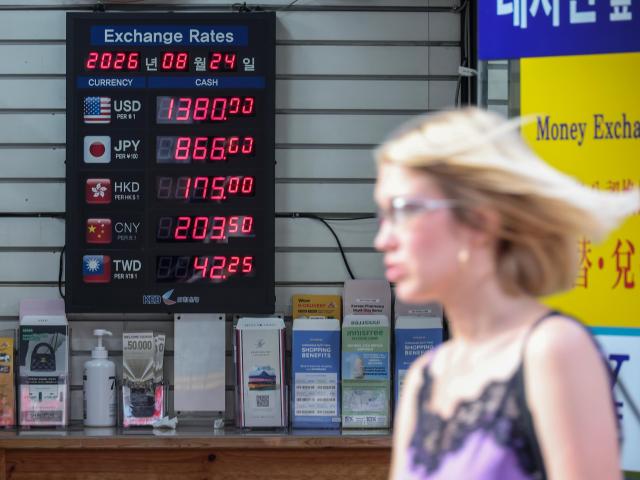
The won strengthened beyond 1,380 per dollar on Monday, reaching 1,376.5 intraday. The advance extended a rally that had already taken the currency to 1,386.5 on Friday from 1,424 at the end of July and 1,439 at the end of last year.
A stronger won does not mean Korea's financial problems have disappeared. It does, however, buy the central bank something increasingly valuable: time.
The BOK on Thursday will decide whether to follow July's 25-basis-point increase with another hike or hold its benchmark rate at 2.75 percent while maintaining its tightening bias.
Strong growth makes another increase defensible. It does not make one urgent.
For much of the year, persistent won weakness was itself an argument for monetary restraint. A currency trading above 1,500 per dollar amplified the cost of imported oil and commodities and threatened to keep inflation elevated even as semiconductor exports propelled the economy forward.
The currency is now moving in the BOK's favor. Exporters' dollar selling, strong semiconductor shipments and a large current-account surplus have helped support the won.
Broader dollar weakness has contributed as well, but the Korean currency has recently outperformed several major Asian counterparts. More important for monetary policy, the appreciation is arriving when Korea needs it.
Brent crude was more than 54 percent higher on Friday than at the end of last year, WTI was up nearly 53 percent and the broader CRB commodity index had risen 35 percent. The won, meanwhile, had appreciated 3.7 percent against the dollar.
For an economy that imports most of its energy, exchange rates matter almost as much as headline commodity prices.
A rising won cannot erase a 50-percent increase in dollar-denominated oil prices. It can cushion the increase before it feeds through to import costs, producer prices and household bills.
The currency that aggravated Korea's inflation problem earlier this year is increasingly acting as a buffer against it.
Consumer inflation slowed to 2.8 percent in July from 3.2 percent in June. Core inflation remained elevated at 2.6 percent, giving the BOK little reason to declare the inflation battle won.
Geopolitical tension in the Middle East also leaves energy prices vulnerable to another shock.
Even so, monetary policy is about changes at the margin. The exchange-rate environment confronting policymakers in August is materially different from the one they confronted when the won was trading above 1,500.
There is an equally important message coming from the bond market. South Korea's 10-year government bond yield reached 4.376 percent on Friday, up 99.1 basis points from the end of last year. The comparable U.S. Treasury yield has increased just 53.7 basis points over the same period, while Japan's 10-year yield has risen 81.9 basis points.
Corporate borrowing costs have moved even more sharply. The yield on three-year AA-minus Korean corporate bonds has climbed 106.6 basis points since the end of 2025.
The BOK therefore enters Thursday's meeting with financial markets already doing a significant portion of its tightening work.
Monetary policy does not operate solely through the benchmark rate.
Companies borrow at market rates. Households feel monetary restraint through mortgages and credit. Investors value equities against the return available on bonds. Higher government yields ultimately raise financing costs throughout the economy.
The effective price of Korean capital has consequently risen much more dramatically than the movement in the policy rate alone suggests. This is where the argument for an immediate second hike becomes less compelling.
South Korea's economy is clearly stronger than the BOK expected only a few months ago. GDP expanded 0.6 percent from the previous quarter and 3.7 percent from a year earlier in the second quarter, largely on the strength of semiconductors.
The central bank is widely expected on Thursday to raise its 2026 growth projection above 3 percent from the 2.6 percent forecast in May.
Strong growth gives the BOK room to raise rates if inflation and financial stability require it. Room, however, is not an obligation.
The more useful question is whether another quarter-point increase this week would provide enough additional restraint to justify its cost when the currency is already appreciating and long-term market rates have risen by close to a full percentage point this year.
The international rate environment reinforces the case for patience.
The Federal Reserve's benchmark range stands at 3.50 to 3.75 percent. If the BOK ultimately raises its rate to 3.00 or 3.25 percent, as several economists expect, the Korea-U.S. policy-rate differential would narrow considerably.
A smaller short-term rate gap should generally reinforce support for the won. Capital markets present a different challenge.
The U.S. 10-year Treasury was yielding around 4.7 percent on Friday, compared with about 4.38 percent for its Korean counterpart. Dollar assets therefore continue to offer Korean investors competitive nominal returns at the same time as the dollar itself has become cheaper to buy.
Exchange-rate expectations, hedging costs, relative asset performance and risk appetite matter far more than a simple comparison between two interest rates.
The more consequential development is that Korea increasingly has to compete for Korean capital.
A cheaper dollar lowers the entry price for Korean investors buying overseas assets. Attractive U.S. yields increase the appeal of diversification. At home, higher bond yields simultaneously raise the hurdle that Korean equities must clear.
The first-half KOSPI boom temporarily obscured that trade-off.
By Aug. 21, the KOSPI remained an extraordinary 64 percent above its end-2025 level. Yet the July rout and renewed volatility in August have demonstrated that even spectacular earnings cannot make stock valuations immune to the rising cost of money.
Foreign investors were net sellers of KOSPI shares in July and again in August through Aug. 21. Korea's financial landscape is therefore beginning to look like a mirror image of the first half.
Earlier in the year, the puzzle was a weak currency alongside booming stocks, strong exports and unexpectedly rapid economic growth.
Now the won is outperforming just as bond yields become more punitive and equities lose some of their earlier momentum.
A stronger currency should therefore neither be celebrated as proof that all is well nor ignored as irrelevant to monetary policy. Central banking requires policymakers to respond not merely to the latest GDP and inflation readings but also to changes in the financial conditions through which monetary policy eventually reaches the real economy.
The BOK still has reasons to maintain its tightening bias.
Core inflation remains elevated. Household leverage and housing prices require vigilance. Economic growth has surprised significantly to the upside. Another rate increase later this year may well prove necessary.
None of those considerations requires the central bank to move at every meeting.
Thursday offers the BOK an opportunity to distinguish between retaining the option to tighten and rushing to exercise it.
The won is already reducing imported inflation pressure. The bond market is making capital more expensive. July's increase has barely had time to work through the economy.
A pause would allow policymakers to measure the combined effect before adding another layer of restraint. A stronger won has not ended Korea's inflation problem, nor has it removed the possibility of another rate hike.
It however can buy the central bank more time.
*The author is the managing editor of AJP.
Copyright ⓒ Aju Press All rights reserved.