

Taiwan's assessment follows its annual Han Kuang exercise, held from Aug. 5 to 14 to test the island's ability to respond to a potential Chinese attack.
Hsiao-Huang Shu, an associate research fellow at Taiwan's Institute for National Defense and Security Research, said this year's exercise showed improvements in both drone operations and counter-drone training but also exposed significant weaknesses.
"Training involving both the use of drones and defense against them clearly increased during this year's Han Kuang exercise," Shu said, according to Taiwan's United Daily News.
"Although the military has begun improving its defenses against drones, its active defense capability at low altitudes remains very limited, while its own use of drones is still at an early stage," he said.
The assessment comes just days after South Korea and the United States cut short the command-post portion of their annual Ulchi Freedom Shield exercise following an order from U.S. President Donald Trump to substantially reduce the drills.
UFS had originally been scheduled to run from Aug. 17 through 27 with about 18,000 South Korean troops participating. The exercise was designed to rehearse combined and all-domain operations against threats on the Korean Peninsula, with scenarios incorporating drone attacks, GPS disruption and cyberattacks, capabilities that U.S. officials said reflected lessons North Korea has gained from its involvement in the war in Ukraine.
The allies had also planned 14 battalion-level or larger field exercises under the broader training program.
Traditionally, the first part of UFS focuses primarily on defending against an enemy attack, while the second shifts toward counteroffensive operations.
But after Trump's directive, the command-post exercise was shortened from 11 days to five and ended Aug. 21. The second-phase counterattack portion was dropped, leaving this year's command-post training concentrated largely on defensive operations.
Only seven of the 14 planned combined field exercises remained on the original schedule. The other seven were removed from the UFS schedule and are expected to be rearranged through consultations between Seoul and Washington.
South Korean military officials have not publicly identified each of the seven affected field drills, meaning it remains unclear which specific live-training scenarios were lost during UFS itself. The Pentagon said some associated live events were reduced, canceled or converted into simulations.
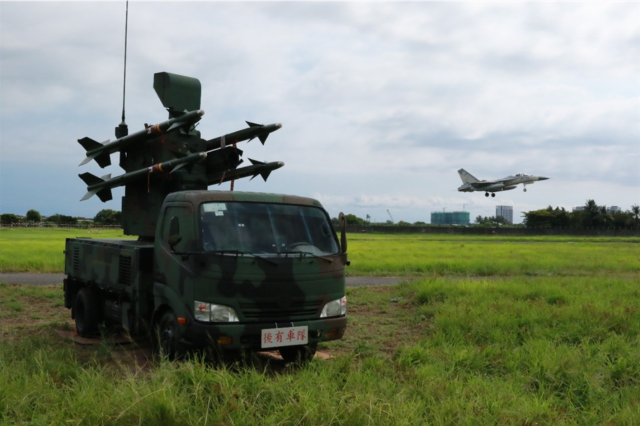
Jyh-Shyang Sheu, another INDSR researcher, said Taiwan also appeared to lack sufficient mobile battlefield air defense equipment to counter drones and other low-altitude threats, calling the construction of a multi-layered integrated air defense system an urgent priority.
Taiwan is already developing such a network under President Lai Ching-te's proposed T-Dome architecture, intended to integrate defenses against ballistic missiles, aircraft, long-range weapons and unmanned systems.
Taiwan already operates U.S.-made Patriot missiles and locally developed Sky Bow systems for higher-altitude threats and is acquiring NASAMS to strengthen its medium-range defenses. Shorter-range weapons form another layer against low-flying aircraft and drones.

Copyright ⓒ Aju Press All rights reserved.
