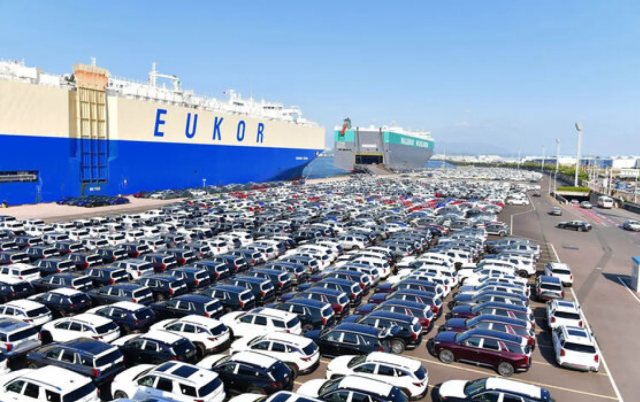
Korean companies poured billions of dollars into North America to escape the heavier tariffs and geopolitical risks of President Donald Trump's second term.
The escalating U.S.-Canada trade conflict is now threatening the very assumption behind that strategy - that the United States, Canada and Mexico could continue functioning as one largely integrated production base.
For Korean automakers, the rupture creates a new layer of supply-chain risk.
For Korea's energy importers, it may create an opening.
Canada, increasingly eager to loosen its dependence on the U.S. market, has more crude oil reaching its Pacific coast just as South Korea searches for alternatives to Middle Eastern supplies disrupted by war.
The United States imposed a 50 percent tariff on about $20 billion of Canadian imports on Aug. 22 after trade negotiations between Washington and Ottawa collapsed.
Canada responded with retaliatory tariffs on roughly the same amount of U.S. goods, scheduled to take effect Sept. 8.
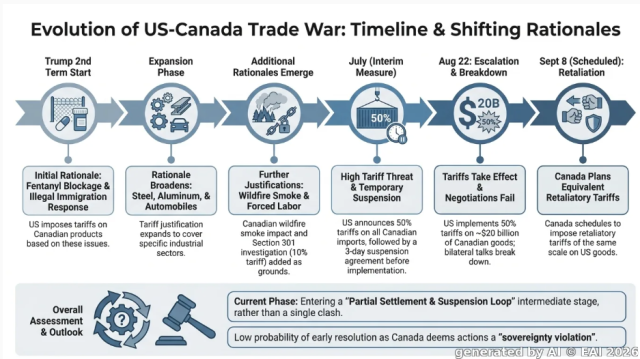
The rates are designed to mirror U.S. tariffs imposed on corresponding Canadian goods.
The much larger disruption could arrive next year.
Trump has announced plans to double tariffs on Canadian cars, trucks and automotive parts to 50 percent from 25 percent on Jan. 1, striking directly at one of the world's most tightly integrated manufacturing systems.
A report released Wednesday by the East Asia Institute (EAI) said the cross-border automotive production network built under the U.S.-Mexico-Canada Agreement, or USMCA, is entering a period of institutional uncertainty.
For Korean companies, North America may no longer be one market in quite the way it used to be.
Few industries illustrate the problem more clearly than automobiles.
A component can cross the U.S.-Canadian border several times before the finished vehicle rolls off an assembly line.
Ford's F-Series Super Duty, for example, is assembled in Ontario using U.S.-made transmissions and axles alongside Canadian-made engines. A tariff collected at one border crossing can therefore work its way through factories and suppliers on both sides.
U.S. automakers have warned that a 50 percent tariff on Canadian vehicles and parts could sharply raise production costs.
The emerging tariff map produces an unusual result.
The United States has lowered tariffs on South Korean and Japanese vehicles to 15 percent under separate trade arrangements.
A Canadian-built vehicle could therefore enter the United States facing a 50 percent tariff while a car shipped across the Pacific directly from South Korea faces 15 percent.
The disparity is awkward enough that American automakers themselves worry North American-made vehicles could lose price competitiveness against Asian imports.
For Hyundai Motor and Kia, however, any apparent advantage comes with a catch.
The companies have spent years localizing production in the United States precisely to reduce exposure to tariffs and political pressure.
South Korea produced about 4.1 million vehicles in 2025 and exported roughly 2.74 million. Around 1.65 million of those exports went to North America, meaning the region absorbed about 60 percent of all Korean-made vehicles shipped overseas.
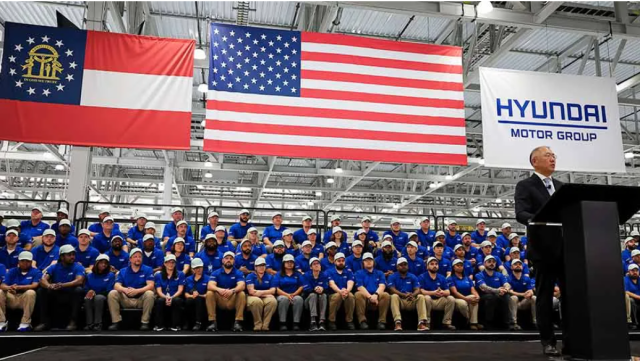
Hyundai Motor produced 362,000 vehicles at its Alabama plant last year and another 65,320 at Hyundai Motor Group Metaplant America in Georgia.
Kia produced another 355,000 vehicles at its West Point, Georgia, plant.
Combined U.S. production reached 782,320 vehicles — equivalent to about 19 percent of all automobiles manufactured in South Korea that year.
Hyundai's Tucson shows how quickly the borders blur.
The model, assembled in Alabama, was Hyundai's best-selling vehicle in Canada in 2025 with 41,840 units sold. The Alabama factory produced 158,789 Tucsons during the year.
A car assembled in America, sold to Canadians and dependent on a regional supplier network can become exposed to a bilateral tariff fight even though the automaker itself is Korean.
That is the new calculation.
Shipping more vehicles directly from Korea could theoretically exploit the lower 15 percent U.S. tariff. But Hyundai and Kia have simultaneously invested heavily in American factories and in suppliers designed around a continent-wide production system.
EAI said the impact would increasingly depend on how much production companies locate inside the United States.
Parts suppliers including Hyundai Mobis and HL Mando could face particular pressure as Washington demands greater U.S.-made content and the economics of moving components across borders deteriorate.
Localization, once the obvious insurance against tariffs, is becoming more complicated when the tariffs begin appearing inside the supposedly protected market.
Canada has a different problem.
About 70 percent of its exports go to the United States, leaving the country exceptionally exposed when relations with its largest customer sour.
Prime Minister Mark Carney has increasingly called for new trade and security partnerships as Ottawa tries to reduce that dependence.
South Korea is already part of that diversification.
Energy ties are growing through LNG Canada, whose first phase includes Korea Gas Corp. as an investor.
South Korea plans to import at least 1.4 million tons of Canadian liquefied natural gas annually for more than 30 years if the project's second phase proceeds as planned.
A longer U.S.-Canada rupture could give Seoul greater room to deepen cooperation in critical minerals, energy and advanced manufacturing.
Oil may offer the most immediate opportunity.
South Korea receives about 69 percent of its crude imports from the Middle East, according to the industry ministry, leaving refiners particularly vulnerable to disruptions around the Strait of Hormuz.
Kpler data on Thursday showed crude flows through the strait averaging only 2.3 million barrels per day in August, compared with 15.82 million barrels a day in the three months before the war.
Asia's overall crude imports were running about 14 percent below prewar levels.
Thousands of kilometers away, Canada has something Asian refiners increasingly want: oil that does not need to pass through Hormuz.
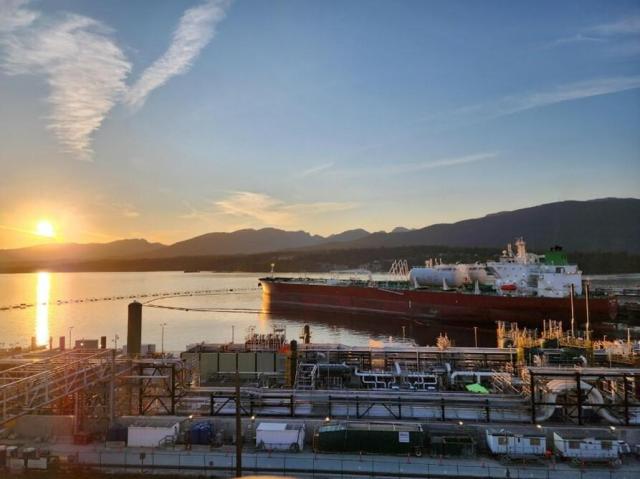
The expanded Trans Mountain pipeline, which nearly tripled capacity for moving Alberta crude to Canada's Pacific coast, has been running at full capacity.
By July, about 77 percent of crude shipped from Vancouver through the pipeline was headed to Asia, up from roughly 51 percent in 2024.
Japan received its first Canadian crude cargo in more than a year, while India, Malaysia and Singapore resumed purchases after the Iran war began.
"Japan's renewed purchases of TMX crude highlight Canada's growing role in Asia's evolving import strategy," said Richard Ro, a senior market analyst at Kpler.
South Korea has another reason to take a closer look.
The latest U.S. tariffs do not directly apply to Canadian crude, so Korean refiners receive no immediate tariff-induced price advantage.
But a prolonged political and trade split could give Ottawa a stronger incentive to move barrels west across the Pacific rather than south into the United States.
One obstacle to Korean purchases has already been lowered.
The Korea Customs Service and Alberta agreed in April to simplify origin certification for Canadian oil-sands crude, which is frequently blended with U.S. light crude before shipment.
Qualifying Canadian crude can therefore receive preferential treatment under the Korea-Canada free trade agreement, eliminating a 3 percent tariff that had discouraged some imports.
Canada still has a long way to go before Asia rivals its traditional market.
The United States accounted for 93.8 percent of Canadian crude exports during the first year after the Trans Mountain expansion.
That dependence explains Carney's urgency.
He has set a goal of doubling Canada's non-U.S. exports over the next decade.
For Seoul, the timing is notable.
Korea itself is trying to secure energy supply lines at a moment when Middle Eastern disruption has exposed the dangers of relying too heavily on one region.
Ottawa is trying to find buyers beyond a U.S. market that has absorbed Canadian output almost by default for generations.
Their diversification strategies increasingly point toward each other.
The irony for Korean industry is that the same trade confrontation producing the opportunity is also undermining another diversification strategy.
Hyundai, Kia and their suppliers invested heavily in North America partly because producing inside the region was supposed to insulate them from Trump's tariff walls.
The wall is now appearing between the countries inside it.
South Korea's relationship with Washington has not deteriorated to anything approaching Canada's.
September nevertheless brings its own test, with a possible meeting between President Lee Jae Myung and Trump on the sidelines of the U.N. General Assembly and Seoul expected to announce the first project under its $350 billion U.S. investment package.
For Korean companies, the lesson from Canada may be uncomfortable.
Putting factories inside North America can reduce the risk of being outside Trump's tariff perimeter. It cannot guarantee that the perimeter will stay in the same place.
For Korean energy buyers, Canada's predicament offers the reverse possibility.
As one of America's closest economic partners searches for markets farther from home, some of the barrels it once sent almost automatically south may increasingly head west instead — toward Asia.
AJP Takeaways
• The escalating U.S.-Canada tariff dispute is challenging the integrated North American production strategy of Hyundai Motor, Kia and Korean auto-parts suppliers, which have invested heavily in U.S. manufacturing while relying on regional supply chains.
• A planned 50 percent U.S. tariff on Canadian vehicles and parts from January could produce unusual competitive distortions, as South Korean-made vehicles face a lower 15 percent tariff while some North American-built models face much steeper duties.
• Canada's push to diversify away from the United States could create new opportunities for South Korea in energy, critical minerals and advanced manufacturing, building on existing LNG cooperation.
• Canadian crude is becoming more attractive to Asian buyers as Middle East disruptions constrain supplies through the Strait of Hormuz, while simplified Korea-Canada origin rules have removed a 3 percent tariff obstacle for qualifying Canadian oil-sands crude.

Copyright ⓒ Aju Press All rights reserved.