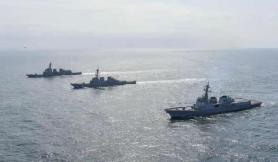
South Korea's Joint Chiefs of Staff said Friday that the three countries will hold Freedom Edge from Sept. 7 to 11 in international waters southeast of Jeju Island.
The five-day exercise is aimed at strengthening the three countries' ability to respond to North Korea's nuclear and missile threats and maintaining peace and stability in the region, the JCS said.
The exercise will mark the fourth iteration of Freedom Edge, a regular trilateral multi-domain drill launched following an agreement reached by the leaders of South Korea, the United States and Japan at their Camp David summit in August 2023.
The inaugural exercise was held in June 2024, followed by a second iteration that November and a third in September 2025.
The latest announcement stands in contrast to recent reductions in South Korea-U.S. military exercises.
The allies ended this year's Ulchi Freedom Shield exercise on Aug. 21, cutting the originally planned 11-day exercise to five days after U.S. President Donald Trump ordered the Pentagon to substantially reduce joint drills with South Korea. Associated field training was also scaled back.
The United States has also withdrawn from next month's Ssangyong amphibious landing exercise. The U.S. Marine Corps cited force constraints stemming from the war with Iran.
Freedom Edge, however, is moving ahead on its planned five-day schedule.
The differing approaches highlight Washington’s broader strategic priorities in the region.
While South Korea-U.S. exercises are primarily centered on contingencies on the Korean Peninsula, Freedom Edge has increasingly been framed as part of a wider regional deterrence architecture involving the three countries.
Ahead of Freedom Edge 2025, U.S. Pacific Command said the exercise would strengthen deterrence in the Asia-Pacific by “bolstering combat-credible forces inside the First Island Chain.”
The First Island Chain, stretching from Japan through Taiwan to the Philippines, is widely regarded as a key geographic line in U.S. military planning for countering China's expanding military reach into the western Pacific.
The continuation of Freedom Edge even as Washington scales back bilateral drills with Seoul therefore highlights the growing importance of trilateral South Korea-U.S.-Japan defense cooperation in U.S. regional strategy.
North Korea has repeatedly condemned Freedom Edge, describing it as an aggressive military exercise directed against the country.
AJP Takeaways
· South Korea, the U.S. and Japan will hold Freedom Edge from Sept. 7 to 11 near Jeju Island.
· The trilateral drill will proceed despite recent cuts to South Korea-U.S. military exercises.
· Freedom Edge reflects the growing role of trilateral defense cooperation in U.S. regional strategy.

Copyright ⓒ Aju Press All rights reserved.