SEOUL, August 28 (AJP) - Porous crystals built around titanium can carry a cancer drug through the bloodstream, hold it shut until they reach a tumor, and then be switched on from outside the body to attack the cells around them.
That range of jobs, long divided among separate materials, is converging on a single compound, according to a review article led by Sookmyung Women's University professor Lee Jung-bok.
The paper appeared this month in Coordination Chemistry Reviews. Sookmyung said the journal carries an impact factor of 25.6 and ranks first in chemistry in the Journal Citation Reports, the citation database used to rank academic publications.
The materials at the center of the review are metal-organic frameworks, crystalline solids assembled from metal ions and organic molecules that link them together. The result is a rigid scaffold shot through with pores, and those pores can be packed with drug molecules. Metal-organic frameworks (MOFs) are already being tested as drug carriers and as probes for medical imaging.
Titanium versions draw attention for a plain reason. The bond between titanium and oxygen is unusually strong, which makes the structure hold its shape in the body, keeps toxicity low and lets tissue tolerate it. Researchers also count titanium MOFs as environmentally benign to produce.
Lee and his co-authors compared the methods used to build these materials, then sorted the medical research into three groups.
The first is targeted drug delivery. Tumors sit in a chemical environment unlike healthy tissue, more acidic and loaded with reactive oxygen species, unstable oxygen molecules that damage cells from within. Carriers tuned to those conditions stay closed as they travel and open once they arrive, which concentrates a chemotherapy dose where it is needed and spares the rest of the body.
The second is repair. Bone graft materials and wound dressings made with titanium MOFs release antibiotics and nitric oxide slowly over time, holding infection down while new tissue grows into the site. Nitric oxide is a gas the body produces itself to prompt blood vessels to form, which is why a dressing that supplies it can speed healing rather than merely protect a wound.
The third is a family of treatments that turn the material into a weapon. In photodynamic, sonodynamic and microwave dynamic therapy, the framework works as a sensitizer, a substance that sits inert until light, ultrasound or microwaves reach it, at which point it floods the surrounding area with reactive oxygen and kills the cells there. Because the trigger arrives from outside the patient, clinicians can confine the damage to wherever the beam is aimed.
Recent work surveyed in the review pushes that effect further by doping the crystals, meaning small amounts of silver or manganese are worked into the structure. The additions improve charge separation, the step in which energy from the trigger splits into the electrical charges that generate reactive oxygen. Cleaner separation produces a stronger kill.
Taken together, the authors argue, the field is widening from delivery alone toward theranostics, platforms that diagnose and treat in the same operation.
None of it has reached a patient. The review sets out three obstacles standing between the laboratory and the clinic. No one has developed a manufacturing process that is both clean enough to be called green and reliable enough at industrial scale to guarantee the material is safe in the body. The mechanisms by which titanium MOFs break down and leave the body remain unmapped. And regulators have no framework written for nanoscale medicines, which leaves approval pathways undefined.
The authors expect artificial intelligence to shape what comes next, with data analysis used to design titanium MOF formulations matched to individual patients rather than to a general population.
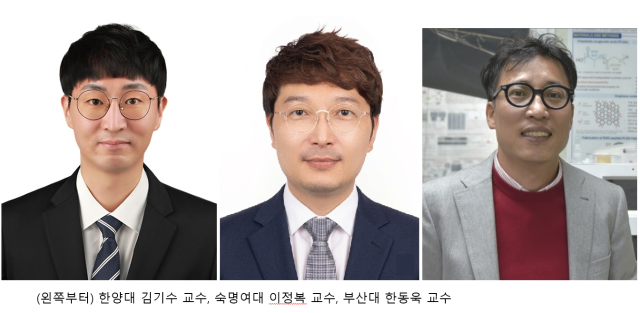
Lee served as co-corresponding author alongside Hanyang University's Kim Ki-su and Pusan National University's Han Dong-wook. Three Pusan National University researchers, Elif Beyza Demiray, Kang Moon-sung and Jang Hee-jeong, shared first authorship. The work was supported by the National Research Foundation of Korea.
[Reference Information]
Journal/Source: Coordination Chemistry Reviews (IF:12.5, JCR top 4.5%)
Title: Ti-based metal-organic frameworks as versatile platforms primed for nanomedicine, a mini-review
Link/DOI: https://doi.org/10.1016/j.ccr.2026.218397

Copyright ⓒ Aju Press All rights reserved.