

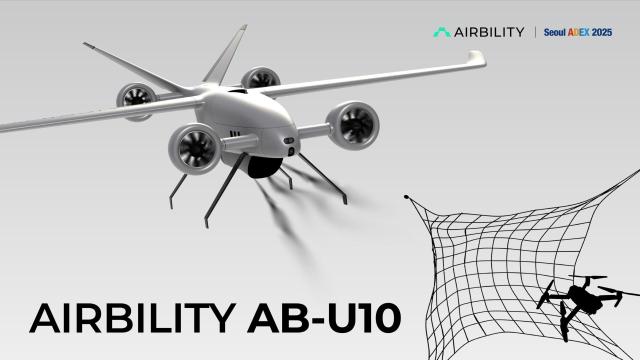
SEOUL, September 01 (AJP) - A Seoul aerospace startup has closed a Series A round to build small aircraft that hunt other aircraft, betting that the cheapest way to stop an incoming attack drone is another drone rather than a missile.
Airbility said Tuesday that the 6.5 billion won ($4.7 million) round was led by Sazze Partners, a Silicon Valley venture capital firm, with existing backer Stonebridge Ventures returning and the Industrial Bank of Korea joining as a new shareholder. Cumulative funding now stands at 10.5 billion won. The company declined to disclose its valuation.
The round lands in the middle of the largest funding boom the defense technology sector has seen. Defense tech startups raised $14.6 billion in the first five months of 2026 alone, already ahead of the full-year record of $9.6 billion set in 2025.
Airbility builds what the industry calls air-to-air hard kill, meaning an interceptor aircraft physically strikes or captures a hostile drone in flight rather than jamming its signal. Soft-kill methods fail against drones that fly preprogrammed routes and never need to talk to an operator.
Three interceptors are planned. In the company's account, the AB-U10 fires a net at its target at speeds up to 180 kilometers per hour, the AB-U2 is a payload-sized drone carried aloft by a larger mothership aircraft and released to strike directly, and the AB-U4L is a fixed-wing model launched from a tube at up to 300 kilometers per hour. All three sit on the same high-speed electric vertical takeoff and landing platform, an airframe that rises like a helicopter and then transitions to winged forward flight. Airbility said the AB-U10 will reach the market by the end of this year and the other two in the first half of 2027.
The economics are the pitch. In Ukraine, air defense crews have repeatedly spent multimillion-dollar surface-to-air missiles on Iranian-designed Shahed attack drones that cost a small fraction of that. Airbility puts the Shahed at roughly $35,000 a unit against about $4 million for a Patriot missile, and says a single engagement using its method costs between $50 and $3,000.
The company argues the same arithmetic works abroad. Foreign systems from suppliers such as Anduril of the United States face origin controls and procurement reviews that slow deliveries, Airbility said, while the AB series is built on Korean technology, can be sold into a wider set of countries and is priced at roughly one-tenth of the alternatives. Discussions are under way with more than nine countries across the Middle East, Southeast Asia and Latin America, according to the company, with four memorandums of understanding and two joint ventures in progress.
The engineering comes out of South Korea's state weapons laboratory. Airbility was founded in November 2023 by researchers from the Agency for Defense Development who led work on domestic aircraft including the T-50 supersonic trainer and the KF-21 fighter, together with staff from Hyundai Motor and LG Electronics. Of 26 employees, 80 percent work in research and development. In December 2025 the company said it flew three prototypes through transition, the passage from vertical lift into winged flight and the hardest phase of an eVTOL envelope to prove.
Government money has followed. Airbility was recently selected for the Korea AeroSpace Administration's 2026 Scale-up TIPS program, worth 3 billion won in research funding, and is building a domestic record through projects with the Marine Corps and the Defense Acquisition Program Administration.
Sazze Partners has invested in more than 100 artificial intelligence, software and consumer companies since 2018, including the South Korean AI firm Upstage. Airbility said the round is the firm's first investment in defense.
"What caught our attention was a company solving the cost asymmetry problem in the counter-drone market, where blocking a single drone can cost hundreds of times more than the drone itself," said Lee Ki-ha, managing partner at Sazze Partners. "If they can convert the rapidly rising global demand for counter-drone systems into contracts, we expect them to grow into a company that represents South Korea's defense sector."
Co-chief executive Lee Jin-mo said the goal is to widen the business from selling airframes to selling integrated systems and to reach 50 billion won in cumulative revenue by 2028.
South Korea's defense industry has crossed $10 billion in annual orders, and the government has made becoming one of the world's four largest arms exporters a national policy goal. Anduril closed a $5 billion Series H in May at a $61 billion valuation, and Shield AI raised at $12.7 billion in March. Airbility has raised 10.5 billion won since it was founded.
Copyright ⓒ Aju Press All rights reserved.
