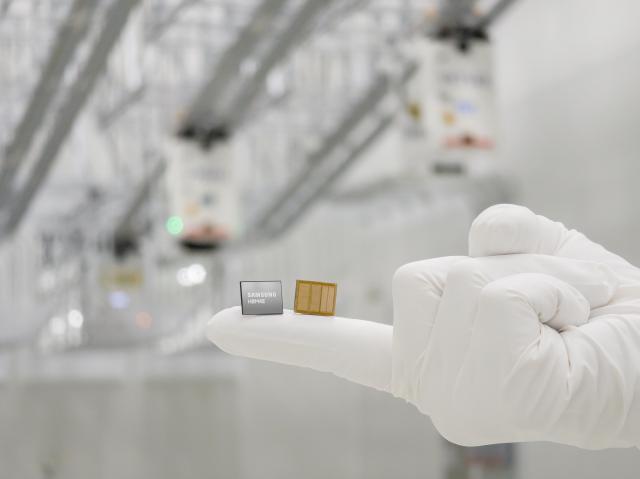
SEOUL, September 04 (AJP) - Samsung Electronics, making up for its passivity and late start in high-bandwidth memory, has ushered in the next generation with an aggressive bet on HBM4 that is paying off by sharply narrowing the gap with frontrunner SK hynix.
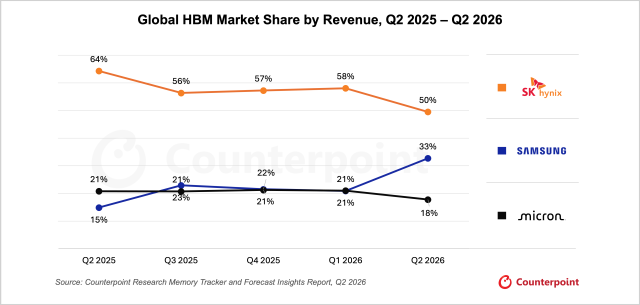
The world's largest memory maker saw its share of the global HBM market jump to 33 percent in the April-June period from 21 percent three months earlier, according to Counterpoint Research.
SK hynix remained comfortably on top with 50 percent, but its share fell from 58 percent.
The gap between the HBM pioneer and its late-charging rival narrowed to 17 percentage points from 37 points in the first quarter and 49 points a year earlier, when SK hynix controlled 64 percent of the market against Samsung's 15 percent.
Micron Technology ranked third with an 18 percent share.
SK hynix still holds the upper hand, backed by accumulated production experience and long-term relationships with Nvidia and other major AI processor customers built during its dominance of the HBM3E cycle.
Most HBM revenue also continues to come from HBM3E, while HBM4 shipments are expected to become increasingly visible in market revenue during the second half of this year.
Samsung's recent gain is therefore notable because much of its recovery has come before the HBM4 transition is fully reflected in industry sales.
Rather than continue chasing SK hynix on the technological path where its rival had already established a commanding lead, Samsung placed a more aggressive bet on moving early into HBM4 and HBM4E.
The company has also sought to broaden its customer base beyond Nvidia toward other AI chip designers as customized processors take a growing role in the AI infrastructure market.
Lee Jong-hwan, professor of system semiconductor engineering at Sangmyung University, said Samsung made a strategic push into HBM4 and HBM4E after falling behind SK hynix in previous generations, creating an opportunity to expand shipments as the market transitions to newer products.
"Samsung has a good chance of narrowing the gap further," Lee said.
Samsung began commercial shipments of HBM4 in February, becoming the first in the industry to do so.
Its HBM4 combines sixth-generation 10-nanometer-class, or 1c, DRAM with a logic base die manufactured using Samsung's 4-nanometer foundry process.
The company followed in May by shipping samples of 12-layer HBM4E, seeking to carry its early HBM4 momentum into the next stage of the memory race.
SK hynix, meanwhile, has been expanding HBM4 production while defending the customer relationships it built during the HBM3E cycle. It shipped samples of 12-layer HBM4E to major customers in June.
The contest is therefore becoming less about catching up in HBM3E and more about which company can turn next-generation technology into high-volume customer orders first.
Lee said Samsung's early HBM4 push reflects a broader strategy of trying to move ahead technologically rather than merely matching a competitor's existing product.
Its rollout indicates the company had been preparing for the generational transition in advance and intended to use HBM4 to close the gap created during HBM3E, he said.
The strategy could carry greater weight in HBM4 than in previous generations because the architecture increases the importance of capabilities extending beyond DRAM itself.
HBM stacks multiple DRAM dies vertically to provide significantly greater bandwidth while keeping memory close to an AI processor. In HBM4, the logic base die beneath the memory stack becomes more sophisticated and increasingly customized for the processor it serves.
Samsung has an unusual advantage in such an environment.
The company is the only major HBM supplier combining large-scale memory manufacturing, advanced logic foundry production and semiconductor packaging within the same corporate structure.
Its HBM4 pairs Samsung's own 1c DRAM with a logic base die produced through its 4-nanometer foundry process, allowing it to offer customers an integrated approach spanning memory, logic and advanced packaging.
Closer coordination among those technologies could become increasingly important as HBM products are customized for individual AI processors.
Vertical integration, however, only becomes an advantage if Samsung can execute consistently and translate its technology into volume orders.
SK hynix retains years of accumulated HBM production experience and the industry's strongest customer relationships.
Its partnership with Nvidia in particular gives it a formidable head start. Developing increasingly customized HBM requires memory suppliers to work closely with processor designers well before commercial production begins, making established supplier relationships difficult to displace.
A customer already accustomed to jointly developing products with SK hynix has less incentive to switch suppliers solely because a rival reaches a technology milestone first.
Winning an early technology race also does not automatically guarantee large-volume orders.
Lee cautioned against treating Samsung's strategy as evidence that it will inevitably overtake SK hynix.
"That is the strategy and direction, but of course not everything necessarily works out that way," Lee said.
The decisive test will come as HBM4 production ramps up and customer qualification translates into actual shipments.
If SK hynix leverages its existing customer base and HBM3E leadership to retain those clients through the transition, Samsung's early HBM4 push may prove less disruptive than the latest market-share numbers suggest.
But the pace of Samsung's catch-up is beginning to put pressure on the frontrunner.
In the second quarter of 2025, SK hynix controlled 64 percent of global HBM revenue compared with Samsung's 15 percent — a 49-percentage-point gulf.
Four quarters later, the gap has narrowed to 17 points.
The stakes are rising alongside the market itself as AI infrastructure investment drives demand for increasingly powerful and customized memory.
SK hynix, Samsung and Micron are pouring enormous sums into fabs, advanced manufacturing equipment and research and development to secure their positions as HBM moves through successive generations.
SK hynix enters the HBM4 era with the strongest customer relationships and production track record.
Samsung enters with something it lacked during much of the previous cycle: momentum from an aggressive move into the next generation.
The next six months should show whether the narrowing gap can turn what had been a lopsided contest into a genuine horse race.
AJP Takeaways
- Samsung's global HBM revenue share jumps to 33% from 21% in one quarter
- Gap with market leader SK hynix narrows to 17 percentage points from 49 a year earlier
- Samsung seeks to bypass its HBM3E setback with an early push into HBM4 and HBM4E
- SK hynix retains an edge in production experience, Nvidia ties and long-term customer relationships

Copyright ⓒ Aju Press All rights reserved.