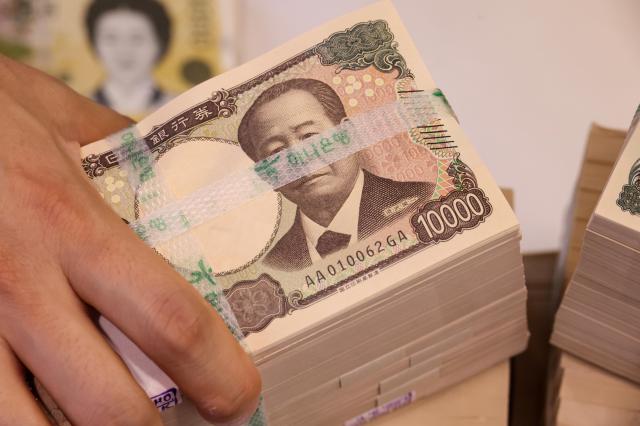
SEOUL, September 08 (AJP) - The Japanese yen and long-dated government bonds rallied together Tuesday as investors priced faster tightening by the Bank of Japan (BOJ) alongside lower longer-term inflation risks.
The yen strengthened as far as 152.89 per dollar, its strongest level since Feb. 17, before returning to around 153.3. Japan's 10-year government bond yield fell 4 basis points to 2.890 percent in morning trading.
Ataru Okumura, senior rate strategist at SMBC Nikko Securities Inc., said underlying inflation was already around 2 percent and the BOJ was increasingly expected to accelerate the pace of rate hikes.
The simultaneous gains in the currency and bonds reflected different expectations at the short and long ends of Japan's rate market.
The 20-year Japanese government bond (JGB) yield fell 5 basis points to 3.695 percent, while the 30-year yield dropped 5.5 basis points to 3.965 percent. The policy-sensitive two-year yield declined a smaller 1.5 basis points to 1.835 percent, flattening the yield curve.
Expectations of another BOJ rate increase strengthened after economic data suggested Japan could withstand tighter monetary policy.
Japan's economy expanded at an annualized 1.4 percent rate in the second quarter, revised up from 1.1 percent. Real wages rose 2.4 percent from a year earlier in July, their strongest increase since May 2021.
Markets were pricing about a 97 percent probability that the BOJ would raise its policy rate by 25 basis points next week. Expectations of further tightening were also building.
A stronger yen meanwhile reduced longer-term inflation pressure by lowering the local-currency cost of imported energy, raw materials and other goods.
JGB futures rose in early Tokyo trading as investors focused on the stronger currency's potential to ease inflationary pressure even as expectations for BOJ tightening remained intact.
Japan's current yield levels have also changed the incentives that helped sustain years of yen weakness.
The 10-year yield briefly exceeded 3 percent earlier this month, reaching its highest level in about three decades before retreating toward 2.9 percent this week.
Higher Japanese yields reduced the appeal of yen-funded carry trades, giving investors less incentive to borrow cheaply in Japan and shift funds into higher-yielding overseas assets.
Cross-border yen borrowing reached 360 trillion yen in March, leaving a large pool of positions potentially exposed to a rapid appreciation of the currency.
Previous BOJ rate increases and foreign-exchange intervention had failed to provide lasting support for the yen. The latest move instead combined tightening expectations with potential capital repatriation and an unwind of carry trades.
Japan and the United States have also maintained a more explicit focus on the currency since their joint intervention in July.
Japanese Finance Minister Satsuki Katayama said Tuesday that Tokyo and Washington remained aligned on maintaining stable foreign-exchange markets and continued to communicate closely on currency policy.
Positioning accelerated Tuesday's move as traders closed bearish yen bets after USD/JPY broke key support levels, helping push the exchange rate briefly into the 152 range.
The shift also reached South Korean markets, although domestic factors remained important.
The won traded at 1,338.95 per dollar in late-morning Seoul trading after touching 1,336.3. Exporter dollar selling, foreign equity purchases and yen strength added downward pressure on USD/KRW.
Korean government bonds strengthened across the curve at the morning session close. The three-year yield fell 2.4 basis points to 3.876 percent, while the 10-year yield declined 2.3 basis points to 4.362 percent.
The 20-year yield fell 2.1 basis points to 4.546 percent, while the 30-year yield dropped 2.4 basis points to 4.607 percent.
Won strength was also supported by semiconductor exports and exporter dollar selling, while Korean bonds continued to reflect domestic monetary-policy and government-bond supply expectations.
Tuesday's moves reflected more than a simple rise in expectations for higher Japanese policy rates.
Investors increasingly distinguished between tighter BOJ policy at the short end and lower longer-term inflation risk, allowing the yen and long-dated JGBs to strengthen together while adding support to neighboring Korean markets.
AJP Takeaways
- Japanese yen strengthened to 152.89 per dollar Tuesday, its strongest level since Feb. 17, as BOJ tightening expectations and short-position unwinding accelerated.
- Japanese government bonds rallied at the long end as yen appreciation reduced imported-inflation pressure despite expectations for another BOJ rate increase.
- South Korean markets moved in the same broad direction, with the won strengthening into the 1,330 range and Korean government bond yields falling through the 30-year maturity.

Copyright ⓒ Aju Press All rights reserved.