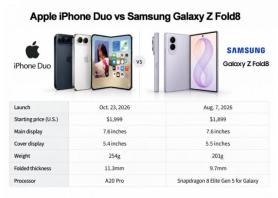
SEOUL, September 11 (AJP) - Apple is ready for a strong comeback after losing loyal Korean consumers to Samsung's foldables, with the iPhone's first foldable form rolling out across Korea on Oct. 23.
The appeal to lure back long-term iPhone users is apparent, if form had been the sole put-off. The sole damper is the starting price tag of 3.29 million won for the entry-level 256-gigabyte model and 5.09 million won for the top-end 2-terabyte iPhone Duo.
Apple has again set the bar by pushing the upper end of smartphone pricing beyond 5 million won for the first time in Korea.
Samsung Electronics' latest foldables are hardly any cheaper. The Galaxy Z Fold8 starts at 2.28 million won in Korea, while the top-end 1TB Fold8 Ultra costs 3.45 million won.
The ultra-premium devices sit at the extreme end of the market. But one thing is for sure. Smartphones are no longer an accessible gadget.
Global smartphone retail prices have risen an average 15 percent so far this year, while newly launched devices are 25 percent more expensive than comparable models a year earlier, according to Counterpoint Research. More than 40 percent of smartphone models tracked by the research firm have raised prices in 2026, the first time the industry has crossed that threshold.
Smartphones have gotten smarter with embedded AI services and agents, but those features rely on chips powerful enough to run them.
The cost of memory has translated into the cost of hardware.
Smartphone memory prices surged more than 80 percent quarter-on-quarter in the second quarter as the artificial intelligence boom continued to reshape how the world's limited memory production capacity is allocated.
Memory makers have increasingly prioritized high-margin products used in AI data centers, tightening the supply available for smartphones and other consumer electronics.
Global DRAM suppliers' inventories remain at historically low levels, while additional supply is being directed primarily toward servers, according to TrendForce.
The result is a form of "chipflation" — rising semiconductor costs that are beginning to spill over from AI infrastructure into the prices consumers pay for everyday electronics.
The impact is already visible inside smartphones.
The bill of materials for comparable low-end smartphones jumped 70 percent from a year earlier in the second quarter, with almost all of the increase attributable to memory, Counterpoint said. Mid-range devices saw their component costs rise 52 percent, with memory accounting for about 40 percent of total BoM costs.
Even premium smartphones were not spared. Their component costs increased nearly 50 percent, with DRAM overtaking the application processor to become the most expensive single component in a premium smartphone.
The effects are moving beyond manufacturers' balance sheets.
Some smartphone makers are reducing storage capacity, scaling back camera specifications or bringing back 4G models in certain price segments to contain costs. Others are concentrating on higher-end products where elevated component costs can be more easily absorbed or passed on to consumers.

As smartphone prices rise, consumers are likely to respond by holding on to their devices for longer, according to Hwang Yong-sik, a professor of business administration at Sejong University.
"As prices continue to rise and more premium phones enter the market, replacement cycles will inevitably get longer," Hwang said. "The switching cost is getting higher, so consumers are likely to choose to use their devices more sparingly and for longer."
Consumers have begun to accept the cost of higher memory — effectively the hardware tokens of the AI age.
For Park, a 30-year-old office worker in Seoul, higher smartphone prices mean one thing: holding on to his current device for longer.
"If smartphone prices weren't such a burden, I might think about replacing my phone even if it still works," Park said. "But at these prices, unless my phone reaches the point where I really can't use it anymore, I'll probably just keep using it."
Park, who uses a Samsung Galaxy S24 Plus, said he extended his mobile contract for another year after his initial two-year contract expired rather than replacing the device. He said he would still prefer a new premium phone over a refurbished one, but rising prices have raised the threshold for when he considers an upgrade.

Counterpoint said buyers are delaying upgrades, choosing devices with less storage or turning to refurbished smartphones as prices climb. The research firm expects the global smartphone average selling price to rise 22 percent this year to $450, although it cautioned that the increase should not be interpreted simply as consumers willingly spending more on premium devices.
Global smartphone shipments fell 11 percent from a year earlier in the second quarter to their lowest second-quarter level since 2013, with Counterpoint describing the memory shortage as the dominant drag on the market.
The pressure is also spreading to PCs.
TrendForce said rising retail prices are already weighing on consumer spending and notebook shipments as PC makers face higher DRAM costs. Conventional DRAM contract prices are expected to rise another 13 percent to 18 percent quarter-on-quarter in the third quarter, even after steep increases earlier this year.
Hwang said the impact could extend beyond electronics if higher prices leave households with less room for discretionary spending.
"If inflation continues, consumers will tighten their belts and close their wallets," Hwang said. "They will spend less, and that could eventually become a factor affecting sales in the smartphone industry as well."
For consumers, the question is therefore no longer simply how much more advanced the next smartphone or laptop will be, but how much more they will have to pay for it.
A 5-million-won smartphone remains an extreme example, driven by factors well beyond memory costs. Apple has in fact kept prices of its existing iPhones steady despite the memory surge, according to Counterpoint.
But as AI infrastructure competes for the same underlying memory manufacturing resources used by consumer devices, the industry's cost structure is changing.
Whether today's 5-million-won smartphone remains an outlier or becomes an early sign of a more expensive era for consumer electronics may depend in part on how long the global memory shortage lasts — and how much of the bill device makers are willing, or able, to pass on to consumers.
AJP Takeaways
- AI-driven memory shortages are spilling into consumer electronics, pushing up smartphone and PC prices as chipmakers prioritize higher-margin products for AI data centers.
- Global smartphone retail prices have risen an average 15 percent so far this year, while smartphone memory prices surged more than 80 percent quarter-on-quarter in the second quarter, according to Counterpoint Research.
- Rising device prices are prompting consumers to delay upgrades, choose lower-cost configurations or turn to refurbished models, raising the prospect of longer replacement cycles and weaker consumer electronics demand.

Copyright ⓒ Aju Press All rights reserved.