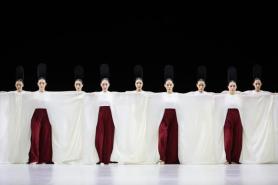
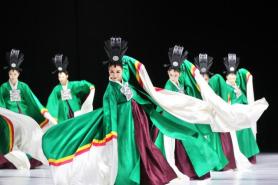
Draped in a shaman’s ceremonial robes, dancers pray for blessings through movement alone. Inspired by one of the most dynamic moments of “Gut: Whispering Steps” goes beyond simply recreating tradition on stage. Instead, it traces a journey through wounds and memory toward the strength to live again, expressing an ancient ritual through the language of the contemporary body.


Mugamseogi is a ritual within Seoul gut in which the shaman removes her ceremonial robes and hands them to the person who has requested the ritual. Wearing the robes, the individual then dances freely, improvising through movement. At first glance, the ritual may seem to embody an act of dependence—entrusting one’s wishes to the shaman. Yet it also contains a more self-directed gesture by wrapping themselves in the robes, the individual symbolically takes divine energy into their own body and receives the blessing through their own movement.


Choreographer Yoon Hye-jung draws on this tension between dependence and agency, reinterpreting the ritual as a deeply personal process of confronting one’s own struggles. In her work, the act of receiving a blessing becomes an act of self-empowerment in a way of gathering the inner strength and mental resilience needed to face hardship and move forward.


The work unfolds through five “tears,” each drawn from the five traditional colors of gut - black, yellow, blue, red, and white. It begins with the Black Tear, a tangle of painful memories, before moving into the Yellow Tear, an awakening impulse to rise again. The journey passes through the coldness of the Blue Tear and arrives at the Red Tear, a moment of stepping back to see oneself with greater clarity and detachment. Finally, it reaches the White Tear: a state of release, letting go, and stillness.
As the dancers move through this process of individual healing, their movements gradually expand beyond the self. What begins as a solitary journey becomes a shared, liberating celebration, culminating in a moment when everyone moves together as one.


The stage props, too, were conceived not as literal reproductions of traditional gut objects, but as “ritual mediums” - vessels through which memories and emotions embedded in the body could be stirred and released. Prop designer Song Mi-young drew inspiration from the repetition, symmetry, and interplay of emptiness and fullness found in seolgyeong, a traditional form of folded and cut paper art, reimagining its patterns in the design of a fan. Bells, trailing threads, and a staff extend the shaman’s movements beyond the body, creating a tangible connection between the human and an unseen world

Whispering Steps draws its roots from the rituals of our ancestors, yet what it discovers within them is an unmistakably contemporary language of healing. It becomes a journey in which each of us, not a shaman but ourselves, takes on the role of our own mugam, confronting the pain within and reclaiming the strength to keep moving forward. In the end, the performance leaves us with a simple message. The happiness found in an ordinary, peaceful life may be the truest blessing of all.


Copyright ⓒ Aju Press All rights reserved.