

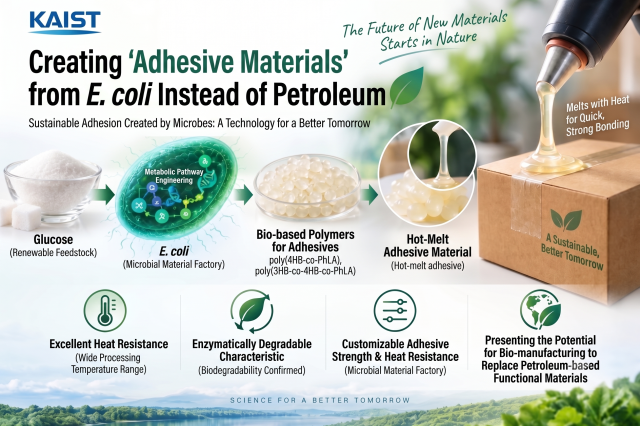
SEOUL, September 17 (AJP) - Bacteria fed on sugar have produced an adhesive that held stainless steel together more strongly than the petroleum-based glue now used across industry, offering a way to make a common factory material without oil and with the ability to break down.
In a shear test on stainless steel, the bio-made polymer withstood 4.58 megapascals. A commercial adhesive made from ethylene-vinyl acetate, or EVA, withstood 4.20 megapascals under the same test. That works out to about 47 kilograms of force per square centimeter, compared with 43. Shear strength measures how well two bonded surfaces resist being pushed apart sideways.
The Korea Advanced Institute of Science and Technology (KAIST) said Thursday that a team led by Lee Sang-yup, a distinguished professor in its Department of Chemical and Biomolecular Engineering, engineered Escherichia coli bacteria to turn glucose into the new material. The findings were published online July 20 in the journal Nature Communications, with doctoral student Kang Min-ju and researchers Lee Young-jun and Kim Gi-bae as co-authors.
The work targets hot-melt adhesives, the kind loaded into a glue gun. They melt when heated and harden as they cool, bonding surfaces quickly without chemical solvents. That makes them standard in packaging, furniture, electronics, cars and building materials.
Most hot-melt adhesives are made from petroleum-derived plastics such as EVA. They bond well but do not break down easily in nature, which adds to waste and microplastic pollution. KAIST pointed to a practical consequence. A package made of biodegradable material is less green if the glue holding it together does not degrade.
To build an alternative, the team turned to polyhydroxyalkanoates, or PHAs. These are biodegradable plastics that microbes can make from renewable feedstocks such as glucose. Their flexibility, strength and heat resistance change depending on which chemical building blocks go into them and in what proportion.
The researchers combined two building blocks with opposite strengths. One, 4-hydroxybutyrate, makes the material soft and sticky. The other, phenyllactate, adds stiffness and helps it withstand heat.
Changing the ratio between the two changed how the polymer handled heat and how well it bonded. Adhesion was strongest when 4-hydroxybutyrate made up roughly 24 to 34 percent of the building blocks, counted by number of molecules.
Getting E. coli to make both building blocks and link them into one chain took several rounds of genetic redesign. Producing multiple components at once threw the cell's chemistry out of balance, so the team adjusted how strongly and when key genes switched on. The researchers also added an enzyme, CoA transferase, that prepares the building blocks for the next step of assembly inside the cell.
A computer model of the thousands of chemical reactions running inside the bacterium helped the team find where raw materials ran short or production stalled. Those bottlenecks were then removed.
Grown in fed-batch fermentation, a method that feeds nutrients to the microbes continuously, the engineered bacteria produced 10.2 grams of the two-part polymer per liter of culture. When the team added a third building block, 3-hydroxybutyrate, the resulting polymer reached 52.8 grams per liter.
The three-part version was tested on wood, where its bonding strength was about the same as the commercial EVA adhesive. The two-part polymer that beat EVA on steel kept a substantial share of its bonding strength after being melted and reapplied several times, and the added phenyllactate improved its heat resistance.
To check whether the material breaks down, the team treated it with lipase, an enzyme that digests fats. The polymer's surface was damaged, and both its molecular weight and total mass fell.
Those results come from laboratory tests. KAIST did not report how the material degrades in soil, seawater or landfill conditions, and it gave no estimate of production cost or a timeline for commercial use.
KAIST said the same approach of designing a microbe's metabolism could be used to tune other properties, such as flexibility and heat resistance, and to produce other functional plastics that are now made through petrochemical processes.
"This study shows that by precisely designing microbial metabolism, we can go beyond simply producing polymers and directly produce functional materials," Lee said. With a wider range of unnatural building blocks and engineered microbes, he said, the approach "could expand into a biomanufacturing technology that produces not only petroleum-based adhesives but a range of functional polymers in a sustainable way."
[Reference Information]
Journal/Source: Nature Communications
Title: Synthesis of poly(4HB-co-PhLA) and poly(3HB-co-4HB-co-PhLA) as sustainable hot-melt adhesives using engineered Escherichia coli
Link/DOI: https://researchgate.net/publication/410617396_Synthesis_of_poly4HB-co-PhLA_and_poly3HB-co-4HB-co-PhLA_as_sustainable_hot-melt_adhesives_using_engineered_Escherichia_coli

Copyright ⓒ Aju Press All rights reserved.
![[UPDATES] Stepparent arrested for killing daughter with adhesive tape](https://image.ajunews.com/images/site/ajupress/v2/img/v2/ajp_noimg.png)