

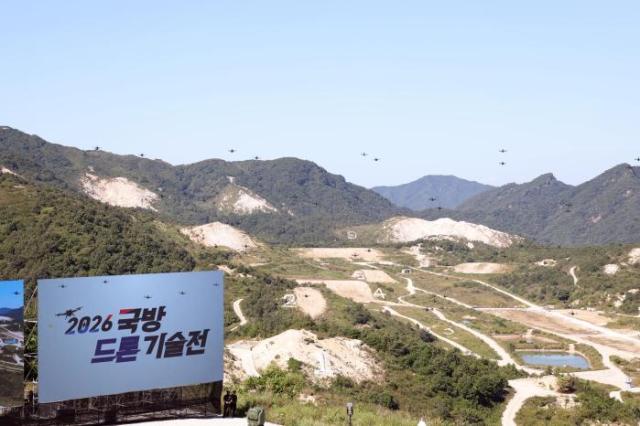
Six of 17 demonstrations failed to go as planned during the inaugural 2026 Defense Drone Technology Exhibition held Wednesday at the Seungjin Training Ground in Pocheon, north of Seoul, according to the ministry.
The other 11 demonstrations were successful, including all systems currently operated by the Defense Ministry or military, ministry spokeswoman Jeong Bit-na said during a regular briefing Thursday.
She later clarified that the military-operated systems were not necessarily fully deployed weapons and included equipment being used by test units.
Among the systems that ran into trouble was a medium-sized jet-powered drone developed by Korea Aerospace Industries (KAI), which crashed shortly after takeoff. A direct-impact attack drone, rotary-wing swarm drones and a drone-launched air-to-ground guided weapon also failed to complete their demonstrations as planned.
The ministry pushed back against descriptions of the event as a failure, saying its purpose was partly to expose technological shortcomings before systems reach operational units.
“Some prototypes from private companies did not successfully complete their demonstrations, but we see this not as a failure but as part of the process of developing better technology,” Jeong said.
“Actual battlefield environments involve various variables, including frequencies, weather and terrain, and identifying unexpected technical challenges during testing is an important reason for holding demonstrations like this,” she added.
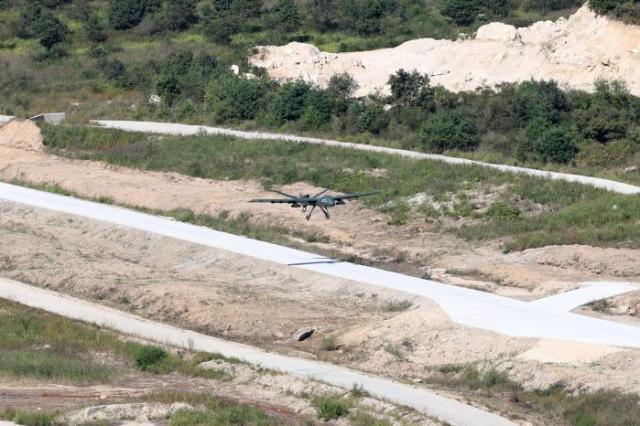
Asked whether the ministry was investigating why the six demonstrations went wrong, Jeong said there would be no separate military inquiry.
“We opened the military training ground, and we are not separately investigating the causes,” she said. “The companies will have to conduct their own analyses and use the findings for further technological development.”
One possible factor raised by participating companies was radio-frequency interference.
Jeong said some companies suspected interference from civilian frequencies may have affected their systems as large crowds gathered at the site, stressing that the explanation was the companies' assessment and had not been confirmed by an official investigation.
Some systems had operated normally during rehearsals a day earlier but encountered problems during the main event, when more than 1,000 people were present, according to a ministry official.
The event was intended to give private companies a rare opportunity to test prototypes outside laboratories and under conditions closer to actual military operations.
Reporters at Thursday's briefing questioned whether drones designed for battlefield use should be vulnerable to interference from an ordinary crowd in the first place.
If mobile phones or other civilian signals were enough to disrupt control or navigation, the problem could carry greater implications for systems expected to operate in far harsher electromagnetic environments.
Electronic warfare has become a defining feature of drone combat. North Korea has repeatedly carried out GPS jamming against South Korea, while the war in Ukraine has demonstrated how electronic warfare can disrupt drone navigation and communications.
Ukrainian forces had received 485,000 drones and other pieces of equipment through the platform by late May, with the average delivery time for in-stock equipment later shortened to nine days.
Seoul is pursuing its own rapid drone buildup. The Defense Ministry plans to introduce around 60,000 domestically produced training drones and train 500,000 service members as so-called “drone warriors,” while seeking faster ways to bring civilian technologies into military use.
Wednesday's problems came less than a month after two medium-sized loitering munitions under development by the Agency for Defense Development crashed into the sea shortly after being launched from the amphibious assault ship ROKS Marado on Aug. 25.
An initial investigation found that a misaligned door on the launcher caused uneven thrust and destabilized the aircraft during launch, while the drones themselves had operated normally.
The two episodes have sharpened questions over how quickly Seoul should move from prototype development to public demonstration and eventually battlefield deployment as it races to expand drone capabilities.
The Defense Ministry indicated Thursday that it would continue opening military environments to private developers rather than scale back testing after the mishaps.
It plans to expand testing and demonstration opportunities beyond the Army to the Navy, Air Force and Marine Corps, arguing that exposing problems early is part of accelerating technological development.
AJP Takeaways
- Six of 17 drone demonstrations faltered at a Defense Ministry-hosted event, with companies left to identify the causes.
- Possible radio-frequency interference raised concerns over whether military drones can withstand tougher electronic warfare conditions.
- Seoul is still accelerating its drone buildup, targeting around 60,000 training drones and 500,000 “drone warriors.”

Copyright ⓒ Aju Press All rights reserved.
