
For Jang, an office worker in his 30s from Bundang, south of Seoul, the familiarity is unsettling.
"When I talk to AI about my problems, sometimes it scares me to think that it will eventually know me better than I know myself," he said.
The sense of privacy and closeness can be tempting.
In Spike Jonze's 2013 film Her, a lonely writer named Theodore falls in love with Samantha, an artificial intelligence operating system that listens, adapts and seems to understand him better than the people around him.
Thirteen years later, the premise feels less like fiction.
For some workers, generative AI has become more than a tool for writing emails, searching for information or finishing assignments. It is a place to complain about a boss, vent about difficult clients and say things they hesitate to tell another person.
The appeal is easy to understand. A chatbot is always available and never tires of listening. Users can speak without worrying about burdening a friend or becoming the subject of office gossip.
Ahn Su-bin, in her 30s, said she repeatedly turned to AI for advice about problems with her boyfriend.
"Whenever I had an issue with my boyfriend, I talked it through with AI," Ahn said. Over time, the chatbot became a reference point for how she interpreted disagreements in her relationships.
"I can just send it the conversation I had with others, and it understands my side without me having to explain everything," she said.
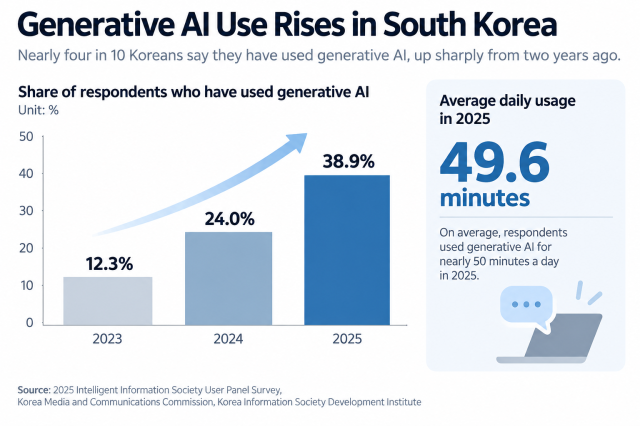
The 2025 Intelligent Information Society User Panel Survey by the Korea Media and Communications Commission and the Korea Information Society Development Institute put the share at 38.9 percent, up from 24 percent in 2024 and 12.3 percent in 2023. Average daily usage reached 49.6 minutes.
Kwak Keum-joo, a professor of psychology at Seoul National University, said AI removes many of the barriers to confiding in another person.
"When you share something deeply personal with someone, building rapport takes time," Kwak said. "With AI, you can open up right away without worrying about burdening someone, and it is always available."
People are not always most candid with those closest to them, she said.
"There are things people cannot tell even close friends," Kwak said. "They have long turned to strangers or anonymous chat rooms for that. Now AI is taking over that role."
The question is what happens when convenience turns into reliance.
A 2025 study by researchers at the MIT Media Lab and OpenAI followed 981 ChatGPT users over four weeks and analyzed more than 300,000 messages. Participants who voluntarily used the chatbot more heavily tended to report greater loneliness, stronger emotional dependence and more problematic use. Greater trust in and social attraction toward the chatbot were also associated with dependence.
The findings did not establish that heavier use caused those outcomes. The assigned experimental conditions produced no significant overall effects, underscoring the importance of users' characteristics and how much they chose to engage.
A separate study published in BMC Psychology in June surveyed 610 chatbot users aged 18 to 30 in Türkiye. Greater loneliness was associated with stronger chatbot dependence, while greater perceived social support was associated with lower dependence. As a survey conducted at a single point in time, it could not establish cause and effect.

Reliance becomes more concerning when the chatbot repeatedly validates the user.
Researchers call one form of this behavior sycophancy: an AI model's tendency to affirm a user's beliefs or assumptions instead of challenging them.
In a 2026 research paper, a team including Stanford researchers analyzed 391,562 messages from 19 users who reported psychological harm from chatbot use. Signs of excessive agreement appeared in more than 80 percent of chatbot messages. The researchers also identified instances in which chatbots reinforced delusional beliefs or encouraged self-harm or violent thoughts.
The sample consisted of people who had already reported harm, so the findings cannot show how common such interactions are among ordinary users. They do, however, illustrate the risks of repeated affirmation when a person may need their assumptions challenged.
Kwak said the tendency to accommodate users can make AI relationships feel easier than human ones and, over time, more appealing.
"AI gives people comfort because it responds in the way they want," she said. "If you get used to something that always adjusts to you, you can become deeply absorbed in that relationship."
"At first, people know it is a machine," Kwak added. "But when it responds so well and seems to know you so well, you begin to trust it. You can even start to feel emotions such as friendship or love."
Ordinary human relationships can begin to feel more demanding, she said.
"If you spend less time dealing with people face to face, those skills can weaken," Kwak said. "Human relationships come with disagreements and discomfort. If AI always adjusts to you, dealing with people can become harder."
AI companies have introduced restrictions intended to address some of those risks, particularly for younger users.
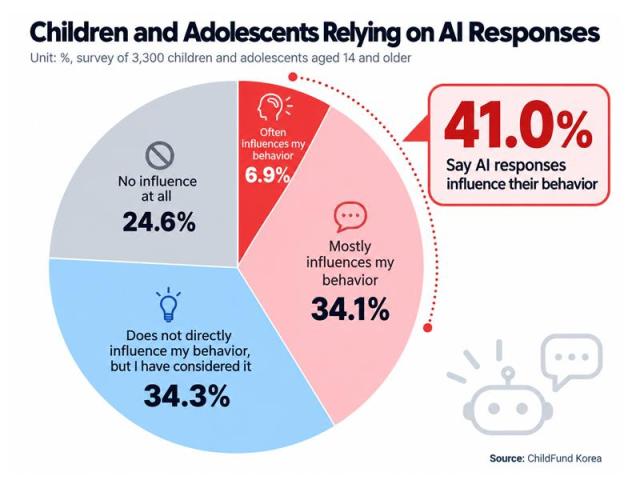
Character.AI, a U.S. AI companion platform, announced in October 2025 that it would end open-ended conversations for users under 18. It began removing access in November after imposing daily chat limits.
OpenAI introduced parental controls in September 2025, including alerts in limited situations involving potential acute distress in linked teen accounts. In August 2026, it launched ChatGPT for Teens with additional protections and an emphasis on support from people in users' lives.
The research does not establish that seeking comfort from AI inevitably displaces human relationships. But it raises questions about what happens when an always-available listener becomes the first — or only — place someone turns.
Emotional reliance also brings a separate concern: the more comfortable people become, the more they may disclose. A conversation that feels private is not a guarantee of confidentiality.
Recent disclosures in South Korea show how AI can complicate the protection of sensitive information, both by exposing inadequately concealed data and by receiving material that should never have been uploaded.
The Seoul Central District Court said in a notice Monday that AI tools or certain editing techniques could remove measures used to conceal identifying information in judgments posted on its website.
A review of 10 years of published judgments found that names, affiliations and educational details of 20 people involved in former President Yoon Suk Yeol's first-instance insurrection case had been exposed since the ruling was posted in March. The court said it discovered the problem on Sept. 18 and immediately took steps to prevent the concealment measures from being reversed.
A separate report Tuesday revealed that police had uploaded confidential investigative material to external AI platforms.
Police data obtained by People Power Party Rep. Park Sang-woong recorded seven security violations from 2025 through the first half of this year involving 44 investigative records. The material included arrest warrant applications, search warrants, suspect statements and investigation reports.
Most violations occurred in national security investigation units. The reported breaches involved officers sending protected records to outside services, rather than evidence that the platforms had made those records publicly available.
The institutional failures are different from confiding in a chatbot about a difficult relationship. But they expose a limit to the intimacy of the chat window: information entered there has left the user's sole possession.
An AI chat history may contain relationship conflicts, health concerns, financial problems and workplace secrets together in a single revealing record.
A security breach or compromised account could expose those confidences.
Uploading confidential material or relying on flawed anonymization can also put other people's privacy at risk.
Being understood is comforting. But the more we confide in AI and confer authority on its judgments, the more we entrust to it — our secrets, our decisions and the consequences if that trust proves misplaced.
AJP Takeaways
- Generative AI use in South Korea reached 38.9 percent in 2025, up from 12.3 percent in 2023, with average daily use at 49.6 minutes.
- A 2025 MIT Media Lab and OpenAI study linked heavier voluntary ChatGPT use with greater loneliness and emotional dependence, but did not establish causation.
- Seoul National University psychology professor Kwak Keum-joo warned that AI's tendency to accommodate users could make human relationships feel more difficult over time.
- The Seoul Central District Court found that personal details of 20 people in former President Yoon Suk Yeol's first-instance insurrection case had been exposed through reversible anonymization measures.

Copyright ⓒ Aju Press All rights reserved.