South Korea’s preliminary trade data put chip exports at $340.3 billion in the first nine months of this year. September shipments alone reached $60.3 billion — nearly matching Japan’s entire goods exports of $64.5 billion in August and equivalent to about 30 percent of U.S. goods exports that month.
The boom appears to have further to run.
TrendForce expects the blended average selling price of high-bandwidth memory, or HBM, used in AI accelerators to jump 121 percent in 2027. The forecast reflects both persistent shortages and a growing share of more expensive HBM4 products in the sales mix.
For Samsung Electronics and SK hynix, that points to another year of strong pricing power as customers compete for production capacity that cannot expand fast enough.
The HBM oligopoly — SK hynix, Samsung and Micron — faces an increasingly difficult allocation problem. HBM and conventional DRAM draw on overlapping manufacturing capacity, meaning more production devoted to advanced AI memory leaves less available for other uses.
The squeeze is already extending well beyond HBM.
TrendForce expects conventional DRAM contract prices to rise another 10 to 15 percent quarter-on-quarter in the fourth quarter of 2026, with NAND flash prices increasing 15 to 20 percent. Enterprise solid-state drives, used in data centers, are forecast to rise even faster at 23 to 28 percent as cloud companies expand storage for AI inference and agentic AI workloads.
Korea’s export figures show how sharply the cycle has turned. Memory shipments alone reached $54.07 billion in September, up 358.6 percent from a year earlier.
Benchmark prices have continued to climb. The contract price of 16-gigabit DDR5 rose to $48 in September from $45 in July and $46.50 in August. The price of 128-gigabit NAND increased to $30.61 from $30.05 and $30.48 over the same period, according to ministry data.
Samsung and SK hynix are positioning themselves to capture more of that spending.
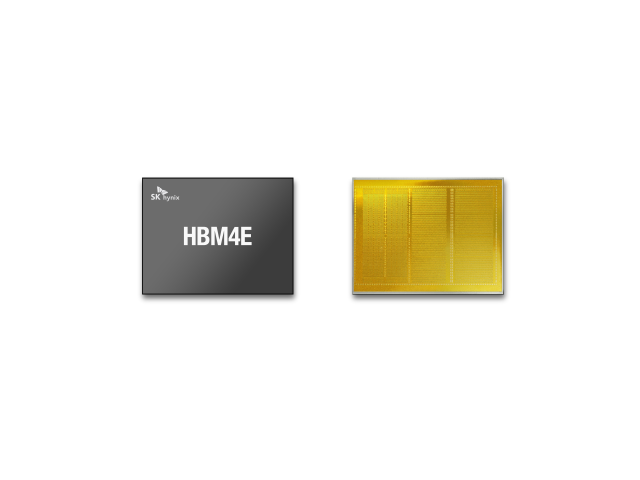
SK hynix began mass shipments of HBM4 in the second quarter and outlined plans to expand production in the second half. It has also concluded negotiations on long-term supply agreements with around 10 customers seeking greater certainty over future memory supplies.
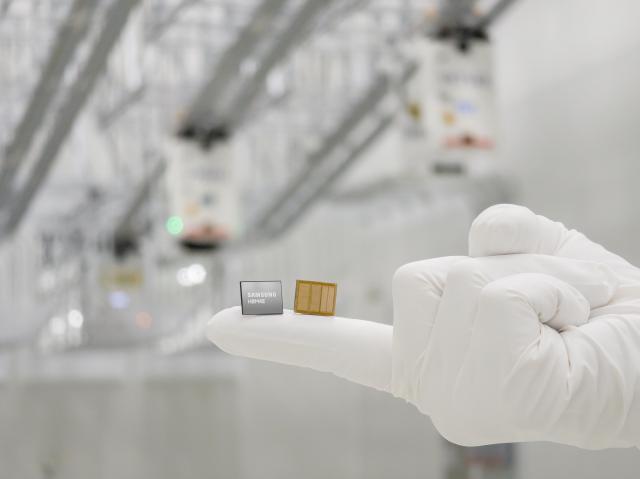
Samsung posted record quarterly earnings in the second quarter and is expanding its focus on HBM4, high-capacity DDR5 and enterprise SSDs as AI infrastructure investment drives demand for more advanced memory products.
Yet the next stage of the HBM boom may involve a retreat from the industry’s recent race to stack more memory dies.
GPU and custom AI chip developers are increasingly evaluating eight-layer HBM instead of 12-layer configurations to contain costs and stretch scarce supplies, according to TrendForce. Fewer dies per stack would allow the same memory output to support more accelerators.
The saving comes with a catch: a cheaper stack can still mean more expensive memory per unit of capacity.
Each stack requires a base die whose cost does not fall proportionately with the number of memory layers. Spread across fewer layers, that cost raises the price per gigabit. TrendForce expects eight-layer HBM to command a premium of roughly 10 to 20 percent per gigabit over comparable 12-layer products in 2027.
Customers may therefore spend less on memory in each accelerator while paying more for the capacity they receive.
Storage demand is adding another source of pressure. As AI moves from model training into everyday deployment, systems need to store and retrieve growing volumes of data.
TrendForce expects enterprise SSD demand measured in bits to increase more than 80 percent this year, with much of the additional supply already committed to customers.
Consumer electronics makers are feeling the other side of the boom.
Higher component costs are weighing on notebook and smartphone demand.
Some PC brands are reducing SSD capacity in mainstream models to contain costs, while smartphone manufacturers are drawing on existing inventories and limiting new purchases. Such resistance is restraining price increases in consumer-oriented memory even as AI-related demand remains strong.
In South Korea, electronics prices are climbing against a backdrop of weak spending on durable goods. August industrial activity data showed sales of durable goods, a category that includes cars, computers and household appliances, fell 5.6 percent from a year earlier.
September consumer price data released Friday showed mobile phone prices rose 8.3 percent on year and computer prices up 27.4 percent, far outpacing headline inflation of 2.9 percent.
For Samsung and SK hynix, sustaining the earnings run increasingly depends on their product mix. HBM, server DRAM and enterprise SSDs are drawing the strongest demand and a growing share of production resources.
The HBM heyday looks set to extend into 2027. But as consumers face higher prices or reduced memory and storage in their next phone or PC, its reach will also depend on how much they are willing to pay.
AJP Takeaways
- HBM prices are set to more than double in 2027, with TrendForce forecasting a 121 percent rise in blended average selling prices as HBM4 adoption grows and supply remains tight.
- The AI squeeze is spreading across memory, with fourth-quarter DRAM prices forecast to rise 10–15 percent, NAND 15–20 percent and enterprise SSDs 23–28 percent.
- Samsung and SK hynix stand to benefit from stronger pricing, but consumers may face the other side of the boom through higher electronics prices or lower memory and storage specifications.

Copyright ⓒ Aju Press All rights reserved.