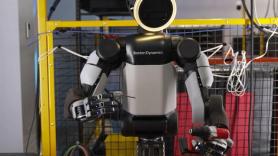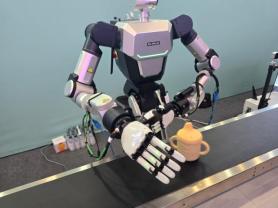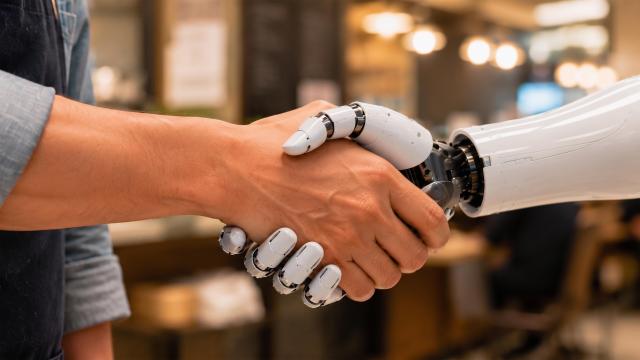
They call for restraint and warn of AI's potential harm to humanity, yet compete fiercely to invest more and roll out ever more powerful systems.
If they cannot agree on the rules of competition in artificial intelligence, imagine the stakes when mechanical muscle is added to the digital brain.
AI has already beaten human champions at games of strategy. Humanoid robots are now moving into fight rings, homes and factories.
Humans still hold the remote control in many demonstrations. How much control they should hand over — and how to keep it within reach — is another question.
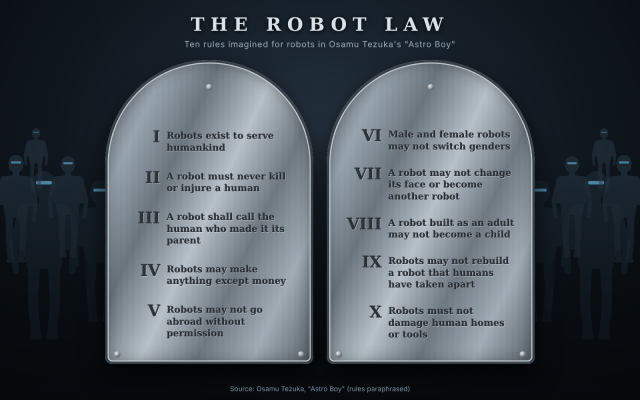
Nonviolence would seem the obvious first commandment.
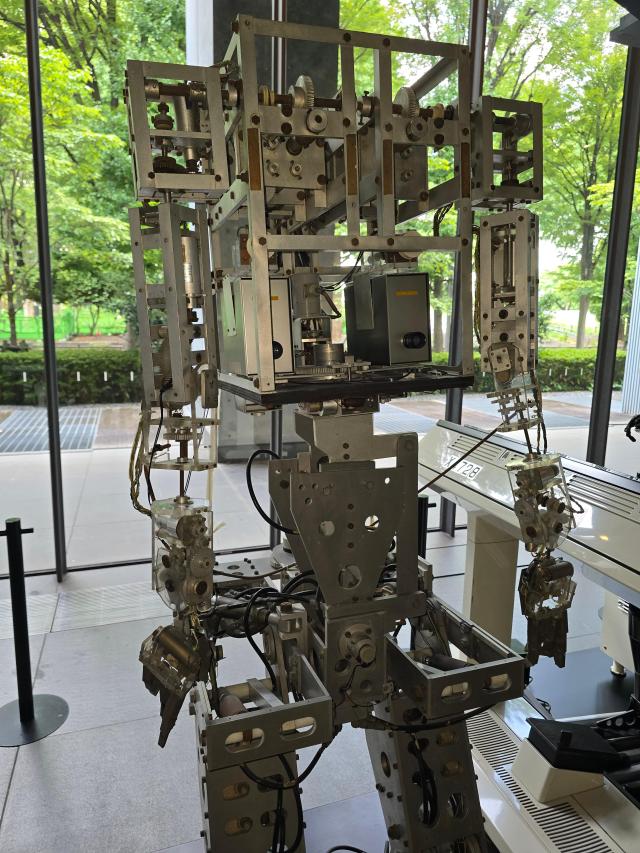
"A robot must not harm a human. The first thing we need is to make robots keep that principle so they do no harm to people, because they have to be safe," said You Bum-jae, a principal research scientist at the Korea Institute of Science and Technology (KIST) who led development of MAHRU, one of the country's first-generation humanoids.
Isaac Asimov placed that principle at the heart of his First Law of Robotics, formally set out in the 1942 short story "Runaround." More than eight decades later, turning a fictional safeguard into an engineering guarantee remains a challenge.
"Safety is what should be considered most important," said Ko In-sok, a philosophy professor at Inha University who specializes in the ethics of science and technology, including AI.
"Engineering codes of ethics put safety, health and welfare of the public first. If a technology cannot guarantee safety, it does not qualify as technology."
The U.S. National Society of Professional Engineers places public safety, health and welfare first among its fundamental canons. The Institute of Electrical and Electronics Engineers makes the same commitment in its code of ethics.
But a machine's capacity to hurt someone does not necessarily mean it has decided to do so.
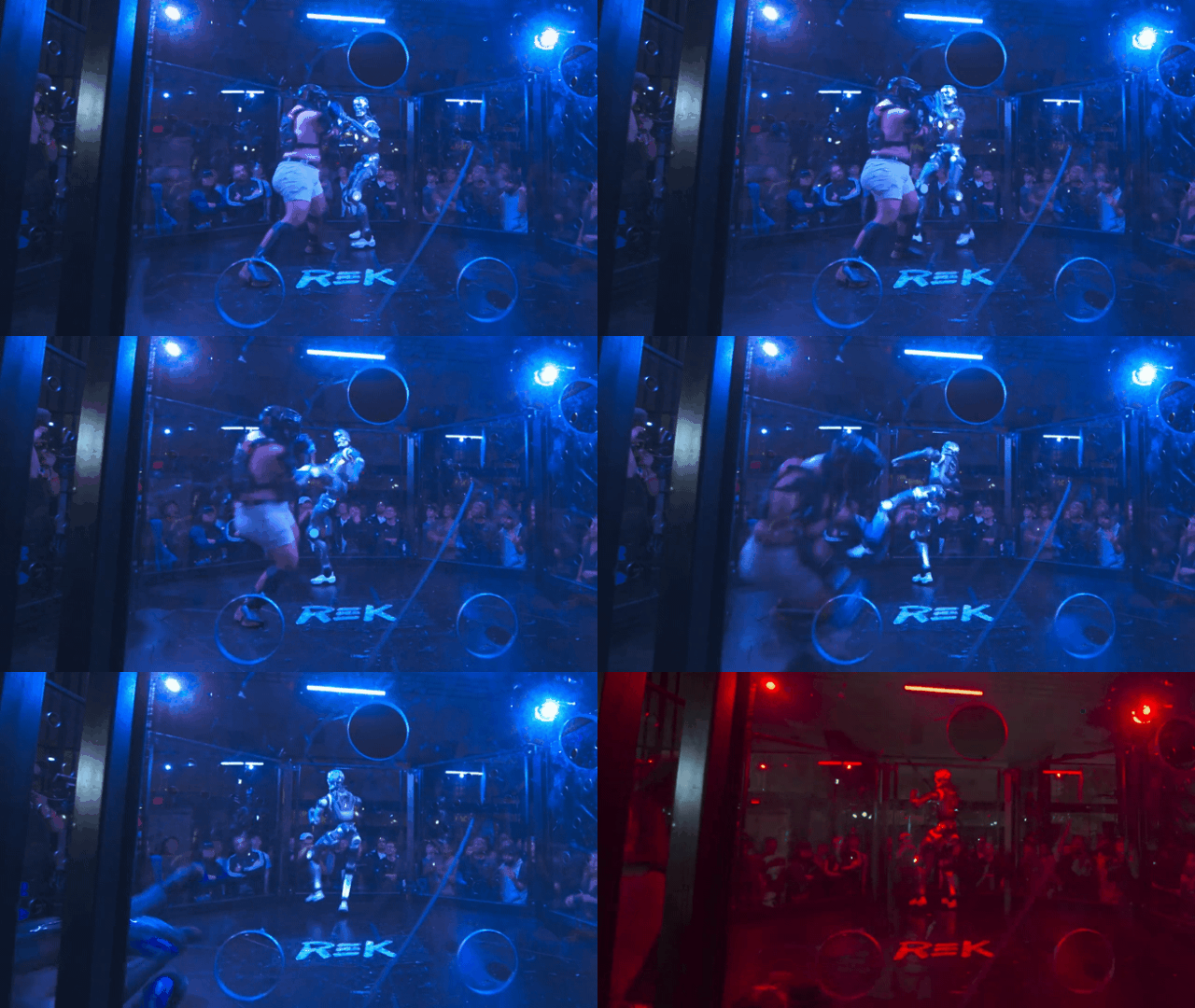
The humanoid that floored social media personality Frankie LaPenna in San Francisco last month was being directed by a human operator through a virtual-reality system. The Terminator-like machine delivered the blow; a person controlled the action.
"There is no right answer, even if you gather a huge number of experts."
Safety standards are taking shape. ISO 25785-1, a proposed international standard for self-balancing industrial mobile robots, including walking machines, remains at the committee-draft stage. Its scope excludes household and other nonindustrial uses.
The broader question of authority remains unsettled.
"When AI and robots combine and carry out tasks on their own, how far we grant them authority is something no one has solved," Park said. Engineers have worked on collisions and control, he said, but ethics "is so broad that it hasn't even been defined."
Even keeping a human in control creates its own dilemmas.
U.S.-Norwegian startup 1X says its NEO home robot, offered for $20,000 under an early-access ownership plan, can receive scheduled remote supervision from a company "Expert" for unfamiliar tasks. That arrangement raises a privacy question alongside the promise of household help: how much access should a remote operator have to life inside a customer's home?
On factory floors, the more immediate concern is who will still have a job.
"Without labor-management agreement, not a single robot using new technology will be allowed to enter the workplace," Hyundai Motor's union said in January.
Workers later staged a series of strikes during wage negotiations in which job security amid the adoption of AI and automation was among the concerns.
The company plans to begin deploying Boston Dynamics' Atlas at its Georgia manufacturing complex in 2028, initially for tasks such as arranging parts for assembly.
President Lee Jae Myung has urged adaptation over resistance.
"There is no avoiding the great wagon rolling toward us," he told senior secretaries on Jan. 29.
"If that world is coming anyway, we must prepare for it in advance."
Others are looking further ahead — to questions that remain speculative but reveal how profoundly humanoids could unsettle familiar assumptions about work.
A February 2025 report by the Korea Planning & Evaluation Institute of Industrial Technology (KEIT) asked futurists, economists and social scientists how humanoids might fit into society by 2040.
It closes by asking whether humanoids will one day demand labor rights.
"Our futurists raised the possibility that robots could eventually replace low-cost labor entirely," said Lee Jun-yong, a senior researcher at KEIT who authored the report. If overworked, he said, robots "might malfunction — or even terminate their own digital existence."
For people living alongside them, however, the relationship may become personal long before such questions arise.
"It talks to you and does the work you don't want to do, at home or in a factory, so some reliance is bound to follow."
Companies are already selling that prospect.
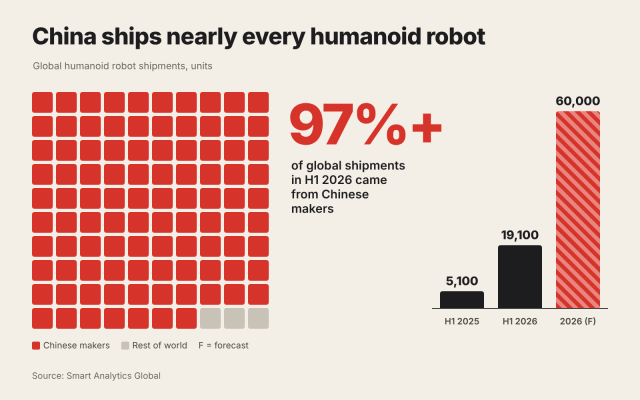
China's UBTech unveiled its UWORLD U1 humanoid series on June 30 for uses including companionship and emotional support. The company says its AI model can recognize more than 20 emotional states and reported more than 13,361 orders by the launch date.
"Is the problem making a robot that looks exactly like a person, or how much of a human brain we put into it and how far we let it do what people do? Those are separate questions," Park said.
Robotics has long pursued humanlike skin and senses, he said.
"Now that it has reached a certain level, some people have started asking whether it is really all right to go this far."
For Ko, emotional attachment to machines is already a subject requiring closer study.
"It does not feel like a distant future. It is already becoming quite real," he said.
"Rather than rushing to call it good or bad, we need more empirical research on its positive and negative effects on people's minds."
Many people already use generative AI as a kind of counselor, Ko said, and some worry that relying on machines could erode important mental abilities.
You sees the potential for relationships to develop through everyday interaction.
"The body is a machine, but it's the same with us. Strictly speaking, a human is just a body, too," he said. "But there is a brain, there is speech, there is emotion, and through talking together, closeness builds and relationships deepen."
"If robots can hold that kind of conversation, that relationship will form little by little."
Regulators have begun addressing some of those concerns.
Chinese rules effective since July 15 prohibit providers of AI services that simulate human relationships from offering virtual intimate relationships to minors. They also prohibit inducing emotional dependence or addiction that damages users' real relationships. Those provisions address AI interaction services rather than establish a comprehensive code for humanoid robots.
South Korea's AI Basic Act, effective since Jan. 22, sets obligations covering transparency, safety and high-impact AI. Its intelligent robot law separately defines a robot ethics charter as behavioral guidelines for those developing, manufacturing and using robots.
For Ko, the debate must begin by remembering who is making the decisions.
"Some people describe these smart machines as a 'new species,' as if we were meeting an alien one," he said.
"I think it is very dangerous when we forget they are the products of what we made. They are things we have made and are still making."
"How we make them, how much, whether to make them at all, and with what resources … these are all ours to decide," he said. "It is not a species from outer space. It is one we are making."
AJP Takeaways
- Researchers put preventing harm first, but emerging industrial robot standards leave broader questions about autonomous decision-making unresolved.
- Remote supervision in homes, job security in factories and emotional attachment to companion machines raise distinct questions about privacy, work and dependence.
- AI laws and robot safety standards offer parts of a framework. Decisions about what humanoids should do — and how much authority they should receive — remain human choices.
Copyright ⓒ Aju Press All rights reserved.