

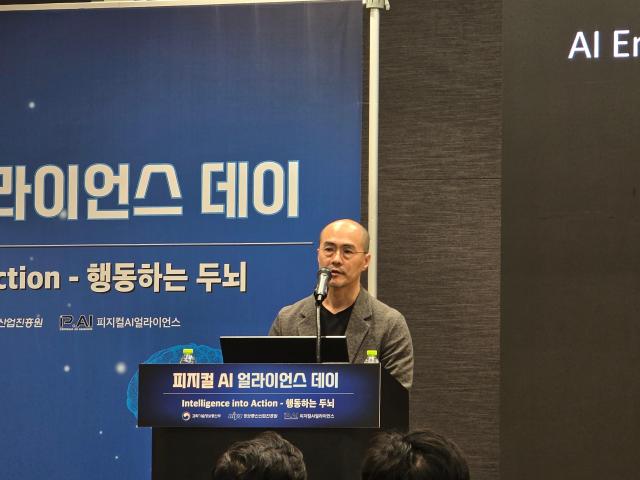
Jeong spoke at the opening session of the Physical AI Tech Week, hosted by the Ministry of Science and ICT at COEX in Seoul. Jeong pointed to foundries such as TSMC and the server and storage makers that anchor the data center value chain.
"If physical AI grows into a bigger market and a key industry, we expect Korea could well take on that role," Jeong said.
Jeong cited Korea's strong manufacturers, its software and AI capabilities, keen government interest and a sizable number of local cloud service providers.
"Countries that have all these conditions are very rare," Jeong said, adding that physical AI could make a major contribution to Korea's future.
Jeong also said physical AI still trails agentic AI by a wide margin.
Real-world training data remains scarce, and safety and cost concerns weigh on deployment. Simulation has therefore become central to the field, from data generation to training, verification and deployment, Jeong said, highlighting Nvidia's Omniverse platform and Cosmos world foundation models.
Physical AI will demand far more computing power than synthetic data for large language models ever did, since data must be generated and verified in simulated environments, according to Jeong.
"Computing requirements for physical AI can only keep growing," Jeong said.
Jeong also cited LG Electronics, which signed a memorandum of understanding with Nvidia in August to deepen robotics cooperation using Nvidia's Omniverse, Cosmos and Isaac platforms. Jeong said "meaningful results" from the partnership are expected soon.
AJP Takeaways
- Jeong So-young, head of Nvidia Korea, said on Oct. 13, 2026, that South Korea could take over the supply-chain role Taiwan holds in data centers once physical AI grows into a major industry. Jeong spoke at the Physical AI Tech Week in Seoul, hosted by the Ministry of Science and ICT.
- Jeong cited Korea's manufacturers, software and AI capabilities, government interest and local cloud providers, calling countries with all of these conditions "very rare."
- Jeong said physical AI still lags agentic AI because of scarce real-world data and deployment limits, and that its computing needs “can only keep growing.” Jeong also cited LG Electronics' August agreement with Nvidia on robotics.

Copyright ⓒ Aju Press All rights reserved.
