

SEOUL, October 13 (AJP) - South Korea's ambassador to the United States acknowledged Monday that Washington's concerns over intelligence cooperation remain unresolved despite efforts to address them, while admitting that communication with senior White House officials has fallen short of Seoul's expectations.
Ambassador Kang Kyung-wha made the remarks during a parliamentary audit at the South Korean Embassy in Washington, describing intelligence cooperation as the most difficult issue currently facing the two allies.
"Intelligence cooperation is what we have been discussing the most," Kang said.
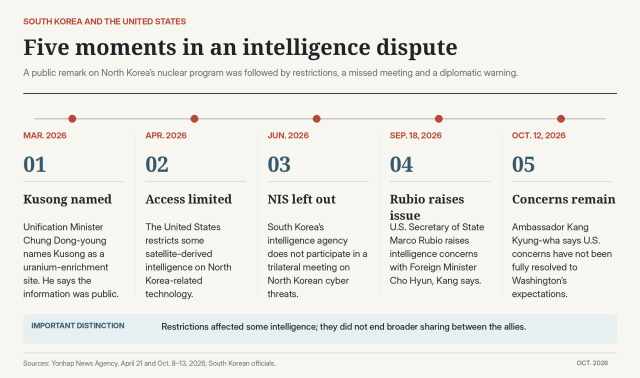
She confirmed that U.S. Secretary of State Marco Rubio had raised concerns about intelligence cooperation during a Sept. 18 meeting with South Korean Foreign Minister Cho Hyun.
Asked whether Seoul had adequately addressed Washington's concerns, Kang acknowledged that the dispute had yet to be fully resolved.
"I don't think the issue has been sufficiently resolved to meet U.S. expectations," she said.
The remarks represent a rare public acknowledgment by a senior South Korean diplomat of continuing difficulties in one of the most sensitive areas of the alliance, which has formed the foundation of South Korea's security since the two countries signed a mutual defense treaty in 1953.
The two governments share intelligence on North Korea's nuclear weapons, ballistic missiles, conventional military capabilities and cyber activities. South Korea relies partly on U.S. surveillance capabilities, including reconnaissance satellites, to monitor military developments across the heavily fortified border.
The dispute emerged in March when South Korean Unification Minister Chung Dong-young publicly identified Kusong, a city in northwestern North Korea, as the location of a uranium enrichment facility.
Chung said North Korea operated enrichment facilities in Kusong as well as Yongbyon and Kangson, two locations already widely associated with Pyongyang's nuclear program.
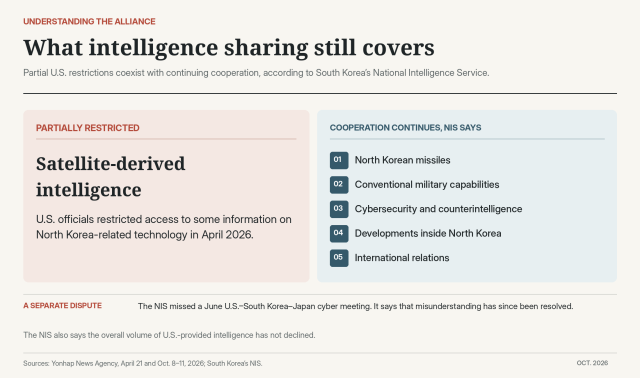
Washington reportedly considered his remarks a disclosure of sensitive intelligence shared by the United States. In April, U.S. authorities restricted South Korea's access to certain satellite-derived intelligence concerning North Korea's nuclear facilities and related technologies.
Chung has denied improperly disclosing U.S. intelligence, arguing that the information was already publicly available. During a news conference Monday, he said he had identified Kusong during his parliamentary confirmation hearing in July 2025, months before the remarks that prompted Washington's objections.
The controversy widened after South Korea's National Intelligence Service (NIS), the country's main civilian intelligence agency, acknowledged last week that it had been excluded from a June trilateral working-group meeting with the United States and Japan on North Korean cyber threats.
South Korean media reported that Washington had requested the agency's exclusion.
The NIS said the incident resulted from a misunderstanding that had since been resolved.
On Sunday, the agency rejected reports that the United States had reduced intelligence sharing with Seoul to information concerning North Korean missiles alone.
It maintained that cooperation continued across a broad range of areas, including conventional military capabilities, cybersecurity, counterintelligence and developments inside North Korea. The agency also said the overall volume of intelligence received from Washington had not declined, despite restrictions in certain areas.
A senior U.S. administration official, however, said Friday that Washington expected South Korea to uphold the standards of their decades-long alliance, particularly in intelligence and counterintelligence matters.
Kang said the two countries' intelligence agencies had remained in contact and made progress toward addressing the dispute, although she did not suggest that Washington's concerns had been fully resolved.
She also said Rubio had not specifically called for the dismissal of Chung or NIS Director Lee Jong-seok, despite demands from South Korea's opposition that both officials be removed over the controversy.
Kang acknowledged a separate diplomatic challenge involving access to senior officials in President Donald Trump's administration.
"I acknowledge that there are limitations in our communication with the White House," she said.
Although she regularly meets with officials at the White House National Security Council, Kang said opportunities for discussions at the senior levels she wanted remained insufficient, describing the situation as frustrating.
Nevertheless, she stressed that Washington's broader commitment to the alliance remained firmly established despite disagreements over individual issues.
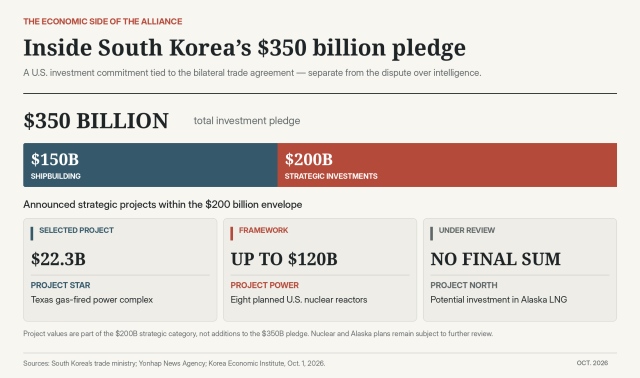
The intelligence dispute comes as Seoul and Washington attempt to implement a sweeping economic agreement reached last year, under which South Korea pledged $350 billion in U.S. investments in exchange for Washington reducing tariffs on South Korean goods to 15 percent.
The package comprises $150 billion earmarked for shipbuilding cooperation and another $200 billion for strategic investments in sectors including energy and infrastructure.
Kang said negotiations over those investments, including the proposed Alaska liquefied natural gas project, had previously been among the most difficult issues in bilateral relations before the first investment projects were announced.
On Sept. 30, Trump unveiled plans involving a $22.3 billion gas-fired power complex in Texas, a framework for constructing eight nuclear reactors in the United States worth an estimated $120 billion, and potential South Korean participation in the Alaska LNG project.
South Korea's finance minister subsequently confirmed that Seoul had transferred an initial $2.4 billion toward the Texas project on Oct. 1.
The Alaska project remains subject to further review, however, with Seoul emphasizing that participation must satisfy commercial viability requirements and South Korean law.
Another issue under discussion concerns South Korea's efforts to secure greater authority to enrich uranium and reprocess spent nuclear fuel.
Kang said the two governments were examining several options, including revising their bilateral civil nuclear cooperation agreement, commonly known as the Section 123 Agreement, or adopting supplementary arrangements.
The agreement, established under Section 123 of the U.S. Atomic Energy Act, governs the conditions under which U.S.-origin nuclear materials, equipment and technology can be used by South Korea.
On North Korea, Kang said there had been no concrete progress toward another summit between Trump and North Korean leader Kim Jong-un, despite the American president's repeated expressions of interest in renewed dialogue.
She described President Lee Jae Myung's suggestion of initially freezing North Korea's nuclear development as a pragmatic approach to preventing further expansion of Pyongyang's capabilities.
Kang stressed, however, that complete denuclearization of North Korea remained the stated objective of both governments.
Copyright ⓒ Aju Press All rights reserved.
