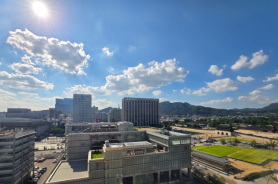
SEOUL, October 14 (AJP) - The Financial Services Commission (FSC) got its orders to move to Sejong on Tuesday. On Wednesday, it was running command in central Seoul against a hacking spree that has hit 16 financial companies, the kind of crisis that relocation will soon test.
After second emergency response meeting held Wednesday at Government Complex Seoul, the FSC said intrusions had been confirmed across banks, savings banks, mutual finance, card and capital firms, peer-to-peer lenders and crypto operators. About 100,000 records, including names, phone numbers, resident registration numbers and email addresses, have been leaked. Authorities warned the count could grow as firms check their systems against attacker IP addresses shared by regulators.
Around the table were the Financial Supervisory Service (FSS), the Financial Security Institute, the science and interior ministries, the Personal Information Protection Commission, the National Police Agency and the Korea Internet & Security Agency.
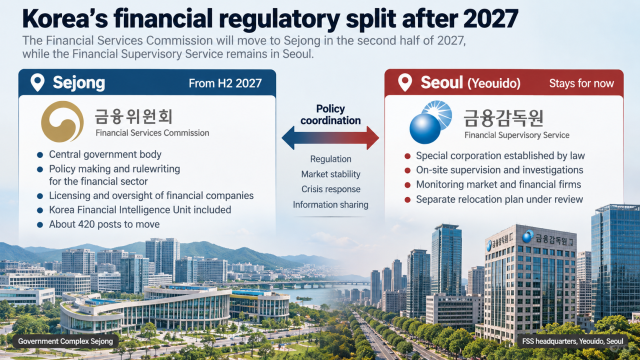
By late 2027 that table will be spread out. The FSC and its Korea Financial Intelligence Unit, about 420 posts in all, are scheduled to move to Sejong in the second half of next year under the second-phase relocation plan unveiled Tuesday. The privacy commission moves in the first half. The police headquarters is to follow by 2031. The FSS, which runs the on-site investigations, is not part of the package and stays in Seoul’s Yeouido district for now.
The division of labor in the hacking case shows what is at stake. FSS inspectors were sent into the affected firms and traced the attacks to 19 IP addresses in 12 countries. The FSC chaired the meetings and set the policy response: a full review of financial firms’ security systems, tighter accountability for chief executives and boards, vulnerability checks at least twice a year for large firms instead of once, and faster easing of network-separation rules.
“Despite repeated orders for full inspections after the Lotte Card leak and the Mythos shock, we found cases where financial firms failed to keep even the basics,” Secretary General Shin Jin-chang said at the meeting.
Moving to Sejong will not change that legal hierarchy. The FSC still writes the rules, licenses financial companies and oversees the FSS. What it risks losing is proximity to the people who see problems first. Officials worry that could turn the policymaker into something like a backseat driver, setting direction from a distance while the supervisor in Seoul has the clearer view of the road.
“The advantage of being in Seoul is ultimately being able to meet people at the center of the capital and financial markets in real time, see how they work and communicate with them,” an FSC official said, speaking on condition of anonymity because officials are not authorized to discuss the move publicly. “If we lose that, what service can we be?”
The official said meetings with the FSS, Korea Exchange, Korea Financial Investment Association and securities firms are not held daily. They become frequent during unfair-trading cases, market disruptions and crises like the current one. Regular face-to-face contact, the official said, builds the working relationships that matter when authorities have to coordinate in real time.
The FSC is not an enforcement body in the same sense as the FSS, the official stressed. Its job is to watch how markets change and turn that into policy. Leaving on-the-ground response entirely to the FSS would reduce policymakers’ direct exposure to the developments they are ultimately responsible for writing into regulation. Some FSC functions could run from Sejong without much difficulty, the official acknowledged. The concern is greater for units that depend on market contact, private consultations and rapid coordination.
That concern reportedly reached the cabinet table. FSC Chairman Lee Eog-weon argued against the move at Tuesday’s closed-door cabinet meeting, citing the clustering of the financial industry and the need to stay connected to markets, the Hankook Ilbo reported. Later that day he told senior staff the relocation serves national goals of balanced development and completing Sejong as the administrative capital.
The two institutions are being treated differently largely because of their legal status. The FSC is a central government body staffed by civil servants and could be moved without legislation. The FSS is a special corporation established by law. Its relocation, along with that of the Korea Deposit Insurance Corporation and the state-run policy banks, falls under a separate public-institution relocation plan, with targets due in the fourth quarter. In a survey by the FSS union, 85.6 percent of employees said they would consider leaving if the agency moved.
The government argued at Tuesday’s briefing that financial policy needs close ties not only to markets but also to other ministries. It concluded the FSC need not stay in Seoul. In Sejong, the FSC would sit alongside the economy ministry and others it works with on household debt, corporate finance and industrial policy.
Experience elsewhere is mixed. After the National Pension Service moved its fund management to Jeonju in 2017, departing fund managers most often cited the location as their reason for leaving. Yet a 2023 analysis found the fund’s attrition rate below the asset-management industry average.
Inside the FSC, open dissent is rare. Few officials want to be seen opposing the drive to make Sejong the administrative capital. That has kept the reaction more muted than at the FSS, where management and the union have publicly campaigned against leaving Seoul.
“At the end of the day, we are civil servants,” the FSC official said.
The FSC’s move has been decided. Still undecided is how its policymakers will keep a clear view of the supervisors, financial firms and markets that remain in Seoul, and of the next crisis when it breaks.
AJP Takeaways
- The FSC and its Korea Financial Intelligence Unit are scheduled to move to Sejong in the second half of 2027, while the FSS remains in Seoul for now.
- An FSC official said market-facing teams rely on direct contact with supervisors and financial firms, particularly during unfair-trading cases, market disruptions and other crises requiring rapid coordination.
- The government says relocating the FSC will improve coordination with ministries in Sejong, but how the commission will maintain its day-to-day links with Seoul-based supervisors and markets remains unresolved.

Copyright ⓒ Aju Press All rights reserved.