Indonesia is confronting a crisis of market credibility. South Korea is reckoning with the price of its AI boom. Both face the pull of higher U.S. bond yields, but economists caution against mistaking simultaneous market stress for a repeat of the financial contagion that swept Asia nearly three decades ago.
The distinction offers some reassurance. The scale of foreign selling offers less.
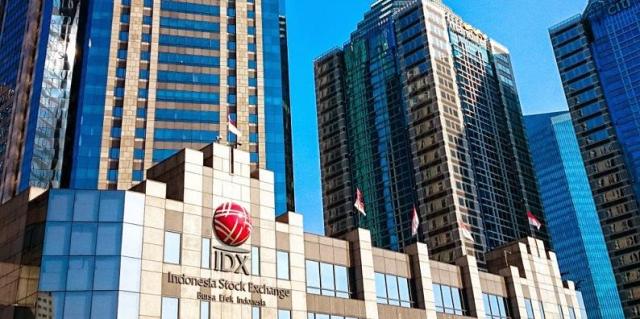
The Jakarta Composite Index plunged 11.57 percent to 5,185.11 on Friday, its sharpest one-day decline since January 1998, after global index provider MSCI proposed stripping Indonesia of its emerging-market status.
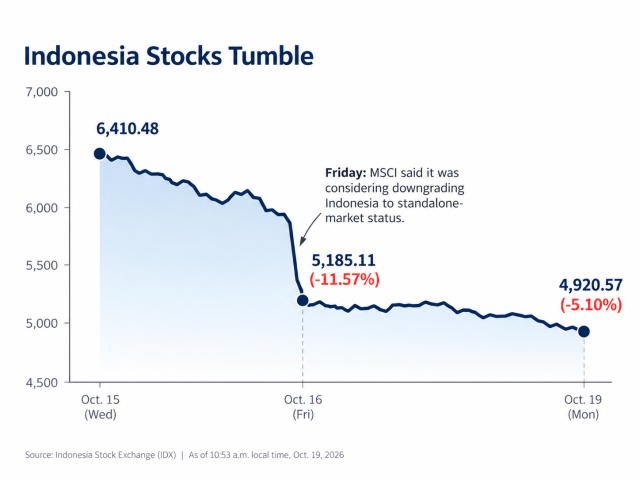
The selloff triggered a temporary trading halt and left the benchmark down about 40 percent this year. It fell a further 4 percent Monday, while the rupiah weakened to around 18,070 per dollar, near a record low.
“This is not a collapse of Indonesia’s economic fundamentals, but a crisis of market governance and investor trust,” said Kim Dae-jong, an economics professor at Sejong University.
Yang Jun-sok, an economics professor at the Catholic University of Korea, said the market’s weaknesses predated the latest shock.
“These problems have been building for at least a year, if not longer,” Yang said. “The rupiah had already been weakening, and MSCI’s latest warning only made matters worse.”
Indonesia’s benchmark had climbed above 9,100 to a record in January, buoyed by the appeal of a large consumer market, abundant natural resources and ambitions to expand manufacturing. The rally masked longstanding concerns over who owned listed shares, how freely those shares traded and whether prices could be trusted.
MSCI brought those concerns into focus in late January, questioning the transparency of share ownership and the amount of stock genuinely available for public trading. It also flagged coordinated trading that could distort prices.
Regulatory investigations have underscored the problem. In March, Indonesia’s Financial Services Authority announced a probe into suspected manipulation of PT Berkah Beton Sadaya shares between 2020 and 2022. Investigators said transactions involving affiliated companies and shareholders acting for others may have helped drive the stock up about 7,150 percent.
The regulator said in February that it had fined 151 parties a combined 240.65 billion rupiah for stock manipulation between 2022 and January 2026. Another 32 suspected cases involving artificial trading and pre-arranged transactions were under investigation.
MSCI did not identify individual cases. Its concerns centered on opaque ownership, suspected coordinated trading and weak enforcement.
In June, it retained Indonesia’s emerging-market classification but warned that insufficient reform by November could prompt a reassessment. Four months later, it proposed moving the country directly to standalone status, bypassing the frontier-market category.
MSCI said reforms had yet to produce lasting improvements in transparency and enforcement. Consultation runs until April 30, 2027, with a final decision expected by the end of June.
The stakes extend beyond the label. Funds that replicate MSCI indexes could have to sell Indonesian shares regardless of the underlying companies’ earnings or prospects. Goldman Sachs estimates potential selling by passive funds alone at about $5.6 billion.
“The prospect of a direct downgrade to standalone status has raised fears that passive funds could be forced to sell large amounts of Indonesian stocks,” Kim said.
Doubts over economic policy have compounded the loss of confidence. Moody’s and Fitch revised Indonesia’s sovereign credit outlooks to negative from stable in February and March, respectively, citing growing policy uncertainty. Both retained their investment-grade ratings.
Investors have questioned the fiscal cost of President Prabowo Subianto’s free meals program for students and pregnant women, launched in January 2025. Higher oil prices and U.S. interest rates have meanwhile pressured the rupiah, narrowing the central bank’s room to cut rates without encouraging further capital flight.
Bank Indonesia has sought to support the currency and attract foreign investment. The government has pledged to keep the budget deficit within the legal ceiling of 3 percent of gross domestic product.
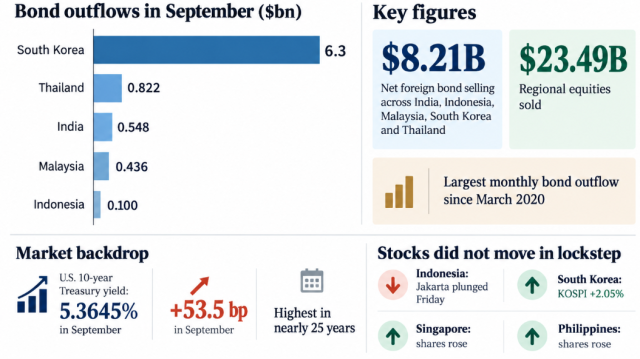
Across Asia, the retreat of foreign money began well before Indonesia’s latest collapse.
Overseas investors sold a net $8.21 billion of bonds in India, Indonesia, Malaysia, South Korea and Thailand in September, the largest monthly withdrawal since March 2020. They also sold about $23.49 billion of regional equities, according to regulatory and market data.
South Korea accounted for $6.3 billion of the bond outflows, the largest among the five markets.
The common pressure came from U.S. Treasuries. The 10-year yield rose 53.5 basis points in September to 5.3645 percent, its highest in nearly 25 years, raising the return investors could earn without taking on the additional risks of Asian markets.
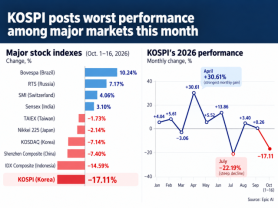
Yet regional stocks have not moved in lockstep. As Jakarta plunged Friday, South Korea’s KOSPI rebounded 2.05 percent. Singapore and Philippine shares also advanced.
Kim described the divergence as selective rebalancing.
“Investors are reducing their exposure to markets with weak governance or high valuations,” he said.
Some money leaving Indonesia could find its way into other Asian markets, he added.
That does not make Seoul a haven from the selling. The KOSPI lost about a fifth of its value over seven consecutive declining sessions through Oct. 15, capped by a 7.57 percent plunge to 5,554.22. Even after Friday’s rebound, it was down 17.1 percent for the month.
The vulnerability lies in what drove the earlier rally: expectations that AI spending would keep delivering exceptional profits for Korean chipmakers.
Stronger U.S. inflation and the prospect of faster monetary tightening have sharpened concerns over the cost of debt-financed AI investment. A slowdown in data-center construction would threaten the demand on which much of Korea’s manufacturing windfall rests.
“Indonesia faces problems with stock market transparency, while South Korea is grappling with concerns over AI profitability and semiconductor valuations. China, meanwhile, is struggling with weak domestic demand and a prolonged property downturn,” Kim said.
Yang likewise distinguished Korea’s earnings and valuation risks from Indonesia’s loss of market credibility.
“Samsung Electronics and SK hynix are still expected to perform well for the time being,” he said. “I don’t expect foreign capital to leave Korea for the same reasons it is leaving Indonesia.”
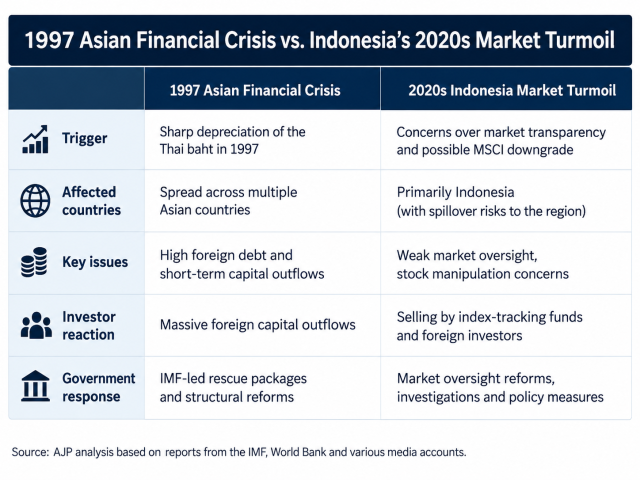
The distinction from 1997 is also structural.
That crisis began when Thailand abandoned its defense of the baht after speculative pressure depleted its foreign exchange reserves. Investors then questioned whether other fast-growing Asian economies could repay their overseas debts.
Pressure spread through Indonesia, Malaysia and the Philippines before reaching South Korea, where banks and companies struggled to refinance short-term foreign borrowings. Seoul sought emergency assistance from the International Monetary Fund in November 1997.
“In 1997, countries struggled to defend fixed exchange rates as foreign reserves ran low,” Kim said. “Today, more flexible exchange rates, larger foreign exchange reserves and stronger banks help economies withstand external shocks.”
Indonesia held $146.3 billion in foreign exchange reserves at the end of September, sufficient to cover 5.3 months of imports, according to Bank Indonesia. South Korea held $440.56 billion.
Those defenses give policymakers more room to absorb market shocks. They do not remove the danger that distrust could spread.
“If allegations of market manipulation, insider dealing or corruption emerge in Thailand or Malaysia, investors will start looking much more closely,” Yang warned.
For now, Indonesia’s crisis of confidence and Korea’s AI-driven correction remain distinct. But both face pressure from higher U.S. yields drawing foreign money out of Asian markets and the urgency to win back foreign confidence.

Copyright ⓒ Aju Press All rights reserved.