

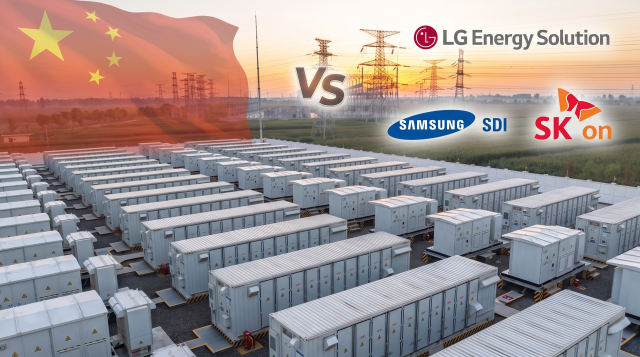
Major Chinese energy storage system (ESS) suppliers have largely withdrawn from U.S. operations this year, Taiwanese media (name), citing U.S. supply chain sources.
The reports attributed the retreat to mounting regulatory restrictions, overlapping tariffs and tighter scrutiny of corporate ownership.
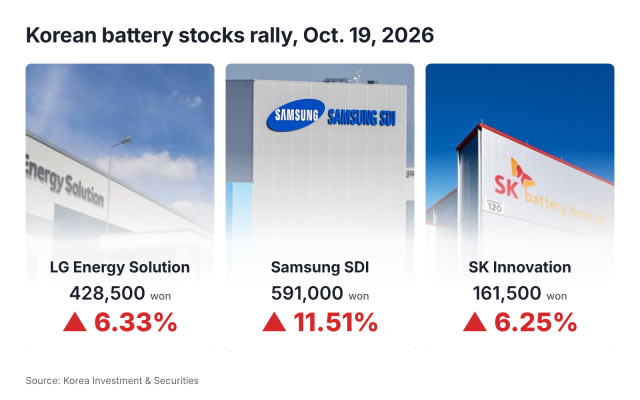
Korean battery shares rallied Monday despite a decline in the benchmark KOSPI, as investors weighed the prospect of reduced Chinese competition alongside hopes for a recovery in electric vehicle demand.
"It's a mix of factors. Chinese batteries had dominated the U.S. ESS market, but the Trump administration issued an executive order shutting out Chinese products on security grounds," said Han Byung-hwa, a battery analyst at Eugene Investment & Securities.
The potential opening is substantial. China's CATL and Hithium accounted for 38.8 percent and 17.2 percent, respectively, of batteries shipped to North America's ESS market in the first half, according to SNE Research.
LG Energy Solution held 13.6 percent and Samsung SDI 6.1 percent.
Several policy changes are reshaping that market.
The U.S. Section 301 tariff on Chinese lithium-ion batteries for non-vehicle use rose from 7.5 percent to 25 percent in January. Storage projects seeking federal tax credits also face restrictions on material assistance from prohibited foreign entities, including covered Chinese companies.
President Donald Trump tightened the pressure on Aug. 26 with Executive Order 14421, which gives the Energy Department authority to restrict transactions involving foreign-produced grid equipment deemed to pose national security risks.
The order covers battery storage systems and allows the department to require the replacement or removal of existing equipment where the specified risks are identified. It does not automatically require all Chinese batteries already installed to be retired. Implementing rules are due within 120 days of the order, in late December.
Beijing has imposed constraints of its own. Last year, China added certain lithium iron phosphate (LFP) cathode production technologies to its restricted-export list, placing controls on the transfer of that know-how overseas.
LG Energy Solution is already seeing the benefit. Its third-quarter operating profit rose 25.7 percent from a year earlier to 756 billion won ($569.2 million), on record quarterly sales of 9.64 trillion won, according to preliminary results released Oct. 8.
The company credited higher ESS shipments to North America.
Excluding 416.9 billion won in U.S. production tax credits, operating profit stood at 339.1 billion won, about three times the second-quarter figure. LG Energy Solution aims to have more than 50 gigawatt-hours (GWh) of ESS production capacity in North America by year-end.
Its Michigan plant, central to that expansion, has been converted entirely to LFP cells. In May, the company signed a $1.8 billion agreement to supply 6 GWh of storage batteries to Michigan utility DTE Energy. On Sept. 30, it announced a master supply agreement with Canadian storage integrator Eneon.
Samsung SDI is set to begin mass production of prismatic LFP storage cells this month at StarPlus Energy, its joint venture with Stellantis in Kokomo, Indiana.
Last December, it secured an order worth more than 2 trillion won to supply a U.S. energy infrastructure company from 2027 through 2030.
Samsung SDI Executive Vice President Cho Yong-hwi said on a July 30 earnings call that secured U.S. ESS orders already accounted for a large share of production capacity through 2029.
Including orders anticipated in the second half, "demand is projected to exceed our production capacity from 2028 onward," he said.
Analysts expect Samsung SDI to report third-quarter operating profit of 165.4 billion won, reversing a year-earlier loss, according to an FnGuide consensus. Results are due Oct. 29.
SK On, the battery unit of SK Innovation, faces a more difficult transition.
The company agreed in August to supply about 9 GWh of LFP batteries to NeoVolta Power over five years from 2027, in a deal valued at about 1.5 trillion won. Its storage production lines in Georgia and Tennessee, however, are still ramping up.
Meritz Securities forecasts a third-quarter operating loss of 179.4 billion won, wider than a year earlier. The one-off gains that lifted second-quarter operating profit to 821.8 billion won are not expected to recur.
Beyond storage, investors are also weighing the possibility of a more favorable U.S. policy environment for electric vehicles.
"If Democrats win the U.S. midterm elections, the EV purchase subsidy that Washington scrapped might come back as the House reworks the budget, and that expectation has helped lift share prices," Han said.
He expects the U.S. EV market to return to growth next year.
"With Chinese batteries blocked in the U.S., any improvement there, whether EVs come back or not, is good for Korean companies. From next year, K-batteries are entering a second golden age," he said.
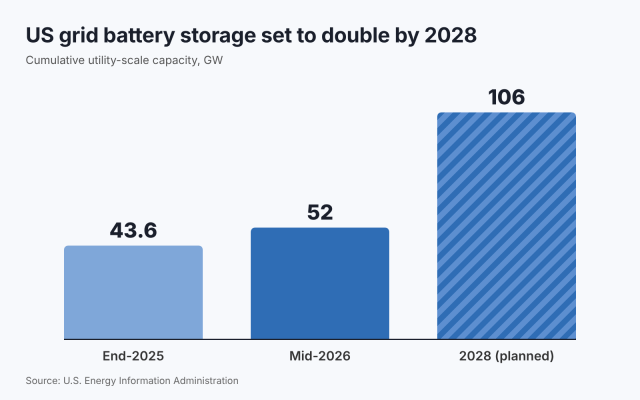
"China's lithium battery exports rose 36 percent in the first three quarters, as gains elsewhere offset lower U.S. shipments. CATL's share of the EV battery market outside China rose to 34 percent from 29 percent, while the combined overseas share of Korea's three makers fell to 27 percent from 38 percent," said Kim Hyun-soo, an analyst at Hana Securities.
AJP Takeaways
- Chinese energy storage suppliers have pulled out of nearly all U.S. operations in 2026, citing regulation, tariffs and ownership scrutiny.
- CATL and Hithium held a combined 56 percent of North American ESS battery shipments in the first half of 2026, according to SNE Research. LG Energy Solution held 13.6 percent and Samsung SDI 6.1 percent.
- Samsung SDI shares rose 11.51 percent and LG Energy Solution 6.33 percent on Oct. 19, 2026. Eugene Investment & Securities analyst Han Byung-hwa expects Korean battery makers to enter a "second golden age" from 2027.
- Outside the U.S., Korea's three battery makers saw their combined EV battery share fall to 27 percent from 38 percent, while CATL's rose to 34 percent, according to Hana Securities.
Copyright ⓒ Aju Press All rights reserved.
