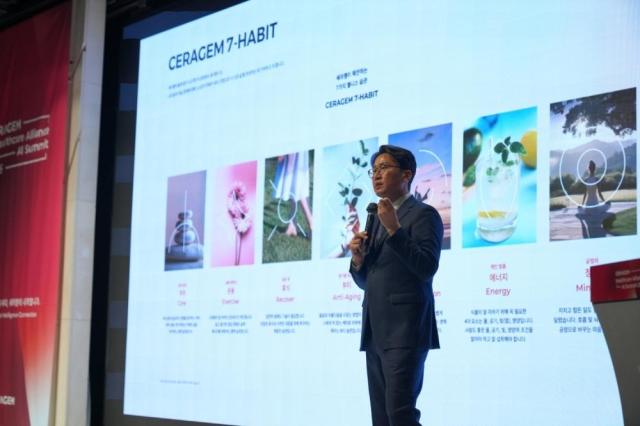
SEOUL, October 20 (AJP) - In a country where corporate empires are often passed from one generation to the next, South Korean healthcare company Ceragem is taking an unusual approach: its founder has made a longtime professional manager his legal son to hand over the business.
Ceragem said Tuesday that founder and Chairman Lee Hwan-sung adopted CEO Lee Kyung-soo last year and transferred 10 percent of the company's outstanding shares to him this year, marking the first step in a long-term ownership succession plan.
The arrangement challenges South Korea's traditional family-controlled business model, under which company ownership typically remains with a founder's descendants, even when professional managers oversee daily operations.
Rather than choosing a successor based on blood ties, Lee selected an executive who had spent more than two decades working his way through the company.
But the decision also presents an unusual paradox: to transfer ownership outside his biological family, the founder first brought his chosen successor legally into it.
The younger Lee joined Ceragem in 2003 as an entry-level employee, working in strategic planning, marketing and overseas sales before taking charge of the company's domestic operations in 2018.
He helped expand Ceragem beyond its traditional spinal-care medical devices into the broader home healthcare market. The company also introduced Wellcafe, combining retail spaces with cafes where customers can experience its products.
Lee became CEO in 2022, taking responsibility for a business seeking to diversify beyond its established product lines.
Ceragem reported revenue of 549.8 billion won ($414 million) in 2025, up 0.7 percent from a year earlier. Operating profit jumped more than elevenfold to 25.8 billion won, according to the company's April earnings announcement.
The improvement followed investments in new healthcare products and efforts to restructure its business, although revenue growth remained modest.
The succession therefore comes as Ceragem seeks to strengthen profitability and expand its presence in AI-powered home healthcare services.
The founder, who has one biological daughter, held a 60.5 percent stake in the company according to last year's disclosure. A substantial portion of ownership therefore remains under his control, leaving the timing and structure of future transfers unresolved.
Ceragem said the decision reflected the CEO's management record and understanding of the business, rather than a preference for blood relations.
Under South Korean law, adoption gives the CEO the legal standing of a child, including inheritance rights. That makes the arrangement different from simply appointing an outside executive or granting a performance-based stock award.
The company said the adoption was not intended to obtain tax benefits and that the relevant business succession tax incentives were unavailable under its circumstances.
For Ceragem, the challenge now goes beyond choosing a successor. It must complete the transfer of ownership while maintaining the management stability that prompted the decision.
The case also highlights a broader question for South Korea's corporate sector: whether leadership can be chosen on professional merit without abandoning the family-based ownership structures that have long shaped the country's businesses.
Copyright ⓒ Aju Press All rights reserved.