
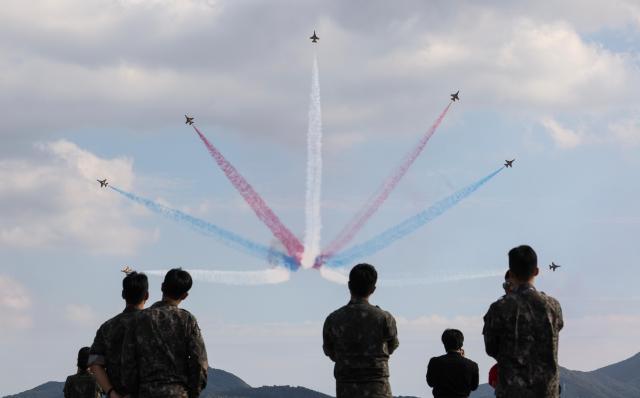
The Republic of Korea Air Force's aerobatic team, the Black Eagles, performs an aerial demonstration during a press day for the 2026 Sacheon Airshow at Sacheon Air Base in South Gyeongsang Province, South Korea, on Oct. 21, 2026.
The four-day airshow will take place from Oct. 22 to 25, jointly hosted by the Republic of Korea Air Force, South Gyeongsang Province, Sacheon City and Korea Aerospace Industries.
Yoo Na-hyun
Photojournalist, AJU PRESS (AJP) Covering news, culture and society in South Korea through an Asian perspective.
Copyright ⓒ Aju Press All rights reserved.
Related News
-
 Court Denies Request to Cancel Detention of Kim Hyun-tae, Former Army Commander
Kim Hyun-tae, the former commander of the Army's 707th Special Mission Battalion, was sentenced to 12 years in prison for his involvement in the blockade of the National Assembly during the emergency martial law on December 3. He requested the cancellation of his detention, but the court denied his request.According to legal sources on November 13, the Seoul High Court's Criminal Division 12-2, consisting of judges Jo Jin-goo, Kim Min-a, and Lee Seung-cheol, rejected Kim's request for detention cancellation on November 12.Detention cancellation occurs when there are no grounds for detention, such as flight risk or evidence tampering, leading the court to release the defendant.Former President Yoon Suk Yeol, who was detained on charges of being a leader of a rebellion last January, had his request for detention cancellation granted by the court, resulting in his release from March to June of that year.In August, Kim Hyun-tae was sentenced to 12 years in prison for leading troops to blockade the National Assembly during the martial law and was subsequently detained. He applied for bail last month, but it was denied, prompting him to seek cancellation of his detention.During the first preparatory hearing for his appeal on November 2, Kim's legal team argued for his release, claiming that the composition of the first trial panel was unlawful. They contended that the law governing the special tribunal for rebellion, foreign exchange, and insurrection crimes is unconstitutional, thus questioning the court's authority.In this context, Kim's legal team has requested a constitutional review of the special tribunal law.Kim has completely denied the charges of involvement in rebellion, stating, "There was no intent to disrupt the constitution, nor was there any awareness of a riot." He also requested an on-site verification at the National Assembly, but the court expressed skepticism about its necessity, noting that the movements and actions at the time are already verifiable through evidence.The first hearing for Kim's appeal is scheduled for November 17.* This article has been translated by AI.
-
Debate Over Relocation of Army Academy Resurfaces Amid Military and Educational Goals
The debate over relocating the Army Academy has resurfaced alongside discussions about the establishment of the National Military Academy. Previously, proposals for relocation were based on regional development, balanced national growth, and housing supply in Seoul. This time, the military and educational goal of enhancing jointness has been added. However, as discussions on educational system reforms evolve, concerns arise that the focus on relocation may overshadow the necessary conditions for training officers.The idea of relocating the Army Academy has been publicly raised since 2004. However, most proposals from politicians and local governments have not progressed to actionable plans due to insufficient review and alternatives.During the Roh Moo-hyun administration, Nowon District included the relocation of the Army Academy in its long-term development plan, proposing the development of tourism and leisure facilities based on the academy's site. This plan aimed to promote regional development, but it was not realized as the Ministry of National Defense expressed opposition to the relocation.In 2005, some members of the government and the then-ruling Open Uri Party suggested the need for relocating the Army Academy as part of a plan for developing the metropolitan area. However, then-Minister of National Defense Yoon Kwang-woong stated on May 25 that year during a National Assembly budget committee meeting that "it is not the time to consider relocating the Army Academy," affirming its retention in Seoul.Under the Moon Jae-in administration, the need for housing supply revived discussions on relocation. In October 2018, then-Lawmaker Ha Tae-kyung proposed utilizing the Army Academy and the Taereung Golf Course site for housing supply during a National Defense Committee audit. Then-Minister of National Defense Jeong Kyeong-doo acknowledged the need for consensus but stated there were no plans for relocation. Although proposals emerged, they did not lead to a government decision on relocation.In 2020, as discussions on developing the Taereung Golf Course intensified, calls to also utilize the adjacent Army Academy site grew. Gyeonggi Province suggested relocating the academy to the northern border area to use the existing site for housing supply and support underdeveloped regions. Other local governments, including Chungcheongnam-do, also entered the competition, advocating for the relocation based on connections with military educational institutions and regional economic revitalization.However, the government distinguished between the relocation of the Army Academy and the development of the Taereung Golf Course. Then-Prime Minister Jeong Se-kyun stated in July 2020 that the Army Academy site would not be considered for housing supply. Then-Minister of Land, Infrastructure and Transport Noh Hyung-wook explained in August 2021 that discussions on utilizing the Army Academy site could not proceed due to strong opposition from the Ministry of National Defense. The rationale for securing land for housing supply did not translate into inter-departmental agreement on relocating the military educational institution.The 2022 presidential election saw a competition over promises regarding potential relocation sites. Lee Jae-myung, then the Democratic Party candidate, pledged on February 1 to relocate the academy to Andong, citing the historical significance of the anti-Japanese movement and the potential for revitalizing the local economy by utilizing the former 36th Division site. Yang Seung-jo, then-Governor of Chungcheongnam-do, who was advocating for relocation to Nonsan, demanded a review, stating he had not received prior consultation.During the transition to the Yoon Suk-yeol administration, discrepancies emerged. The Special Committee on Regional Balanced Development announced a pledge and policy task for relocating the Army Academy to Chungcheongnam-do. However, then-Minister of National Defense Lee Jong-seop stated during the October 2022 National Defense Committee audit that it was not included in the 120 key national tasks and opposed the relocation.The Chungcheongnam-do Promotion Committee expressed opposition, arguing that the presidential pledge they accepted was not reflected in the plans of the relevant ministry. This situation illustrates a growing gap between regional expectations and political promises before establishing a common understanding of the necessity and educational effectiveness of the relocation.The current government's justification differs from the past. In July, the Ministry of National Defense announced a basic plan to establish the National Military Academy in Daejeon to enhance jointness and train officers capable of responding to future warfare. Recently, there has been consideration of a network model linking the integrated main campus with educational facilities from each military branch.According to explanations provided to the National Assembly, options are being considered for relocating only the Army Academy to the Chungcheong region while utilizing existing facilities of the Naval Academy and Air Force Academy, along with a '1+2+1' educational curriculum.However, the Ministry of National Defense maintains that the status, location, and curriculum of each military academy have not been finalized. Defense Ministry spokesperson Jeong Bit-na explained during a briefing on the 12th that the goal of establishing the National Military Academy remains unchanged, describing the refinement of the basic plan as a process to enhance policy acceptance and completeness. She stated that actual project costs would be determined through preliminary research.The key issue is whether the need for integrated education can substantiate the necessity of relocating the Army Academy. If jointness can be enhanced through a method that connects dispersed educational facilities, then the compromise of relocating only the Army Academy may lack persuasive power.The repeated proposals for relocation that have not been implemented highlight the limitations of policies that have failed to adequately reconcile political proposals with the educational and operational needs of the military. To avoid repeating the same process in this discussion, it is essential to first address what kind of officer training system is needed and how relocation contributes to that goal before deciding where to move.* This article has been translated by AI.
-
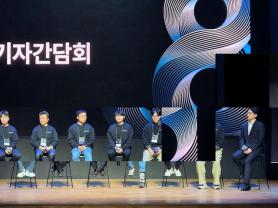 Samsung Electronics' startup army marches into robotics
From right: Samsung Electronics C-Lab's Park Nam-hyun, The Dimension Company CEO Lee Ray, PiaSpace Vice President Park Sung-hyuk, Doctors Biotech CEO Nam Sung-woo, Nanoforge AI CEO Kim Dong-hyun and Config Intelligence CEO Seo Min-jun. Candice Kim SEOUL, November 10 (AJP) - Samsung Electronics commanding an empire in memory chips and smart devices big and small aspires to extend its reach into robotics — with help from its army of startups. Thirty startups showcased their latest innovations at C-Lab Demo Day at Samsung Electronics’ Seoul R&D campus on Tuesday, offering a glimpse of technologies that could eventually enter the company’s factories and consumer products. From robotic skin and AI-assisted engineering to wearable walking aids and digital healthcare, the exhibits showed both the possibilities emerging from research laboratories and the work still needed to turn them into viable businesses. One of the more striking demonstrations came from MIDAS H&T, a Korean startup developing electronic skin that allows robots to detect physical contact. Midas H&T's flexible tactile sensors displayed at Samsung Electronics C-Lab Demo Day / AJP Candice Kim Its flexible tactile sensors, roughly 0.5 millimeters thick, can stretch across robotic fingers and palms to detect pressure over surfaces that conventional rigid sensors struggle to cover. The technology could help robots handle delicate objects, from eggs to electronic components, without crushing or damaging them. "Humans can tell where their hands are being touched or pressed, but robots cannot easily do that," Steve Chang, CEO of Midas H&T told AJP, explaining that the sensors are designed to give robotic hands a sense of touch. Steve Chang, CEO of Midas H&T answers questions from reporters / AJP Candice Kim MIDAS H&T is working with Samsung Electronics’ Future Robotics Office to test the sensors on robotic hands, with commercial production targeted for next year. The technology remains at the proof-of-concept stage. But it reflects a broader ambition in robotics: machines that can feel their surroundings as well as see them. Another robotics startup, Config Intelligence, is tackling a different challenge — teaching robots to perform tasks using data drawn from human movements. The company said it had developed technology that converts human hand movements into training data for five-fingered robotic hands, reducing reliance on data gathered directly from robots. CEO Seo Min-jun said an internal benchmark showed that combining real robot data with converted human movement data improved task performance compared with using either dataset alone. The company plans to expand its training dataset from roughly 100,000 tasks to 1 million by year-end. Seo acknowledged, however, that further development is needed before the technology can be deployed reliably in industrial settings. Config Intelligence has attracted 50 billion won in cumulative investment, including funding from Samsung Venture Investment, and is collaborating with Samsung on robotics technology. AI is also making its way into Samsung’s appliance development process. The Dimension Company, another C-Lab participant, said it had worked with Samsung’s home appliance division to reverse-engineer about 10 components used in products including refrigerators and washing machines. Reverse engineering reconstructs a component’s design from an existing part. CEO Lee Ray said the startup’s AI-based approach had reduced certain tasks from an estimated two to three months to several hours. The company is now testing more advanced design applications, although the technology has yet to reach evaluation for mass production. Beyond robotics and manufacturing, healthcare startups demonstrated technologies intended to address everyday medical and mobility needs. Rebodis showcased a wearable robotic device designed to assist older adults and people with mobility difficulties. Weighing about 1.8 kilograms, it aims to make walking and other physical activities easier without the bulk of conventional robotic assistance systems. Rebodis' ReboStep wearable device is displayed on a mannequin's knee / AJP Candice Kim A company representative said Rebodis was preparing a crowdfunding campaign in Japan early next year as it explores commercial opportunities. Digital healthcare startup Lansik demonstrated an AI-powered platform that analyzes data from continuous glucose monitors to predict how an individual’s blood sugar may respond to different foods. Doctors Biotech, founded by pediatrician Nam Sung-woo, presented technology that analyzes respiratory sounds through an ordinary smartphone, potentially helping parents monitor their children’s symptoms outside hospitals. Nam said the company was nearing the final stages of the medical device approval process and hoped for a decision within six months. Resorius, founded by four Seoul National University medical graduates, is developing AI tools to analyze brainwave data and support research into neurological disorders. Co-founder and Chief Technology Officer Jang Jun-ho said the company’s aim was to shorten the long journey from medical research to treatments that could reach more patients. For Samsung, the exhibition also demonstrated how its startup program is expanding beyond funding and mentoring to connect young companies with potential customers and development partners within the group. Samsung Electronics President Park Seung-hee said some C-Lab startups had secured investment from Samsung or become business partners, illustrating the program’s role in bringing emerging technologies into established businesses. Park Nam-hyun, who oversees C-Lab Outside, said Samsung business executives participate in selecting startups. The program then spends three to five months arranging meetings with relevant Samsung divisions to explore potential technology verification projects. Some collaborations have already moved into practical use. Park said water treatment technology developed by Geogrid was being used at Samsung’s Suwon campus. Other startups had worked with Samsung’s overseas operations on building management and industrial Internet of Things solutions, which connect equipment and sensors to monitor operations. Of the 30 startups participating in this year’s event, 15 are conducting technology verification projects with Samsung. The event also marked a milestone for C-Lab, which has supported 1,000 internal venture projects and external startups since its launch in 2012. The total comprises 434 internal projects and 566 external startups. Selected C-Lab Outside startups receive up to 100 million won in funding without giving up equity, along with technical consulting, workspace and opportunities to collaborate with Samsung businesses. For the startups gathered in Seoul, access to Samsung offers a chance to test their inventions against the demands of a working factory or a consumer product. The next test is commercial: whether robotic skin, human movement data and AI-assisted design can perform reliably beyond the demonstration floor. For Samsung, that will determine how much of its next technological expansion this startup army can deliver.