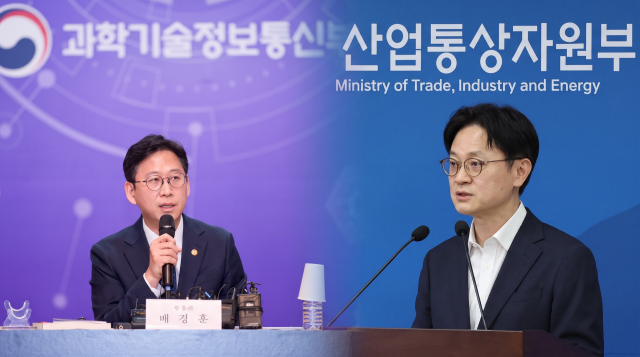
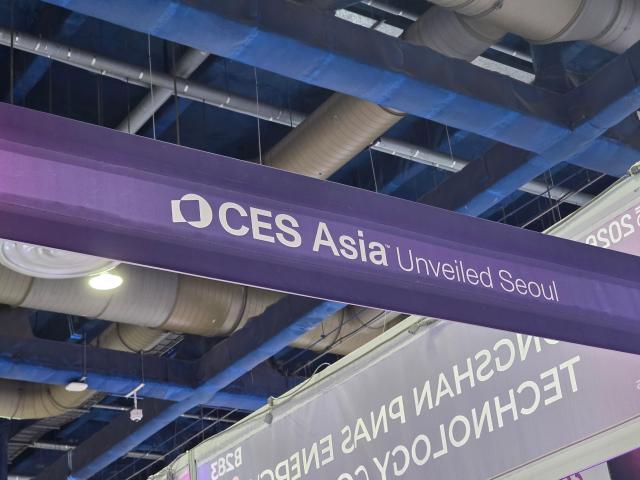
On Oct. 13, the science and industry ministries hosted separate physical AI showcases two floors apart at Seoul's COEX.
The Ministry of Trade, Industry and Resources sponsored the Korea Electronics Show with "CES Asia Unveiled Seoul," while the Ministry of Science and ICT ran its Physical AI Tech Week upstairs, where Deputy Prime Minister Bae Kyung-hoon toured robot and AI chip booths.
"We must pool the full capabilities of the government and the private sector to build a Korean-style AI ecosystem with speed," President Lee Jae Myung said at Cheong Wa Dae on June 29, pressing his goal of making Korea one of the world's top three AI powers.
The goal is shared, but who steers the government's AI ambitions remains unclear.
Bae and Trade, Industry and Resources Minister Kim Jung-kwan shared the stage at that June briefing. Yet each ministry's plan called for an AI foundation model of its own.
Bae pledged a general-purpose physical AI foundation model within three years. Physical AI enables machines such as robots to perceive and act in the real world.
A manufacturing AI strategy led by Kim's ministry, backed by 20 trillion won ($15 billion) in public and private funding through 2030, called for a separate manufacturing AI foundation model.
The same split runs through a 2.3 trillion won government humanoid plan unveiled on Aug. 27. It assigns the science ministry a general-purpose robot model and the industry ministry a lightweight model for factory tasks, which it plans to develop into a general-purpose model over time.
"If universities, research institutes, large companies and the government move separately, we cannot catch up with a formidable competitor called China," Kim said at a Korea Enterprises Federation forum on June 26, three days before the Cheong Wa Dae briefing.
Joint action has largely come when the stakes turned global, as with Nvidia's October 2025 pledge to supply more than 260,000 graphics processing units, or GPUs.
Bae told lawmakers on Oct. 6 that past physical AI investment had been "woefully short" and that he would expand it with the industry ministry.
But the ministries' data plans also run on separate tracks.
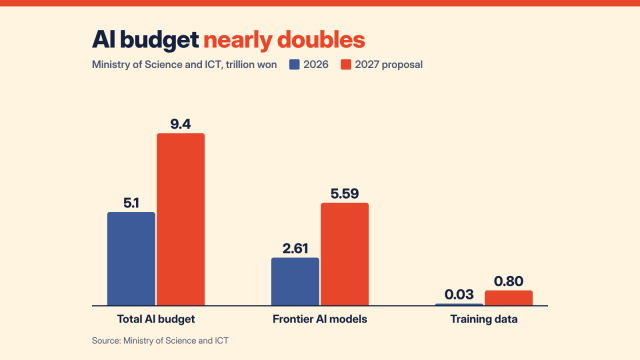
The industry ministry plans a national data library to keep factory data at home and aims to have more than 200 AI factories operating by year-end. The science ministry has sought 800 billion won next year for model training data.
Neither plan, as announced, explains how the two will connect.
"Take a car. If you build the engine separately and the transmission separately, what are you going to do with it?" said Cho Dong-keun, professor emeritus of economics at Myongji University. Companies are left unsure which ministry's door to knock on, he added.
Japan has taken a more consolidated approach. Its industry ministry committed about 1 trillion yen ($6.34 billion) on June 30 through fiscal 2030 to Noetra, a single venture backed by SoftBank, Sony, NEC and Honda. The venture will build a physical AI model that manufacturers can train on their own data.
In the United States, OpenAI, Anthropic and Google built their frontier models with private capital, while SpaceX carries NASA astronauts under contract.
South Korea's big technology bets still put the state in front.
The state-funded Korea Institute of Machinery and Materials leads the country's KAIROS humanoid project.
The sovereign AI model race is itself a government contest in which companies compete for state-backed GPUs. That state-led approach is closer to China's, although Beijing's State Council issued a single "AI Plus" blueprint covering all sectors in August 2025.
"The private sector is not there to be guided. The government needs to be willing to accept its lead," Cho said. "This is a time to solve calculus. You cannot come at it with the multiplication table and try to teach."
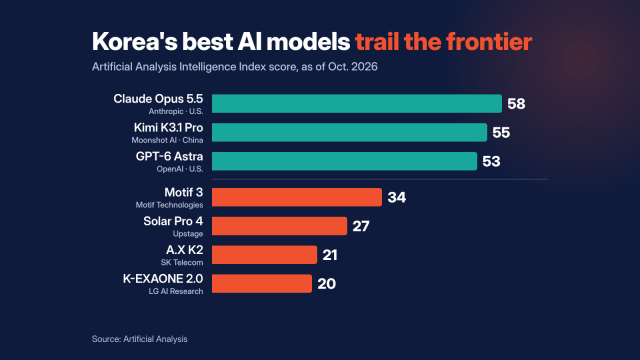
"The results through the second stage are at about the midpoint of the global level," Bae said on Oct. 6.
The science ministry's other flagship, "AI for All," a free AI service run by SK Telecom, KT and Kakao, entered closed beta testing on Oct. 16. Their competing versions draw on a patchwork of Korean models, including two eliminated from the sovereign AI project.
"If AI for All fails to create a clear edge over foreign AI services, I think it will fail," Bae said at the project's launch briefing on Sept. 4.
Foreign AI companies, meanwhile, are making their own pitches for a place in Korea's sovereign AI ambitions.
Palantir Technologies offered its answer at a sovereign AI-themed pop-up store in Seoul's Hannam-dong on Oct. 22 and 23, where the U.S. data analytics firm briefed reporters on why Korea matters.
"Physical manufacturing and industrial field work are areas AI does not yet adequately support," said Akshay Krishnaswamy, Palantir's chief architect. Korean manufacturers could build or fine-tune their own factory AI models using that know-how, he added.
"Sovereign AI goes beyond simply choosing a Korean-style model," said Chad Wahlquist, Palantir's head of AI architecture.
Canada's Cohere plans a Korean subsidiary this year, while France's Mistral AI is hiring in Seoul.
Fans began lining up in Hannam-dong about 90 minutes before Palantir's doors opened for a pop-up featuring clothing with sovereign AI designs. The sovereignty on sale came with an American label.
"If you want to go fast, go alone, but if you want to go far, go together," he said.
The industry ministry's show was two floors below.
AJP Takeaways
- South Korea's Ministry of Trade, Industry and Resources and Ministry of Science and ICT held separate physical AI events at Seoul's COEX on Oct. 13, 2026, after presenting separate physical AI and manufacturing AI plans, each with its own foundation model, on June 29.
- A 2.3 trillion won humanoid plan announced on Aug. 27, 2026, assigns the science ministry a general-purpose robot model and the industry ministry an industry-specific one, while Japan's industry ministry committed about 1 trillion yen on June 30, 2026, to a single physical AI venture, Noetra.
- Upstage, SK Telecom and LG AI Research remain in the science ministry's sovereign AI foundation model project, with two finalists due around mid-February 2027, while SK Telecom, KT and Kakao opened closed betas of the "Modu-ui AI" service on Oct. 16, 2026.
- Palantir Technologies held a sovereign AI-themed Seoul pop-up on Oct. 22-23, 2026, focusing on Korean manufacturing know-how, while Cohere plans a Korean subsidiary and Mistral AI is hiring in Seoul.
Copyright ⓒ Aju Press All rights reserved.