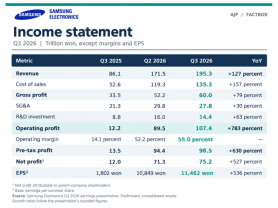
Samsung posted quarterly revenue of 195.3 trillion won and operating profit of 107.4 trillion won on Thursday, with its semiconductor division accounting for nearly all of its earnings.
The Device Solutions (DS) division generated 147.1 trillion won in revenue and 106.5 trillion won in operating profit, making up more than 99 percent of the company's total operating profit.
The figures highlight the strong profitability of Samsung's semiconductor business, driven by soaring memory prices and growing demand for advanced chips used in AI data centers.
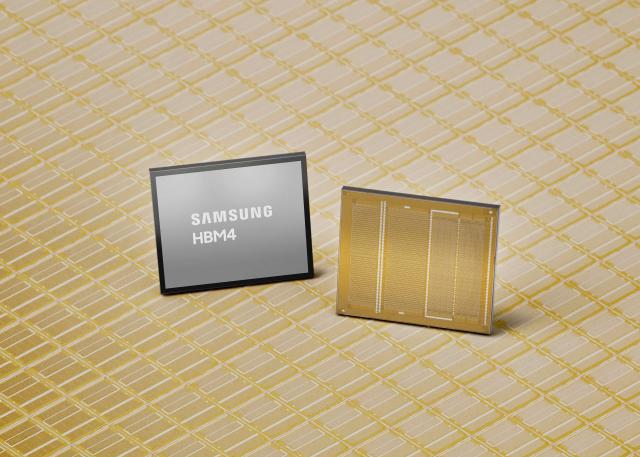
A closer look, however, reveals the importance of HBM4, the latest generation of high-bandwidth memory designed to meet the demands of powerful AI processors.
Samsung said its HBM4 revenue more than tripled from the previous quarter, with the product accounting for approximately 60 percent of its total HBM revenue. The company also said it appeared to have achieved its target of bringing its HBM market share in line with its broader DRAM market share.
According to Counterpoint Research, SK hynix accounted for 50 percent of global HBM revenue in the second quarter of 2026, down from 64 percent a year earlier. Samsung's share rose to 33 percent from 15 percent over the same period, while U.S. rival Micron Technology held approximately 18 percent.
The figures indicate that Samsung had been closing the gap even before its latest HBM4 sales acceleration, although independent third-quarter market share data have yet to confirm whether it has reached its latest target.
Lee Jong-hwan, a professor at Sangmyung University, said Samsung's latest results suggest it is narrowing the gap with SK hynix, though rising prices for conventional memory chips may also have played a significant role in its earnings growth.
"Conventional memory prices have risen substantially, and Samsung may have a larger share of that business," Lee told AJP.
The distinction is important because HBM, despite commanding premium prices, represents only part of the broader DRAM market. Samsung has not disclosed the precise proportion of HBM and conventional memory in its production or revenue, making it difficult to determine how much of its earnings surge came directly from the latest HBM generation.
Samsung nevertheless expressed confidence in its ability to secure a larger share of the advanced memory market.
"Negotiations for our 2027 HBM supply volumes have been completed at our target price levels, and the volumes are already sold out," Kim Jae-jun, vice president of memory business strategy and marketing, said during Thursday's earnings conference call.
Kim added that major customers continued to request additional supply.
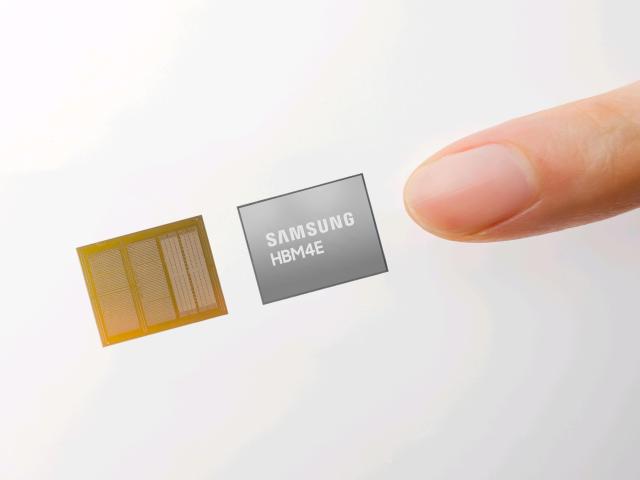
Samsung has already shipped samples of HBM4E, the next iteration of the technology, and plans to begin mass production in the first half of 2027 before expanding output in the second half.
The company is also seeking to leverage its ability to manufacture both memory chips and advanced logic chips, including the base dies that control HBM stacks, as the technology becomes more complex.
The company posted its third-quarter revenue of 104.62 trillion won and operating profit of 83.33 trillion won the previous day, achieving an operating margin of approximately 80 percent.
It expects HBM4 to overtake HBM3E in both shipment volume and revenue during the fourth quarter as production expands at its M15X facility.
SK hynix also said it had signed long-term supply agreements with 14 major customers, securing volumes equivalent to more than half its planned production capacity for 2027 and 2028.
It expects memory supply constraints to persist through 2030, reflecting its view that AI infrastructure investment will continue to outpace the industry's ability to expand production.
Micron is also seeking to strengthen its position in the three-way contest.
The U.S. chipmaker reported revenue of $54.23 billion and GAAP operating income of $43.75 billion for its fiscal fourth quarter ended Sept. 3. It has begun shipping HBM4 for a leading customer platform and is developing HBM4E products for 2027.
Although the three companies' earnings are not directly comparable because of differences in reporting periods and business scopes, their results illustrate the extraordinary profitability of the current memory cycle.
The boom is being reinforced by an unusual relationship between HBM production and conventional DRAM supply.
HBM is manufactured by vertically stacking multiple DRAM dies, requiring additional processing and consuming production capacity that could otherwise be used for conventional memory.
As chipmakers allocate more capacity to HBM, conventional DRAM supply becomes tighter, pushing up prices across the broader market.
Samsung said that the transition toward HBM4E and HBM5 would intensify these constraints, as larger die sizes and additional processing layers limit how quickly manufacturers can increase effective bit output.
The company expects tight memory supply conditions to continue through 2028, arguing that even a substantial increase in capital expenditure would not necessarily translate into an immediate expansion in production.
New semiconductor facilities require lengthy construction and equipment installation periods, while rising building costs and longer machinery lead times can inflate investment budgets without producing proportional increases in output.
Market researcher TrendForce also expects HBM prices to rise sharply in 2027 as the product mix shifts toward HBM4 and supply remains constrained, adding to expectations that the current boom could last longer than previous memory upcycles.
Lee said the shift toward HBM production was creating a powerful incentive for manufacturers to maintain supply discipline.
"When more capacity is allocated to HBM, conventional DRAM supply inevitably decreases," he said.
With memory prices already elevated, Samsung and SK hynix have little immediate incentive to rush into expanding production, he explained, particularly when constrained supply is helping sustain strong profitability.
That dynamic could prolong the upcycle, but Lee cautioned that the industry's established players cannot assume they will retain control over supply conditions indefinitely.
The biggest uncertainty, he said, is the rapid expansion of Chinese memory manufacturers, whose growing presence could eventually disrupt the favorable pricing environment enjoyed by South Korean producers.
Although Chinese competitors are unlikely to close the technological gap within a single year, their increasing production capabilities could put pressure on conventional memory prices and complicate supply strategies for Samsung and SK hynix.
Lee expects favorable market conditions to continue through 2027, provided demand for AI infrastructure remains strong.
The memory boom is already producing sharply contrasting results within Samsung itself.
While its semiconductor division generated extraordinary profits, the Device eXperience division, which makes smartphones, televisions and home appliances, posted an operating loss of 800 billion won as higher memory costs squeezed profitability.
Lee described the widening imbalance as a growing concern, noting that Samsung's success in memory was coming alongside deteriorating economics for its finished-product businesses.
The contrast highlights a central tension in the current cycle: the same memory price increases driving record profits for chipmakers are raising costs for manufacturers that depend on their products.
For Samsung, the latest earnings suggest its HBM recovery is gaining traction, but the broader competitive picture remains more complicated than a simple race to overtake SK hynix.
With HBM4 production accelerating, conventional DRAM prices surging and Chinese competitors expanding, the next phase of the memory boom will depend not only on technological leadership but also on how the industry's major suppliers balance capacity, pricing and investment against the continued growth of AI demand.

Copyright ⓒ Aju Press All rights reserved.