

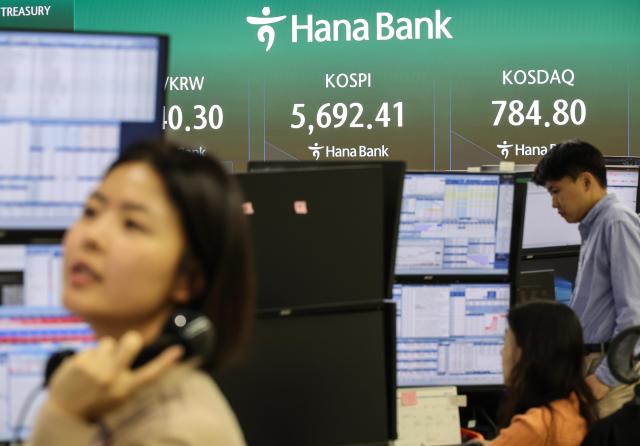
Chip giants Samsung Electronics and SK hynix led the decline, while retail investors absorbed selling by foreign and institutional investors.
The benchmark KOSPI stood at 5,682.59 as of around 9:30 a.m., down 3.01 percent from Monday's close of 5,859.08. The index opened 2.46 percent lower at 5,715.19 before extending losses below 5,700.
The decline reversed much of the previous session's 2.24 percent gain, when the index recovered from an early selloff on institutional buying despite weakness in U.S. chip stocks.
Retail investors bought a net 670.4 billion won (US$498 million) of KOSPI shares, while foreign investors sold a net 388.1 billion won and institutions unloaded 308.2 billion won. Decliners outnumbered advancers 649 to 197.
The selloff followed another decline in U.S. technology stocks overnight, as concerns grew over whether heavy AI spending would generate sustainable profits.
Oracle, a U.S. cloud computing and enterprise software giant, fell 8.8 percent after announcing plans to raise $20 billion through stock and bond sales to finance its AI infrastructure expansion, reviving concerns over the growing cost of the technology boom.
U.S. semiconductor stocks also suffered steep losses, with Intel dropping 8.83 percent, Advanced Micro Devices (AMD) losing 7.52 percent and Micron Technology falling 5.80 percent.
The Nasdaq Composite declined 1.07 percent to 25,164.32, while the S&P 500 slipped 0.51 percent to 7,541.40. The Dow Jones Industrial Average rose 0.41 percent to 51,983.98, supported by broader market gains as oil prices fell sharply amid hopes of progress in U.S.-Iran negotiations.
The weakness spilled into Seoul's semiconductor heavyweights.
Samsung Electronics, a leading global chipmaker, fell 4.04 percent to 219,750 won, while rival SK hynix, a major supplier of high-bandwidth memory (HBM) chips used in AI systems, dropped 4.62 percent to 1,404,000 won.
Samsung Electronics' preferred shares also declined 3.16 percent to 171,400 won, while SK Square, an investment holding company and major shareholder in SK hynix, shed 4.53 percent to 907,000 won.
Elsewhere in technology, Samsung Electro-Mechanics, which produces electronic components and semiconductor substrates, lost 2.60 percent to 1,162,000 won.
Selling extended to other major stocks. Hyundai Motor, South Korea's largest automaker, fell 2.96 percent to 278,500 won, while electric-vehicle battery maker LG Energy Solution slipped 1.26 percent to 351,500 won.
Samsung Biologics, a contract manufacturer of biopharmaceutical products, bucked the broader decline, rising 4.43 percent to 1,485,000 won.
The junior KOSDAQ index also fell 2.56 percent to 715.54, as losses spread across smaller technology stocks.
Retail investors purchased a net 143.7 billion won of KOSDAQ shares, while foreign investors sold 68.3 billion won and institutions offloaded 61.1 billion won. Decliners overwhelmed advancers 1,336 to 334.
Semiconductor-related companies were among the hardest hit. Jusung Engineering, a manufacturer of chipmaking equipment specializing in thin-film deposition technology, tumbled 5.48 percent to 158,800 won. SIMMTECH, a supplier of semiconductor packaging substrates and memory-module circuit boards, fell 3.49 percent to 116,200 won.
Battery-materials stocks also weakened. EcoPro, a holding company focused on battery materials, dropped 2.85 percent to 71,700 won, while its cathode-materials subsidiary EcoPro BM declined 2.50 percent to 89,800 won.
Rainbow Robotics, a developer of collaborative and humanoid robots, lost 2.76 percent to 352,500 won.
Among biotechnology stocks, Alteogen, a developer of technology that converts intravenous drugs into subcutaneous injections, edged up 0.23 percent to 213,500 won, bucking the market decline. HLB, a pharmaceutical and biotechnology group developing cancer treatments, fell 2.64 percent to 40,600 won.
The South Korean won meanwhile was little changed at 1,344 per U.S. dollar, compared with 1,343.8 at the previous close.
Tuesday's selloff highlighted the market's continued sensitivity to U.S. technology stocks, with doubts over AI spending weighing on investor sentiment despite strong earnings from South Korea's major memory-chip makers.
Investors are also watching Tuesday's U.S. midterm elections, with results expected Wednesday morning in South Korea. The outcome could reshape Washington's approach to AI regulation, government spending and industrial policy, adding another layer of uncertainty for South Korean chip shares.
Analysts expect the elections to ease some political uncertainty, potentially paving the way for foreign investors to return to Seoul's stock market. But renewed U.S.-Iran tensions, oil prices and interest rates remain key risks, while Friday's U.S. employment report could further influence expectations for Federal Reserve policy.

Copyright ⓒ Aju Press All rights reserved.
