

Please check the related infographic article -> AJP Factbox: What happened to Koreans at Sado mine?
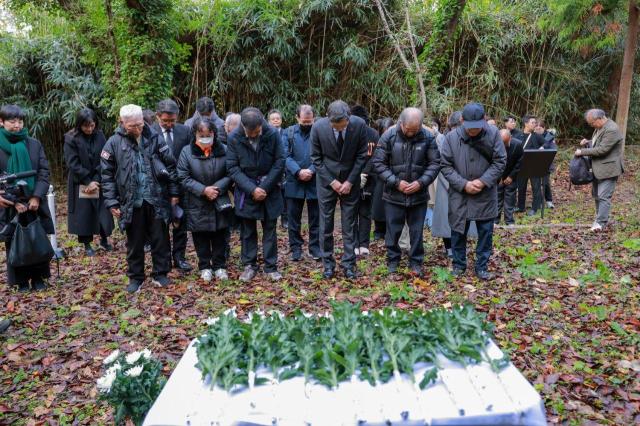
SEOUL, November 03 (AJP) - South Korea will hold its own memorial on Nov. 13 for Korean laborers forced to work at Japan's Sado mine during World War II. It will be the third straight year Seoul has held a separate ceremony because Tokyo will not acknowledge that the labor was forced.
Lee Hyuk, South Korea's ambassador to Japan, will lead government officials and nine bereaved family members at the morning ceremony in Sado, Niigata Prefecture, foreign ministry spokesperson Park Doo-soon said at a regular briefing on Tuesday.
After the ceremony, the delegation will lay flowers at the site of a dormitory that housed Korean workers and visit other places linked to them on the island, Park said.
The memorial grew out of a deal struck in July 2024, when the UNESCO World Heritage Committee added the Sado Island Gold Mines to its list at its 46th session in New Delhi. South Korea, a committee member, agreed to the decision after Japan pledged to present the site's full history, including the Korean workers, and to hold a memorial on the island every year for everyone who worked there.
The mine, on an island in Niigata Prefecture on Japan's northwestern coast, was famous for gold during the Edo period (1603~1868) and later supplied copper, iron and zinc for Japan's war effort. An exhibit at the Aikawa Folk Museum, about 2 kilometers from the mine, says records show 1,519 Koreans worked there between 1940 and 1945, when Korea was under Japanese colonial rule.
The exhibit, which Japan set up as part of its UNESCO commitment, describes the harsh conditions Korean workers faced but does not use the word "forced."
The first memorial, held by a Japanese organizing committee in November 2024, went ahead without South Korea. Seoul withdrew a day before the event, and the foreign ministry later said the main reason was that Japan's memorial speech and other arrangements fell short of what the two sides had agreed when the mine was listed.
South Korean officials and nine family members held their own ceremony at the former dormitory site the day after Japan's event. Park Cheol-hee, then ambassador to Japan, led it.
In 2025, the two governments again negotiated over the text of Japan's memorial speech but could not agree on how to describe the coercion. Seoul skipped Japan's Sept. 13 ceremony and held its own on Nov. 21, with Lee and 11 family members attending.
Lee's speech that day used the language Seoul had sought. He said many Korean workers on the island had been "mobilized against their will" through recruitment, government-arranged placement and conscription, with the involvement of the Japanese Government-General of Korea, and "forced to labor."
This year's talks ended the same way. On Sept. 9, the foreign ministry said it had held "serious consultations with Japan so that this year's ceremony could be held in full, but failed to reach mutual agreement on the core issue." Japan held its ceremony on Sept. 12 and sent a director-general-level foreign ministry official as its representative.
UNESCO has also found Japan's follow-up lacking. At its 48th session, held in Busan in July, the World Heritage Committee said Japan had made some progress. It called on Tokyo to cover the site's whole history across all periods of mining and to consult closely with the countries concerned on how the site is presented to visitors.
Japan faced similar criticism over Hashima Island, a former coal mine listed as a World Heritage site in 2015. It opened an information center on the listed sites in Tokyo, about 1,000 kilometers from the island, and the committee said in 2021 that it "strongly regrets" Japan had not yet fully implemented its decisions.
At a parliamentary audit at the embassy in Tokyo on Oct. 12, Lee told lawmakers he planned to push Japan hard from next year on the gap between the two sides over the wording.
The committee has ordered Japan to report on its progress by Dec. 1, 2027, for review at its 50th session in 2028.
Copyright ⓒ Aju Press All rights reserved.
