
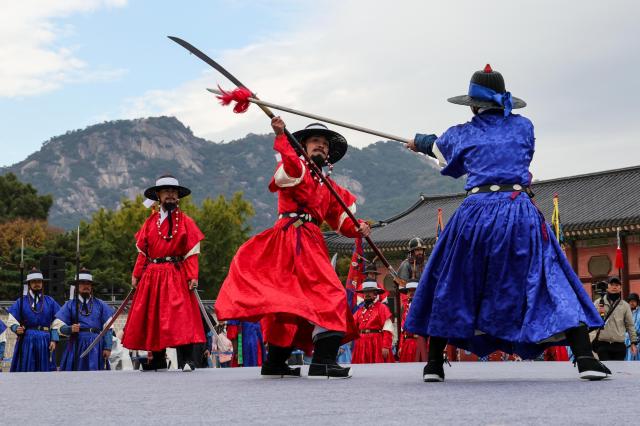
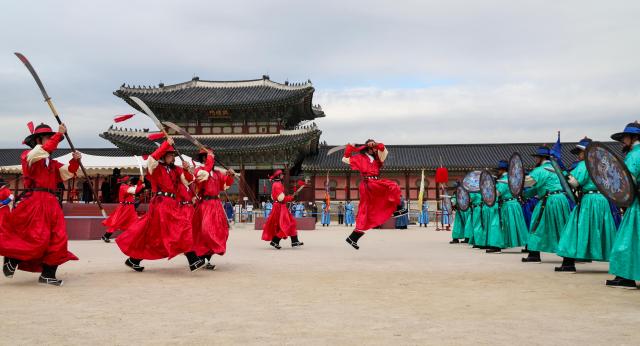
Swords flash, spears clash and royal bodyguards spring into action, showing off their martial prowess before the king against the majestic backdrop of Gyeongbokgung Palace in central Seoul.
The warriors of the Joseon Dynasty (1392–1910) have returned to life in a vivid reenactment of "Cheopjong," a royal military inspection ceremony staged at Heungnyemun Square from October 30 to November 1.
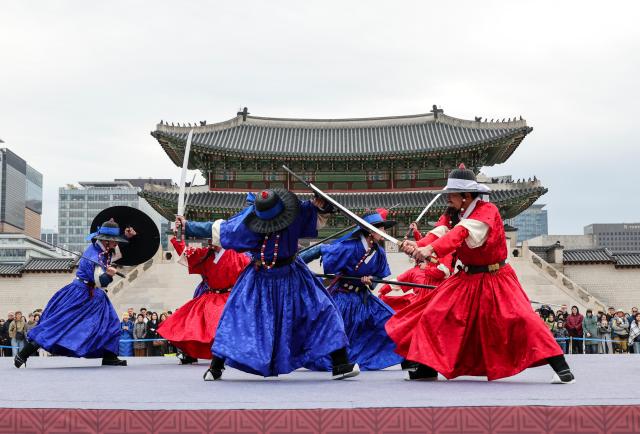
Dressed in colorful military uniforms, the guards engage in mock sword fights, wield spears and shields, and demonstrate elaborate combat formations. Their choreographed battles recreate the discipline, bravery and fighting skills once expected of the soldiers entrusted with protecting the king.
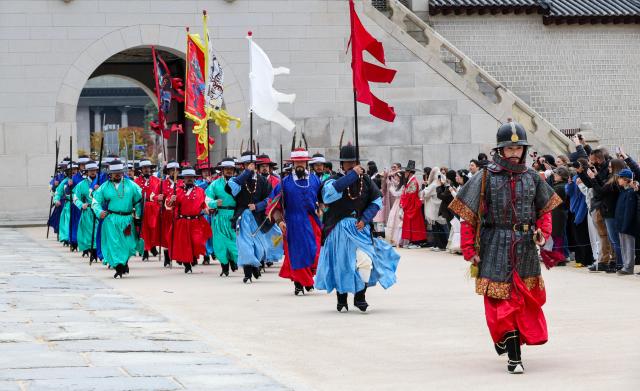
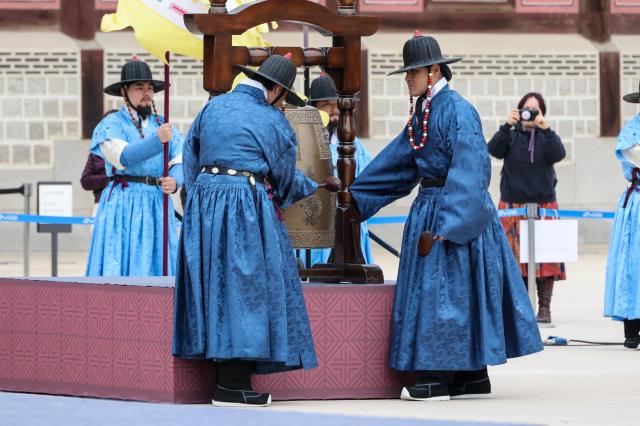
The spectacle begins with the repeated ringing of bells, summoning the royal guards to assemble before the monarch. The king then inspects their formations and martial arts demonstrations, assessing their readiness to defend the palace in an emergency.
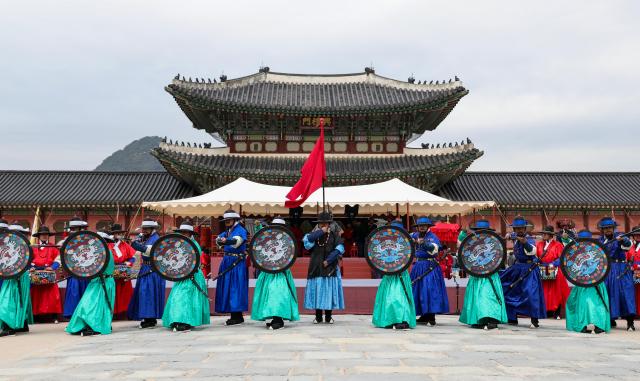
"Cheopjong," literally meaning "the repeated ringing of bells," was a military ritual designed to maintain discipline and reinforce royal authority.
The reenactment draws on historical records, including the "Gyeongguk Daejeon," the Joseon Dynasty's comprehensive legal code, and the "Gukjo Oryeui," a manual of royal ceremonies.
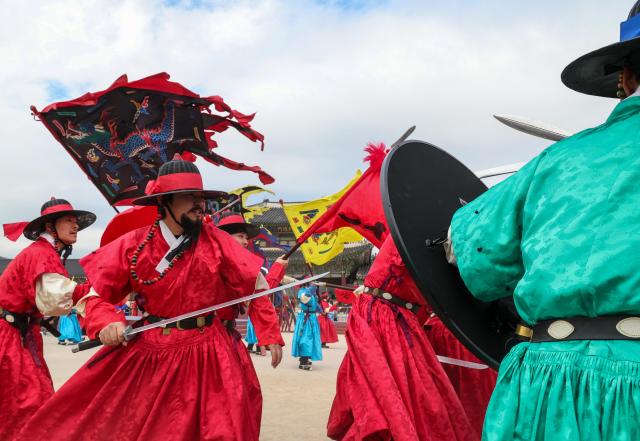
This year's performance features reconstructed early Joseon military costumes, weapons and ceremonial objects, along with additional "Geumgun," elite guards responsible for protecting the king.
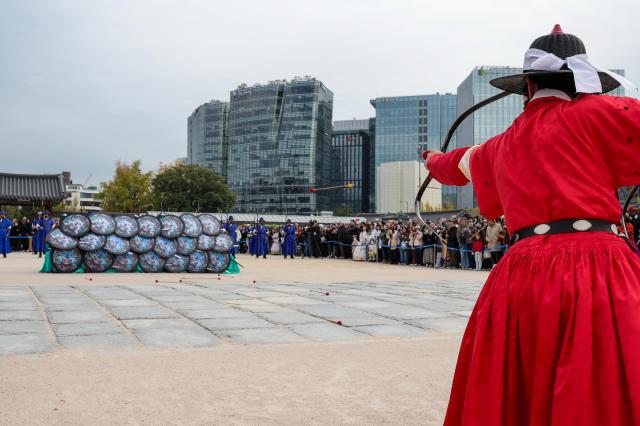
Organized by the Korea Heritage Service's Royal Palaces and Tombs Center and the Korea Heritage Agency, the 45-minute spectacle takes place twice daily at 11 a.m. and 2 p.m.
For visitors, the palace grounds become a living battlefield of royal history, where the clang of weapons and the sweeping movements of warriors bring centuries-old military traditions back to life.
Photojournalist, AJU PRESS (AJP) Covering news, culture and society in South Korea through an Asian perspective.
Copyright ⓒ Aju Press All rights reserved.
Related News
-
 How Sejong Became a Great King: Insights from 'Great Thoughts of Sejong'
King Taejong, known for solidifying royal power, laid the groundwork for his son Sejong, who became a beloved ruler focused on the welfare of his people and the inclusion of talented individuals. In his book Great Thoughts of Sejong, author Park Hyun-mo, who has studied Sejong for 26 years, examines Sejong's political philosophy and leadership through 100 selected quotes from the Annals of Sejong. Rather than merely listing his achievements, such as the creation of the Hunminjeongeum and advancements in science and technology, the book delves into Sejong's motivations for inspiring people and leading the nation. It piques curiosity about the remarkable governance of Sejong himself. Sejong was not born with the qualities of a great king. As a child, he was known as Chungnyeong and often lacked flexibility, strictly adhering to notions of right and wrong and reporting his brother's mistakes to their father. His transformation began with reading. Taejong, who had initially deemed Chungnyeong as unlikely to ascend the throne, advised him, "You have nothing to do, so just enjoy yourself." Chungnyeong immersed himself in academics and the arts, practicing 'Baekdok,' or reading over a hundred good books. Through this, he cultivated the wisdom to govern himself and lead the nation. Taejong's decision was pivotal in Sejong's ascension. He deposed his eldest son, Prince Yangnyeong, and appointed Chungnyeong as the crown prince. Although it was a painful process that made him want to "cry out loud," he prioritized the nation's future over familial ties. The author notes that Taejong's greatest achievement was choosing a successor who would surpass him. After Sejong's ascension, Taejong took on difficult tasks to shield his son from public discontent. He stated, "I take on all the responsibilities of the people so that after the crown prince ascends, not even a handful of dirt or a piece of wood will burden the people" (Annals of Taejong, July 5, 18th year). Building on his father's foundation, Sejong ushered in a new era. The most significant difference between the two was their approach to power. While Taejong excelled at selecting talented individuals, he kept them under strict control. In contrast, Sejong regarded his officials as partners in governance. On the third day of his reign, August 12, 1418, he told Chief State Councilor Ha Yeon, "I do not know people well, so let us discuss together." Sejong rarely expressed anger, even in the face of dissenting opinions. The author notes that during his 32-year reign, he only displayed anger 21 times, allowing officials to voice their opinions freely. Stubborn officials maintained their positions in front of the king. Sejong appointed Jang Young-sil, a former slave, to oversee the creation of the water clock, and he valued the abilities of Hwang Hee, despite allegations of bribery and judicial interference. While Taejong enjoyed discussions, the final decision always rested with the king. Sejong's leadership fostered advancements in science and technology. He not only embraced new knowledge but also encouraged experimentation and verification tailored to Joseon's realities. New rice varieties were cultivated in the palace garden, and artillery underwent hundreds of test firings before being adopted. Research indicates that from 1418 to 1450, Joseon achieved 21 scientific and technological advancements, significantly outpacing China's four during the same period. Sejong's hands-on approach was also noteworthy. When droughts worsened, he personally visited rural areas to listen to farmers' concerns. The compilation of agricultural experiences from various regions resulted in the publication of Nongsajikseol, reflecting his emphasis on practical knowledge. However, Sejong did not achieve the same success as his father in securing a successor. His dedication to governance left him with little time for his children, and even during rare moments with them, he often prioritized admonishment. Nevertheless, the great thoughts of Sejong have yielded lasting results that continue to resonate today. The Hunminjeongeum, created for the people, evolved into Hangul, while advancements in the water clock, astronomy, calendar systems, and agricultural technology elevated Joseon's scientific standards.* This article has been translated by AI.
-
Celebrating King Yeongjo's Birthday with a Special Popup Cafe in Daehakro
A birthday celebration for King Yeongjo, the 21st monarch of the Joseon Dynasty, will take place in Daehakro, Seoul. A special 'birthday cafe' will be set up to commemorate the occasion, coinciding with a unique popup store for the musical 'Shadow,' which explores the tragic relationship between Yeongjo and Crown Prince Sado.According to Blue Stage, the production company behind 'Shadow,' the interactive popup store will operate from October 31 to November 1 at Field Space in Jongno-gu, Seoul.Notably, the popup store opens on October 31, which is the same date as Yeongjo's actual solar birthday. Yeongjo was born on the 13th day of the 9th month in the lunar calendar in 1694, which corresponds to October 31 in the solar calendar. This year marks the 332nd anniversary of his birth.The event is designed to allow audiences to experience the characters and stories from the musical ahead of its revival in February. Different programs will be available on the first, second, and sixth floors of the venue.On the first floor, interactive games utilizing key lines and lyrics from the musical will be featured. Three programs titled 'Remember This Move,' 'If Only I Could Turn Back Time,' and 'Tangpyeong' will be available, along with a stamp lottery and limited-edition merchandise.The second floor will recreate actual performance stages, including 'Yeongjo's Room' and 'Sado's Room.' Visitors can follow the story of a randomly assigned character through a reservation system, immersing themselves in the world of the musical.A special cafe celebrating Yeongjo's birthday will be located on the sixth floor. It will offer desserts inspired by elements from the musical, such as dried persimmons and strawberries, as well as modern interpretations of traditional Joseon beverages like Jeho-tang. There will also be a product for making a model of a waterwheel.Additionally, a special program featuring a screening of the musical will take place. On November 1, neuroscientist Jeong Jae-seung will give a lecture exploring the 'tunnel of space-time' featured in the production from a scientific perspective.'Shadow' is a creative musical based on the historical event known as the 'Imo Incident' in 1762, when Yeongjo imprisoned and ultimately caused the death of his son, Sado. The production combines elements of fantasy, time travel, and rock music to depict the conflict and relationship between the two figures. After a showcase and premiere last year, it has also been performed in Shanghai, China, this year.Meanwhile, 'Shadow' is scheduled to take the stage at the Incheon Jemulpo Cultural and Sports Center on December 4-5, before its revival at the Link Art Center in Daehakro, Seoul, in February.* This article has been translated by AI.
-
Interview with Artistic Director Park Mi-hwa: 'Hangul and Video Art... The Communication and Creativity of King Sejong and Nam June Paik Are Connected'
"King Sejong's Hangul and Nam June Paik's video art share a fundamental starting point in that they both dealt with media representative of their times," said Park Mi-hwa, the artistic director of the 2026 special exhibition 'Sejong and Nam June' at the Sejong Central Park Biennale exhibition hall. This exhibition highlights the communication and creativity of these two innovative figures, showcasing over 90 pieces, including literature and artifacts from the Sejong era and works by Nam June Paik.Park, who planned the exhibition, emphasized that both figures opened new ways of communication in their respective eras. King Sejong created Hangul, a new script that lowered the barriers to knowledge and information, while Nam June Paik pioneered video art, sending messages of peace to the world. From the perspective of media theorist Marshall McLuhan (1911–1980), who believed that media technology changes human senses, behavior, and social structures, both are innovators who led changes in their times through new media.In a written interview with this agency, Park stated, "If Hangul opened an era of written communication from the Joseon Dynasty to today, video art has opened an electronic era that allows for interactive communication, not just the domain of a privileged few." She added, "In this regard, the communication and creativity of King Sejong and Nam June Paik are closely connected."The exhibition is organized around three themes: 'Communication, Hangul and Video Art,' 'Collaboration, Jiphyeonjeon and Fluxus,' and 'Art Expanding Beyond Boundaries.' This year marks the 580th anniversary of the proclamation of Hunminjeongeum and the 100th anniversary of Hangul Day, providing an opportunity to reflect on how Hangul and video art have connected and expanded technology and culture.Sejong and Nam June: Pioneering Media Artists with Shared Ideals and PracticesPark Mi-hwa is an exhibition planning expert who worked at the National Museum of Modern and Contemporary Art from 1997 to 2025, serving as the exhibition director at the Seoul Museum and the Cheongju Museum. He has curated notable exhibitions such as 'Ai Weiwei' and the 'Lee Kun-hee Collection' special exhibition. In August of this year, he was officially appointed as the artistic director of the '2027 Sejong Hangul Biennale.' This exhibition also serves as a preview of the direction for next year's inaugural Sejong Hangul Biennale.One of the biggest challenges in preparing the exhibition was visually representing the intersection of two figures from different eras and fields. "Finding the artistic intersection of the two figures was my greatest concern. King Sejong can only be represented through literature and archives. To provide visual elements for the audience, we staged videos by contemporary artist Ryu Jae-ha and paintings by Hong Soon-myung together," he explained.The work that most succinctly illustrates the connection between the two figures is Nam June Paik's 'King Sejong' (1998). Paik viewed King Sejong as a pioneering media artist. "For Nam June Paik, King Sejong was the first media artist who precisely and beautifully recombined knowledge and information like electronic devices and shared it with the public. He visually praised this through the creation of 'King Sejong.'"Another intriguing section of the exhibition is 'The World of Reading,' which offers insights into the ideological foundations of both figures. It features ancient texts such as 'Gusosugan,' which is said to have been read so intensely by young Sejong that it harmed his health, along with 'Chosa,' 'Daehak Yeonui,' 'Jajitonggam,' 'Geunsarok,' and 'Yanghwisanbeop.' Works that inspired Nam June Paik's artistic world, including 'Understanding Media,' 'The Joy of Learning,' 'Lectures on Metaphysics,' 'On Permanent Peace,' 'The Book of Sand,' and 'Cybernetics,' are also on display.Park noted, "By looking at what books the two figures read, we can understand their great achievements and the ideological backgrounds and foundations they left behind. Just viewing their reading records side by side will be fascinating."Ideas translated into action. Visitors can encounter King Sejong's 'Hunminjeongeum Haerye,' which opened a new era of script for the people, as well as practical experiments with the new script in 'Yongbieocheonga' and 'Wol In Cheonggang Jigok.' Correspondingly, Nam June Paik's section features works that elevate technology into art, such as 'King Sejong' (1998) and 'Tae Naegi Autobiography.'Collaboration is another theme connecting the two figures. While King Sejong collaborated with scholars at Jiphyeonjeon to advance scholarship and science, Nam June Paik participated in the avant-garde art movement Fluxus, breaking down the boundaries of art. The exhibition also turns its attention to those who led a new era alongside these two figures. Hong Soon-myung's oil painting series 'Surrounding People,' which imagines the backs of figures from that time against the backdrop of scientific instruments like the rain gauge and celestial globe from the Sejong era, adds visual interest to the exhibition. Across from this, 20 pieces from the '1963 Series,' which captures an exhibition held in Wuppertal, Germany, during Paik's time as a Fluxus member, and 'Voice Box,' a tribute to his artistic partner Joseph Beuys, are showcased.Park expressed hope that visitors would approach the core of Nam June Paik's artistic world at the intersection with King Sejong, stating, "Nam June Paik was a figure who practiced all the ideas and theories he knew, viewing the world in a very interesting and peaceful way."At the Heart of the Sejong Hangul Biennale is CheonjiinThis exhibition also marks the starting point for the first Sejong Hangul Biennale, set to take place next year. The specific outline of the biennale is expected to be revealed by the end of the year. Park is conceptualizing the theme around 'Cheonjiin,' the philosophical foundation of Hangul's creation. He aims to connect the form and philosophy of Hangul with contemporary art without limiting it to specific genres. "I am considering all fields of art. However, since it is the first edition, I believe a special exhibition showcasing the principles and development process of Hangul is essential. I plan to create a space that serves as the focal point of the entire exhibition," he said.Park emphasizes the importance of differentiation. While many biennales focus on specific art fields such as ceramics, ink painting, or crafts, Hangul is a language. Therefore, a different approach from existing art biennales is necessary. "It is rare to find a biennale that specializes in language itself globally. We need to draw out the internal, external, and formal meanings of Hangul and integrate them with contemporary art."There are also plans to actively promote participation from international artists. The goal is to expand the possibilities of Hangul beyond traditional letter arts like calligraphy, typography, and design, into all fields of art, including painting, sculpture, installation, and video.The global spread of K-culture also enhances the potential of the biennale. "As Korean culture gains global attention, interest in Hangul is also very high. I believe that if we effectively connect the form of Hangul with contemporary art, the Sejong Hangul Biennale can establish its place in the art world."The exhibition runs from October 9 to November 8 at the Sejong Biennale exhibition hall.* This article has been translated by AI.