

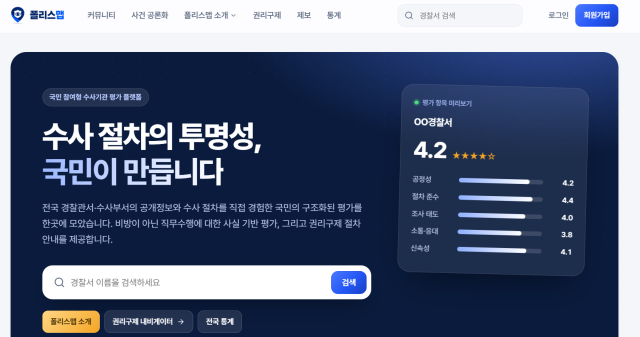
The website, called Policemap (policemap.co.kr), describes itself as a citizen-participation platform designed to improve transparency and accountability in police investigations.
It allows complainants, crime victims, witnesses and lawyers to evaluate police stations, investigative departments and individual officers using a five-star rating system.
Users can assess investigations across five categories, including fairness, compliance with procedures, investigators' attitudes, communication and responsiveness, and speed of investigations.
As of Thursday, the platform listed 263 police stations and 2,688 investigative units nationwide. Its statistics page displayed 14 evaluations, with an average rating of 2.3 out of five.
Some users have posted complaints about investigations they considered inadequate or unfair.
One reviewer alleged that police refused to formally register a complaint involving a road-rage incident. Another criticized officers for closing a case without referring it for prosecution despite what the reviewer believed was sufficient evidence.
The allegations could not be independently verified, and the limited number of reviews makes it difficult to draw broader conclusions about police performance.
The platform says it aims to collect factual accounts of investigative procedures rather than encourage personal attacks against individual officers.
"It is records, not punishment, that change the system," the website states.
According to its operating guidelines, reviews are published without prior screening, although offensive language is automatically filtered. Officers' names are partially concealed, and those concerned can request the removal or correction of information.
Eligibility to submit evaluations is based on users' self-declared involvement in cases, rather than independently verified credentials.
The website also provides information about official complaint procedures, including requests to replace investigators, appeals against police decisions not to refer cases for prosecution and complaints to the National Human Rights Commission of Korea.
Its emergence follows amendments to the Criminal Procedure Act that took effect on Oct. 2, fundamentally restructuring South Korea's investigative and prosecutorial system.
Under the reform, the country's prosecution service, which had exercised both investigative and indictment powers for 78 years, was abolished and replaced by two separate agencies.
The newly established Public Prosecution Service is responsible for indictments and maintaining prosecutions in court, while the Serious Crimes Investigation Agency handles investigations into major offenses, including corruption, economic crimes and drug-related crimes.
Prosecutors can no longer initiate criminal investigations or directly conduct supplementary investigations, although they retain the authority to request additional investigations from police and other investigative agencies.
The revised legislation also strengthened procedural safeguards for complainants. Those challenging a police decision not to refer a case for prosecution generally must file an objection within three months of receiving notification, with extensions permitted under specified circumstances.
The reforms were introduced to separate investigative and prosecutorial powers, long concentrated within the prosecution service. However, the changes have also raised concerns about whether sufficient oversight mechanisms exist to prevent investigative errors, delays and potential abuses of police authority.
Copyright ⓒ Aju Press All rights reserved.
