SEOUL, November 09 (AJP) - A battery layer that lines up its molecules in a single direction can stop lithium from piling up unevenly during fast charging, a flaw that shortens battery life and can start fires, South Korean researchers said Monday.
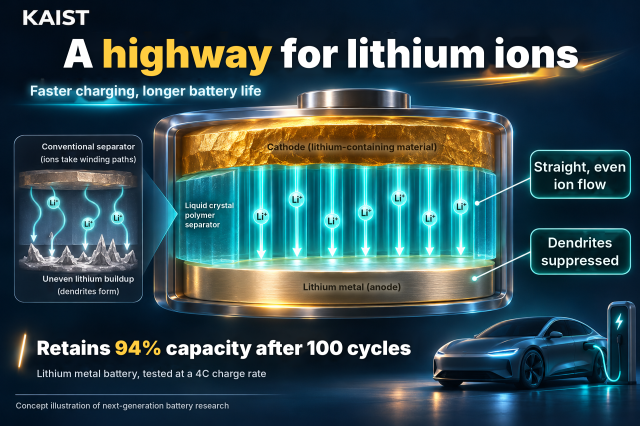
A team led by Yoon Dong-ki and Byon Hye-ryung, both chemistry professors at the Korea Advanced Institute of Science and Technology (KAIST), built the layer from a liquid crystal polymer. Charged at a rate that would theoretically fill a battery in about 15 minutes, a test cell using it kept 94 percent of its starting capacity after 100 charge and discharge cycles.
What set the material apart was the direction its molecules faced rather than their chemistry. Two versions with the same pores and the same chemical makeup moved lithium very differently, depending only on whether the molecules stood upright or lay flat.
The work targets lithium metal batteries, which use a sheet of lithium metal as the negative electrode instead of the graphite found in today's lithium-ion batteries. The swap lets a battery store more energy for the same weight.
During charging, lithium ions that reach the metal surface unevenly settle in clumps and grow into sharp, branch-like structures called dendrites. Dendrites drain a battery's capacity and can pierce the separator, the thin film that keeps the positive and negative electrodes apart, causing an internal short circuit and, in some cases, a fire.
The KAIST team focused on the separator itself. Lithium ions pass through its pores on every charge, and when those pathways twist and turn, the ions take detours and crowd into certain spots.
Most earlier efforts to stop dendrites changed the electrolyte, the liquid that carries the ions, or treated the surface of the electrodes. The team said those approaches do little to control the route ions take before they reach the electrode.
To straighten that route, the researchers turned to liquid crystals, the materials used in LCD screens. Liquid crystals sit between a solid and a liquid. Their molecules line up in an orderly pattern like a crystal but can still flow, and their orientation can be set by treating the surface they rest on.
The team attached chains of polyethylene glycol, a common polymer that interacts with lithium ions and helps them move, to liquid crystal molecules. They aligned the molecules either vertically or horizontally, fixed the structure with light, and then removed a filler material to leave pores about 19 nanometers wide, thousands of times narrower than a human hair.
In the vertical film, the pores formed straight channels running toward the electrode. KAIST compared the change to turning a maze of back alleys into an orderly road. Tortuosity, a measure of how winding an ion's path is, fell by a factor of about 2.5 compared with the horizontal film.
Lithium ions moved through the vertical separator faster and more evenly, reaching the electrode surface spread out rather than bunched together. That suppressed dendrite growth, according to the team.
In the fast-charging test, the cell also recorded an average Coulombic efficiency of 99.86 percent, meaning almost all the charge put into the battery on each cycle came back out. KAIST said the separator showed better cycling stability than both a commercial separator and the horizontally aligned version.
The 15-minute figure describes the theoretical speed of the test, a rate known as 4C. KAIST noted that the actual time needed for a full charge depends on the battery and the charging method.
"This study shows that controlling the molecular arrangement of liquid crystal polymers lets us design efficient paths for lithium ions and improve battery performance and stability," Yoon said. He added that he expected the work to feed into high-energy-density batteries for uses where "long driving range and fast charging are essential."
The separator has so far been made and tested only at laboratory scale. In a Q&A released with the findings, the team said commercial use would require a way to form the same precise internal structure evenly across large films, along with tests showing that performance holds over long periods of repeated charging in real operating conditions. Mechanical strength and manufacturing cost also have yet to be addressed, the team said.
The findings were published in the journal ACS Nano in September. Lee Geun-jung, a Ph.D. candidate in Yoon's lab, and Choi Rak-hyun, a researcher in KAIST's chemistry department, were co-first authors.

Copyright ⓒ Aju Press All rights reserved.