This time, the partners are Nvidia, SK Telecom and Korean chip startup Rebellions. Their agreement at Nvidia AI Day Seoul will connect Rebellions' Rebel R200 neural processing unit (NPU) to Nvidia's platform through its NVLink Fusion technology. SK Telecom will deploy the rack-scale systems in its AI data centers. Nvidia expects them to be ready in 2028.
"This cooperation is meaningful in that it gives domestically developed NPUs an important opening to enter the computing infrastructure market together with Nvidia," said Ryu Je-myung, second vice minister of science and ICT.
SK Telecom plans to run its own A.X K2 model on the hardware, alongside "AI for All," a free government-backed assistant that entered closed beta on Oct. 16 and is scheduled to launch in December.
A.X K2 is one of three remaining contenders in the science ministry's sovereign foundation model contest, launched in June 2025 with the goal of reaching 95 percent of the performance of leading global models.
Naver Cloud and NC AI were eliminated in January, followed by Motif Technologies in August. SK Telecom, LG AI Research and Upstage are now competing for two final places in February.
The three scored between 31 and 37 on the Artificial Analysis Intelligence Index in results published by the ministry on Aug. 18.
The index now places Anthropic's Claude Fable 5.2, released on Nov. 9, at 65 and OpenAI's GPT-6 Astra at 57. An October revision to the index, however, means those scores cannot be directly compared with the Korean models' August results.
"The results through the second stage are at about the midpoint of the global level," Deputy Prime Minister and Science Minister Bae Kyung-hoon told lawmakers on Oct. 6.
OpenAI expects to spend $50 billion on computing power this year, President Greg Brockman said in May. Anthropic reported $8.9 billion in computing and infrastructure costs for the first half alone in its October share-sale filing. It had about 5,300 employees as of Sept. 30.
Seoul's contest provides its finalists with about 1,000 Nvidia B200 chips, up from 768 before the August round.
"An investment of a different order from the sovereign model project is needed," Ryu told reporters on Oct. 2.
The government is proposing a separate frontier AI project with a 2027 budget of 4.7 trillion won ($3.49 billion), including about 3.85 trillion won for Nvidia graphics processing units. The National Assembly has yet to approve the allocation.
Private investment offers a comparatively modest supplement.
Korean private investment in AI totaled $1.78 billion in 2025, ranking 12th globally, against $285.9 billion in the United States and $12.4 billion in China, according to Stanford University's 2026 AI Index.
China's much smaller investment total has not prevented its models from gaining commercial traction.
U.S. companies using OpenRouter, a marketplace for AI models, directed more than 30 percent of their tokens to Chinese models every week from Feb. 8, with the share peaking at 46 percent, CNBC reported in July. Tokens are the units of data AI models process.
Those models cost 60 to 90 percent less to use than leading U.S. systems, according to OpenRouter. ByteDance's Seedance 2.0 also topped Artificial Analysis' video generation rankings in March.
China's advantage extends to its talent pool.
Graduates of Chinese universities accounted for 57 percent of the world's top AI researchers in 2025, compared with 13 percent for U.S. universities, according to Carnegie China.
Developers in Seoul's AI industry told AJP that Chinese engineers were considerably ahead in technical skills, while Korean engineers often aspired to join Meta, Alphabet or Anthropic for the pay and prestige.
AI skills commanded a wage premium of about 6 percent in Korea, compared with about 25 percent in the United States.
Against those constraints, the government has also outlined a more focused ambition.
On July 20, Bae said the ministry would release a model specializing in security within the year, initially for use in the public sector.
"We believe fine-tuning the models we already have on security data can produce a specialized model that checks for a range of vulnerabilities," he said.
Sovereign AI tailored to specific fields, including security and public services, remains the right course for Korea, said Kong Duk-jo, a professor of AI policy and strategy at the Gwangju Institute of Science and Technology.
Kong also sees a potential opening in Washington, where Democrats won both chambers of Congress on Nov. 3 after campaigning against data centers.
Senator Bernie Sanders called on election night for a national moratorium on their construction. Any legislation imposing such a halt could face a veto from President Donald Trump.
"If policy tilts toward blocking that, development there will slow. Then there could be an opportunity for us," Kong said.
Experts drew a parallel with the Kobe earthquake of January 1995, which disrupted production at Japanese electronics plants, including those operated by Sharp and Mitsubishi.
In their assessment, technology gaps of six to eight months can separate leading chipmakers, leaving a company vulnerable to being overtaken if production stops for half a year.
Kong expects more processing to move from data centers to devices, expanding the role of NPUs such as those developed by Rebellions.
"I think the efforts to back those companies are, in the end, efforts to secure a field of our own for the future," he said.
AJP Takeaways
- Nvidia, SK Telecom and Rebellions signed a memorandum on Nov. 9, 2026, in Seoul to link Rebellions' Rebel R200 NPU to Nvidia's platform through NVLink Fusion, with systems due in 2028.
- The three finalists in South Korea's sovereign AI foundation model project scored 31 to 37 on the Artificial Analysis Intelligence Index in August 2026. The final two teams are due in February 2027.
- OpenAI expects to spend $50 billion on computing in 2026. South Korea's proposed frontier AI project is budgeted at 4.7 trillion won ($3.5 billion) for 2027, pending approval by the National Assembly.
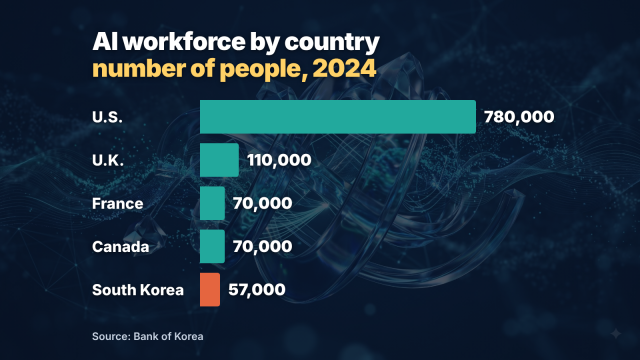
- About 11,000 Korean AI specialists, or 16 percent of the workforce, were working overseas in 2024, according to the Bank of Korea. The Ministry of Science and ICT plans a security-specialized AI model by the end of 2026.
Copyright ⓒ Aju Press All rights reserved.