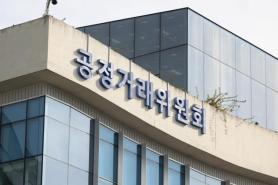
SEOUL, November 11 (AJP) — South Korea's antitrust watchdog imposed a record 1.63 trillion won ($1.2 billion) in fines on 15 banks and securities firms for colluding in government bond auctions, it said Wednesday.
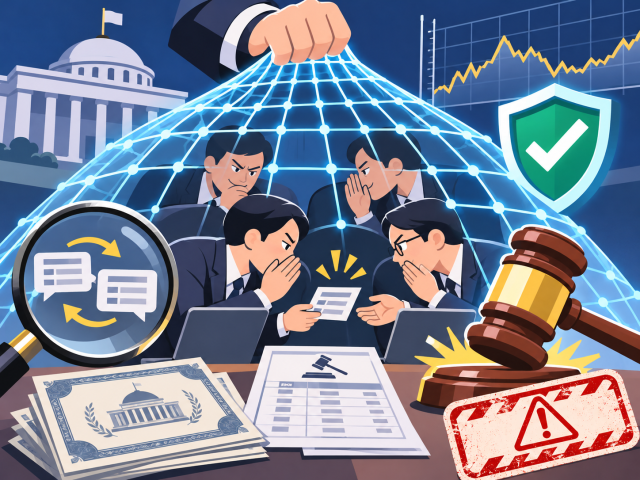
The Korea Fair Trade Commission (KFTC) said the firms coordinated bidding rates and volumes or exchanged sensitive information during 150 Treasury bond auctions between January 2020 and June 2023.
The penalty, totaling 1.6266 trillion won, is the largest imposed in a single case in the watchdog's history, surpassing the 1.03 trillion won fine levied against Qualcomm in 2016.
Seven firms will also be referred to the Serious Crimes Investigation Agency for criminal investigation.
The case centers on South Korea's primary dealer system, under which designated banks and securities firms participate in government bond auctions and help maintain liquidity in the secondary market.
Competitive bidding typically pushes bond yields lower, allowing the government to raise funds at a reduced borrowing cost. The KFTC found that the dealers exchanged bidding information and coordinated their offers to prevent yields from falling through competition.
The regulator concluded that the arrangements artificially raised auction yields, increasing the government's financing costs.
It did not, however, quantify how much additional interest the government paid as a result of the collusion.
Of the 150 auctions involving collusion, 145 included direct agreements on bidding yields or volumes rather than information exchanges alone.
The coordination continued until one or two minutes before bidding closed, with employees exchanging information through telephone calls and messaging applications.
Some agreements were reached within seconds, while employees passed competitors' contact information to their successors when changing positions, allowing the arrangements to continue despite personnel changes.
The regulator said the practices were sufficiently widespread to undermine competition in the government bond issuance market.
The 15 sanctioned institutions comprised 10 securities firms — Kyobo, Daishin, Meritz, Mirae Asset, Samsung, Shinhan Investment, NH Investment, KB, Kiwoom and Korea Investment & Securities — and five banks: KB Kookmin, NH NongHyup, Industrial Bank of Korea, Hana and Korea Development Bank.
The seven firms referred for criminal investigation were Mirae Asset Securities, NH Investment & Securities, Industrial Bank of Korea, KB Securities, Kiwoom Securities, Korea Development Bank and Korea Investment & Securities.
KB Securities received the largest individual fine at 332.18 billion won, followed by NH Investment & Securities at 242.79 billion won and Mirae Asset Securities at 214.83 billion won.
In determining the penalties, the commission assessed the value of transactions affected by the collusion at approximately 54 trillion won and applied a base penalty rate of 4.5 percent.
The final amounts reflected a 30 percent reduction, taking into account the characteristics of Treasury bond auctions and the fact that the value of bonds purchased did not directly represent the dealers' illicit profits.
The financial institutions had argued that routine exchanges of market information among primary dealers should not be treated as collusion and that penalties should be calculated using their trading revenue rather than the face value of bonds purchased.
The commission rejected those arguments, distinguishing general market discussions from agreements involving specific bidding yields and volumes.
The watchdog also ordered the firms to cease the practices and strengthen internal compliance measures, including employee training and disciplinary procedures.
The findings raise broader questions about oversight of South Korea's government bond market, where a relatively small group of financial institutions plays a central role in determining sovereign borrowing costs.
Treasury bond yields serve as benchmarks for corporate bonds and other financial products, making competitive price formation important beyond the government's direct financing needs.
Copyright ⓒ Aju Press All rights reserved.