
ZURICH, November 11 (AJP) -Europe’s ban on goods linked to deforestation begins in seven weeks, putting Asia’s palm oil, coffee and rubber exporters under pressure to prove their supplies meet the rules.
Major companies say they are ready. Many small farmers supplying them still lack the paperwork.
The divide raises a difficult question for a law designed to protect forests: whether small growers can document compliance in time to keep their European customers.
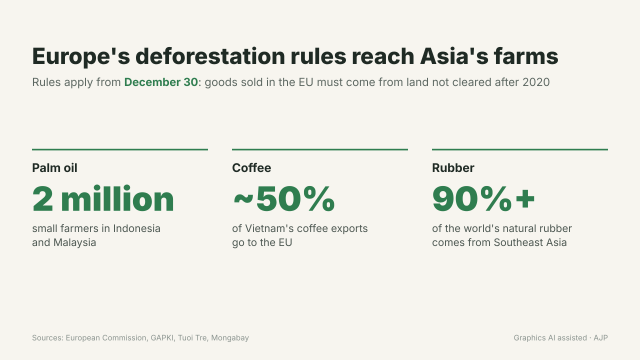
From December 30, the European Union Deforestation Regulation (EUDR) will apply to large and medium-sized operators handling palm oil, coffee, cocoa, rubber, soy, cattle and wood, along with specified products such as chocolate and tires. Covered goods must be legally produced and free of links to deforestation after December 31, 2020. Most micro and small operators have until June 30, 2027.
Operators first placing covered goods on the EU market generally must trace them to their production plots and submit a due diligence statement. Although the filing obligation falls on those operators, the evidence must come from suppliers stretching back to individual farms.
Penalties can be substantial. EU countries must set maximum fines of at least 4 percent of an offending company’s annual EU turnover.
Implementation has already been postponed twice, most recently in December 2025. The European Commission reaffirmed the year-end timetable when it announced further implementation measures in July.
The pressure falls heavily on Southeast Asia, where Indonesia and Malaysia dominate global palm oil production and smallholders supply an important share of the crop used in everything from instant noodles to cosmetics.
Indonesian palm oil companies are ready to meet the requirements, Eddy Martono, chairman of the Indonesian Palm Oil Association (GAPKI), said in October. Smallholders face greater difficulties establishing the legal status of their land, the association said, with some farms falling within officially designated forest areas.
Martono also pointed to a dispute over plantation data. The EU requires geolocation information, while Indonesian rules restrict its public disclosure, he said.
Still, meetings with European buyers in Amsterdam left him confident that demand would hold. European importers “need palm oil from Indonesia. That is the key point,” he said.
Vietnam’s coffee industry faces a similar test. Nearly half its coffee exports go to the EU, while total coffee export earnings reached 4.81 billion dollars in the first half of this year, Tuoi Tre reported.
The country’s coffee plantations cover more than 700,000 hectares and are cultivated predominantly by smallholders. Pilot projects had surveyed more than 153,000 hectares as of the newspaper’s August report.
“Having GPS coordinates for a farm isn’t enough,” Nguyen Thanh Tai of the Vietnam Coffee-Cocoa Association told Tuoi Tre.
Exporters must also track beans through successive traders, warehouses and processors. Mixing supplies from different farms complicates that task, while discrepancies between land records, forestry maps and satellite assessments can leave established farms struggling to prove compliance.
Country classifications add another layer. China and Vietnam are rated low risk, while Indonesia and Malaysia fall into the standard-risk category. Belarus, Myanmar, North Korea and Russia are rated high risk.
The categories determine minimum annual inspection rates: 1 percent of relevant operators sourcing from low-risk countries, 3 percent for standard-risk countries and 9 percent for high-risk countries. A low-risk rating reduces scrutiny but does not remove the obligation to establish a product’s origin and compliance.
Rubber presents another formidable tracing challenge. About 85 percent of the world’s natural rubber comes from some 6 million smallholders, and tire manufacturers consume roughly 70 percent of the total, according to environmental news outlet Mongabay. Latex can pass through numerous intermediaries before reaching a factory.
Michelin and Continental told Mongabay in May that they had been prepared for the rules since before the latest postponement. But Tyres Europe, their industry association, said uncertainties over reporting requirements and the EU information system continued to complicate preparations.
The Commission subsequently updated the system’s operating rules in July, alongside changes intended to clarify which products are covered.
For Asian suppliers, the commercial pressure arrives regardless of who files the paperwork in Europe. Buyers need evidence from the farms behind their products, and growers unable to provide it risk being dropped from supply chains.
If European buyers concentrate purchases among suppliers with the strongest records, smallholders could lose customers even when their crops meet the law’s environmental aims.
Tags: EU Deforestation Regulation, EUDR, European Union, European Commission, palm oil, coffee, natural rubber, Indonesia, Malaysia, Vietnam, GAPKI, Eddy Martono, Vietnam Coffee-Cocoa Association, Michelin, Continental, Tyres Europe, Hankook Tire, Nestlé, Barry Callebaut, Switzerland
Copyright ⓒ Aju Press All rights reserved.