

Journalist
Kim Yeon-jae김연재
duswogmlwo77@ajupress.com
ReporterBank of Korea & Market, Macroeconomics
Kim Yeon-jae is a journalist at AJU Press (AJP's English platform),
covering macroeconomics, international finance, and geopolitics.
He closely tracks central bank monetary policies, global energy supply chains,
and the Korean defense industry. "Peering into the risks behind the euphoria."
covering macroeconomics, international finance, and geopolitics.
He closely tracks central bank monetary policies, global energy supply chains,
and the Korean defense industry. "Peering into the risks behind the euphoria."
Latest by Kim Yeon-jae
-
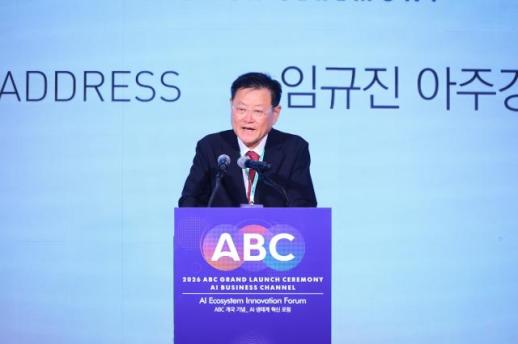 ABC launch forum puts spotlight on Korea's AI ecosystem SEOUL, July 09 (AJP) - Aju Media Group's new AI-focused business channel ABC held the AI Ecosystem Innovation Forum in Seoul on Thursday, bringing together government officials, technology executives and industry experts to discuss South Korea's next steps in artificial intelligence. The forum, held at The Plaza Seoul, followed the official launch of ABC, or AI Business Channel, a day earlier as Aju Media Group expands into television broadcasting with a channel dedicated to artificial intelligence. Key participants included Ryu Je-myung, second vice minister of Science and ICT; Lee Sedol, former professional Go player and special professor at UNIST; Jeong So-young, NVIDIA Korea Country Manager; and Lim Sung-shin, head of AI development at Korea Aerospace Industries. The morning session opened with remarks by Lim Kwu-jin, president of Aju Business Daily, followed by a congratulatory speech from Ryu, a keynote by Lee and a presentation by Jeong. Lim described ABC as South Korea's first AI-focused economic broadcasting channel, launched at a time when artificial intelligence is rapidly changing industry, the economy and everyday life. The channel, Lim said, aims to serve as a media platform linking AI technology, industry, policy and the economy while contributing to the development of South Korea's AI ecosystem. He framed the forum as a starting point for discussions on the strategies and tasks needed for South Korea to become one of the world's three leading AI powers. Ryu said the global AI economy is being reshaped by massive investment and intensifying competition over technologies that will determine the next generation of industrial leadership. South Korea has been building the foundation for its AI ambitions, he said, pointing to the country's rise to third place in the number of notable AI models in Stanford University's AI Index 2026, behind the United States and China. Ryu also cited the implementation of the AI Basic Act and legislation related to AI data centers as part of the government's efforts to support large-scale private investment. The government plans to build a Korean-style AI ecosystem by combining semiconductors, AI data centers and next-generation technologies such as agentic AI and physical AI, he said. AI leadership, Ryu stressed, cannot be achieved through models and infrastructure alone, adding that ordinary citizens, companies and regions must be able to use AI in daily life and work. Lee's keynote, titled "A Decade After AlphaGo: The Age of New Illiteracy," revisited his 2016 match against Google's AlphaGo, which became a turning point in global awareness of artificial intelligence. Lee used the phrase "new illiteracy" to describe a widening gap between people who understand and use AI and those who do not, comparing it to the divide between those who can read and write and those who cannot. When he first received the proposal to play AlphaGo, Lee recalled, he did not view it as a decisive contest between humans and machines, but more as a public event. He believed at the time that Go would eventually be conquered by computers, but did not expect that moment to arrive in 2016. Lee also reflected on his connection with Demis Hassabis, co-founder of Google DeepMind, saying the AlphaGo match helped show how AI could move beyond games into fields such as science and medicine. The match showed both the power and limits of AI, Lee said, arguing that even in a rule-based domain such as Go, the technology could not simply be left to operate without human judgment. The lesson was not that humans had become unnecessary, but that they need to focus on setting direction, planning, designing and making final judgments, he said. AI has since widened the gap within professional Go, Lee noted, because top players have been better able to understand and use AI tools. He added that ABC could play a meaningful role if it goes beyond simply listing AI news and helps viewers understand what fast-moving developments mean for business and society. Jeong framed AI not merely as a large language model, chatbot or software service, but as an entirely new industry. NVIDIA views AI as a broad stack of components that includes energy, high-performance semiconductors, infrastructure, models and applications, with each layer needing to operate without bottlenecks to create new value, he said. Energy, chips and data centers remain key constraints as demand for AI continues to exceed supply, leaving significant room for the technology to expand as those bottlenecks ease, according to Jeong. Jeong described AI factories as revenue-generating infrastructure that can create industrial value by turning electricity and data into intelligence, rather than simply as cost centers. Computing is also moving beyond individual GPUs and servers to the scale of entire data centers, he said, as AI infrastructure shifts from tens or hundreds of megawatts toward gigawatt-scale facilities. NVIDIA is working with partners on platforms for designing, building and operating large-scale AI factories more efficiently, with the economics of AI infrastructure increasingly tied to power use, cooling, networking and system-level optimization, Jeong said. Jeong also pointed to agentic AI as the next phase of software development, where systems can understand user requests, reason through tasks and produce results beyond fixed input-output rules. Physical AI will extend artificial intelligence into the real world through robotics, autonomous vehicles, smart factories, intelligent cameras and digital twins, he said, requiring simulation platforms that can test and validate AI systems before they are deployed in physical environments. The afternoon program is scheduled to feature speakers from AWS Korea, MakinaRocks, Shinhan Bank, Mirae Asset Global Investments and Korea Aerospace Industries, focusing on AI applications across finance, manufacturing and aerospace. 2026-07-09 13:46:43
-
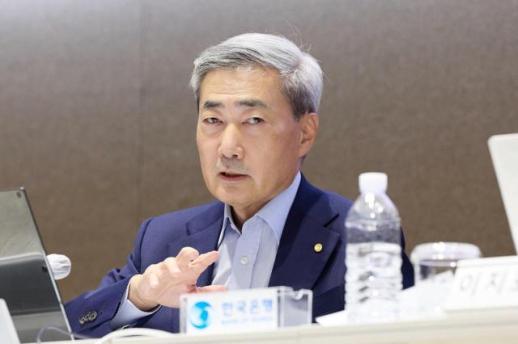 BOK reaffirms rate-hike stance on stronger inflation and growth SEOUL, July 09 (AJP) - The Bank of Korea reiterated Thursday that the benchmark rates should go higher, given inflation running above the 2 percent target, stronger growth, and risks to financial stability. The latest remarks reinforced signals already sent at the BOK’s May policy meeting, when 19 of 21 dots in the central bank’s six-month conditional rate outlook pointed to levels above the current 2.50 percent, followed by Shin’s repeated public comments in June that rate increases would be needed to keep inflation under control. BOK Gov. Shin Hyun-song presented the assessment ahead of facing regular probe by the National Assembly's Finance and Economy Planning Committee. “The Bank of Korea judges that it is necessary to raise the base rate at an appropriate time,” Shin said, citing inflation above the target, improving growth and growing financial stability risks. The central bank has kept its base rate at 2.50 percent since last cut in May last year. The BOK said Korea’s economy is expected to maintain solid growth as the semiconductor cycle remains strong and tensions in the Middle East ease. In its May outlook, the central bank projected the economy to grow 2.6 percent this year, up sharply from 1.1 percent last year. Exports have continued to expand rapidly, led by semiconductors, as global artificial intelligence investment boosts demand for high-performance memory chips. The central bank said semiconductor strength is expected to spill over to other parts of the economy, supporting both exports and domestic demand. Still, it warned that the growth path remains uncertain due to the pace of AI investment, geopolitical risks and U.S. tariff policy. It also noted that the benefits of the semiconductor upturn remain concentrated in certain industries and income groups, which could slow the broader economic spillover. Inflation was another key concern in the report. Consumer price inflation, which had stood at 2.0 percent in January and February, rose to 3.2 percent in June. Core inflation stood at 2.5 percent in June, while the living necessities price index rose 3.4 percent. The BOK said lower oil prices may ease headline inflation, but stronger demand from the improving economy and the pass-through of higher costs from the weak won could keep inflation elevated. Won-denominated import prices rose 24.8 percent from a year earlier in May, while non-energy import prices increased 18.3 percent. Financial and foreign exchange markets have also become more volatile, the central bank said. The won-dollar exchange rate has been trading in the low- to mid-1,500 won range despite Korea’s large current account surplus, pressured by continued foreign selling of Korean stocks and a stronger U.S. dollar. Foreign investors sold a net 40.4 trillion won worth of Korean stocks in March, 48.5 trillion won in May and 57.2 trillion won in June. The BOK said much of the selling since May reflected profit-taking and portfolio rebalancing after a sharp rally in Korean equities. The KOSPI has risen 91.9 percent this year, supported by the semiconductor boom and expectations for capital market reforms. But the central bank said volatility has increased as investment demand remains concentrated in semiconductor stocks, while concerns over AI profitability and uncertainty over U.S. monetary policy add pressure to the market. The BOK said Korea’s financial system remains broadly stable, supported by stronger real economic growth and sound resilience at financial institutions. The central bank said it will continue market stabilization efforts, including monitoring risk events, conducting smoothing operations in the foreign exchange market and using foreign exchange swaps with the National Pension Service. 2026-07-09 12:52:20
-
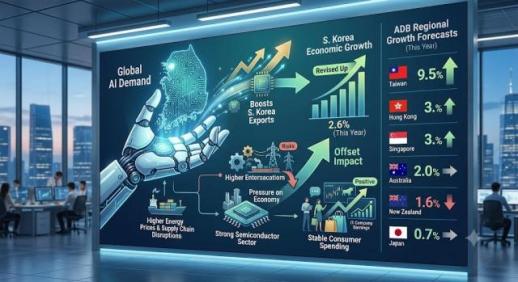 IMF and ADB up South Korea's growth forecast to 2.6% for this year SEOUL, July 9 (AJP) -South Korea's economy is expected to survive global-wide setback from the prolonged Gulf crisis and run above its growth potential through next year as it benefits from feverish chip demand amid artificial intelligence investment boom, drawing one of the steepest outlook upgrades from the International Monetary Fund and the Asian Development Bank. The IMF on Wednesday raised its 2026 growth forecast for South Korea to 2.6 percent, up 0.7 percentage point from its April projection — the largest upward revision among the 30 economies covered in its July World Economic Outlook Update. It also lifted next year's forecast by 0.4 percentage point to 2.5 percent. The ADB in its latest revised outlook released on Thursday also upgraded this year's growth forecast for Korea to 2.6 percent from 1.9 percent projected in April and nudging next year's estimate to 2.0 percent from 1.9 percent, likewise citing robust AI-led semiconductor exports. The IMF said South Korea's strong overseas demand for semiconductors and AI hardware had more than offset the drag from the Middle East conflict, identifying Korea as one of the world's four largest net exporters of AI hardware alongside Taiwan, Thailand and Malaysia. It noted the Korean economy expanded at an annualized 7.5 percent in the first quarter, far exceeding its earlier estimate of 1.8 percent. The ADB similarly said resilient exports driven by global AI demand would continue supporting growth into next year, while stronger corporate earnings, buoyant equity markets and government support should underpin domestic consumption. Both institutions nevertheless warned that the outlook remains vulnerable to rising energy prices and geopolitical uncertainty. The IMF trimmed its 2026 global growth forecast to 3.0 percent from 3.1 percent, saying the world economy is caught between supply disruptions caused by the Middle East conflict and an AI-driven technology cycle. It warned that geopolitical tensions, trade fragmentation and elevated energy costs remain major downside risks, although it expects energy markets to normalize gradually next year. The ADB likewise cautioned that higher production costs stemming from energy prices and supply-chain disruptions could weigh on Korea's economy. It also pointed to the potential return of U.S. tariffs and a correction in equity markets as additional risks, even as the country's semiconductor industry is expected to cushion those headwinds. It projected South Korea's inflation at 2.7 percent this year and 2.2 percent next year, citing the impact of higher international energy prices on consumer prices. The figures are 0.4 and 0.2 percentage points higher, respectively, than its April forecasts. Meanwhile, the ADB revised up its growth forecast for Taiwan to 9.5 percent, while projecting Hong Kong and Singapore to grow in the 3 percent range. But forecasts for Japan and Australia were unchanged from earlier projections, at 0.7 percent and 2.0 percent, respectively, while New Zealand's growth forecast was lowered by 0.3 percentage point from April to 1.6 percent. 2026-07-09 08:21:25
-
 Korean won falls below 1,500 vs USD first time since late May SEOUL, July 8 (AJP) - The South Korean won strengthened below 1,500 to the dollar on Wednesday for the first time in some 27 trading days, supported by dollar-selling linked to SK hynix's planned American Depositary Receipts (ADRs) listing. The won stood at 1,498 per dollar as of 3:30 p.m., moving into the 1,400 range for the first time since May 29. The move marked a sharp reversal in just three days of trading since South Korea launched 24-hour onshore dollar-won spot trading on Monday. Compared with the mid-1,500 level seen on the first day of the new trading system, the exchange rate was down by nearly 40 won as of Wednesday afternoon. Foreign exchange dealers said dollar-selling linked to SK hynix's ADR offering emerged in the dollar-won forwards market, adding to expectations of fresh dollar supply. SK hynix recently launched a U.S. share sale to raise about 43 trillion won or $28.7 billion, drawing strong investor interest as global demand for artificial intelligence (AI)--related chips continued to support appetite for the chipmaker's shares. The company is expected to bring more dollars into the country in the coming week and convert part of the proceeds into won, creating expectations of additional dollar supply in the domestic foreign exchange market. The move comes after the won had remained under pressure near crisis-era levels despite strong exports and gains in South Korean equities. Market participants have pointed to foreign equity outflows, South Korea's interest-rate gap with the U.S. and rising domestic demand for dollar assets as factors weighing on the currency. A senior finance ministry official said supply-demand conditions in the dollar-won market could shift in the second half, citing won demand from SK hynix's planned U.S. share sale. Bond yields moved in opposite directions, indicating that the currency rally did not translate into a broad-based bid for government debt. The three-year government bond yield edged down 0.5 basis point to 3.775 percent, while the 10-year yield rose 3.2 basis points to 4.245 percent. The short end was little changed as the sharp recovery in the won eased some near-term concerns over imported inflation and currency-driven policy pressure. Longer maturities came under pressure amid curve-steepening flows and broader market volatility. 2026-07-08 17:31:48
-
 Counterfeit banknotes hit near-record low in 1st half SEOUL, July 08 (AJP) - The number of counterfeit Korean won banknotes found in circulation fell by more than 30 percent in the first half from a year earlier, the Bank of Korea said Wednesday. A total of 41 counterfeit banknotes were detected during the first six months of this year, down 21 from 62 a year earlier, marking a 33.9 percent decline. The tally includes counterfeit notes discovered by the central bank while handling currency in circulation, as well as those reported to the BOK by financial institutions after being found in cash deposits or at teller windows. The combined face value of the counterfeit notes came to 473,000 won, down 570,000 won from a year earlier. The decline was largely due to a drop in counterfeit 50,000-won notes, which fell to five from 15. By denomination, 5,000-won notes accounted for the largest share with 22 bills. They were followed by 11 10,000-won notes, five 50,000-won notes and three 1,000-won notes. Of the counterfeit 5,000-won notes, 17 were old-series bills with the serial number pattern "77246," which were produced by a large-scale counterfeiter arrested in June 2013. The figure was down from 20 a year earlier. The BOK said 12 newly detected counterfeit serial numbers were found in the first half, with higher-denomination bills accounting for most of them, suggesting that new counterfeiting attempts were concentrated in larger bills. The ratio of counterfeit notes to banknotes in circulation remained very low. The BOK said Korea had 0.6 counterfeit notes detected per 100 million banknotes in circulation. That compares with 4,229 in the U.K., 1,461 in Europe, 1,411 in Canada and 8.6 in Japan. The BOK said the country's counterfeit-note ratio has continued a gradual decline after falling sharply through 2019. Separately, the central bank gave a BOK governor's award to Icheon Police Station in Gyeonggi Province for its role in preventing counterfeit currency from spreading. The police station was recognized for arresting two suspects accused of counterfeiting 20 50,000-won notes and three others accused of passing 12 counterfeit notes at 11 locations, including convenience stores, after launching an investigation from a 112 emergency call last November. The BOK said most of the seized counterfeit notes had mismatched serial numbers on the upper left and lower right of the front side. The lower-right serial number was identical on the seized notes, reading "FC2902733H." The central bank advised people to report suspicious notes to police immediately. 2026-07-08 16:29:46
-
 C/A data explains the mystery behind the stubbornly weak won SEOUL, July 08 (AJP) - The foreign-exchange formula used to be simple for South Korea. The current-account surplus set the tone for the Korean won against the U.S. dollar in the export-reliant economy. Strong exports bolstered the won, while a weaker won made Korean goods more competitive overseas. For foreign-exchange watchers, trade data mattered most. Not anymore. The Korean won has hovered around 1,500 per U.S. dollar since late last year. The dollar ended June at 1,549.4 won, compared with 1,439 won at the end of 2025 and 1,472.5 won at the end of 2024. In the first five months, it averaged at 1,476.99. The weak currency sits uneasily with the broader economy. Exports reached a record $496.71 billion in the first half and the economy grew 3.8 percent from a year earlier in the first quarter — among the fastest in the OECD —while the benchmark KOSPI ended June at 8,476, roughly double its level six months earlier. By the old formula, the won should have been one of Asia's strongest currencies. Instead, it has remained near its weakest level since the 1997-98 Asian financial crisis. The mystery is explained by South Korea's latest balance-of-payments data. From January to May, Korea posted a current-account surplus of $141.28 billion, while foreign investors sold a net $74.67 billion worth of Korean equities and Korean residents bought $41.03 billion of overseas stocks. Together, the two equity-related flows reached $115.70 billion, or more than 80 percent of the cumulative current account surplus. Much of the foreign selling centered on Samsung Electronics and SK hynix, the KOSPI's two largest companies, whose shares have surged five- to six-fold over the past year. Foreign investors still own roughly half of both chipmakers, allowing them to realize substantial gains from the AI-driven semiconductor rally. Semiconductors accounted for roughly half of Korea’s customs-cleared exports in May, underscoring how heavily the record current-account surplus depended on the AI-driven chip cycle. Yoo Sung-wook, head of the Bank of Korea's Financial Statistics Department, said foreign investors continued to show a tendency to sell Korean stocks in June and that it would take more time to determine when rebalancing-driven selling would come to an end. The government's assessment echoed that view. Following an interagency market-monitoring meeting Wednesday, officials said financial and foreign-exchange markets continued to face elevated volatility despite record exports and current-account surpluses because of persistent foreign fund outflows and expectations of higher global interest rates. The figures point to a structural shift in the way the won is being priced. While exports continue to generate record foreign-exchange earnings, capital flows are increasingly determining whether those dollars remain in Korea or leave the country, limiting the traditional support that trade surpluses once provided to the currency. The government said it would strengthen its 24-hour monitoring system after Korea began round-the-clock foreign exchange trading earlier this week. It also plans to announce a roadmap this month to promote the international use of the won in current and capital account transactions. 2026-07-08 14:31:29
-
 Korea's record C/A surplus overshadowed by $31 bn foreign stock sell SEOUL, July 08 (AJP) - South Korea posted another record current account surplus in May, but the windfall was overshadowed by the largest foreign exodus from the country's stock market on record, exposing a widening disconnect between the economy's external strength and global investors' appetite for Korean assets — a divergence that has helped keep the won stubbornly weak. The Bank of Korea said Wednesday the current account surplus widened to a record $38.61 billion in May, driven by booming semiconductor exports and investment income. At the same time, foreign investors sold a record net $31.05 billion worth of Korean equities, resulting in a $24.65 billion decline in foreign portfolio investment in domestic markets. The May current account surplus surpassed the previous record set in March and rising sharply from $28.29 billion in April and $9.91 billion a year earlier. For January-May, the black stretched to $141.28 billion, more than four times $33.9 billion a year-ago period. The goods account, the main driver of the overall surplus, also logged a record surplus of $37.86 billion. Goods exports rose 62.9 percent from a year earlier to $94.34 billion, while imports increased 22.2 percent to $56.48 billion. Exports under the balance-of-payments framework reached a fresh high, slightly topping the previous peak in March. Imports were not at a record high and edged down from $56.70 billion in April, widening the goods surplus sharply. The services account remained in deficit, but the shortfall narrowed to $1.09 billion from $2.42 billion a month earlier. The travel account swung to a small surplus of $50 million, while deficits continued in other business services and manufacturing services. The primary income account recorded a surplus of $2.17 billion, led by dividend income, while the secondary income account posted a deficit of $330 million. For the first five months of the year, the current account surplus reached $141.28 billion. The goods surplus over the same period stood at $145.96 billion. Customs-cleared trade data included in the Bank of Korea (BOK) release showed how heavily the export rebound depended on semiconductors. Exports on a customs basis rose 53.4 percent from a year earlier to $87.82 billion in May. Semiconductor exports jumped 167.7 percent to $37.29 billion, accounting for more than 40 percent of total customs-cleared exports. The increase in semiconductor exports alone accounted for roughly three quarters of the overall export gain from a year earlier. Exports of electrical and electronic products more than doubled to $47.61 billion, while information and communications devices rose 103.9 percent to $6.59 billion. Outside the technology sector, petroleum product exports rose 49.1 percent to $5.44 billion, while chemical and steel products posted moderate gains. But the recovery remained uneven, with passenger cars, auto parts and machinery all declining from a year earlier. Passenger car exports fell 7.5 percent to $5.49 billion, while auto parts declined 7.8 percent to $1.48 billion. Machinery and precision equipment exports also dropped 4.9 percent to $5.59 billion. By destination, exports to China rose 80.8 percent to $18.89 billion, while shipments to Southeast Asia increased 74.4 percent to $29.02 billion. Exports to the United States climbed 59.4 percent to $16 billion. Exports to the European Union rose only 3.2 percent, while shipments to the Middle East fell 7.5 percent. Imports on a customs basis rose 20.7 percent to $60.79 billion in May. Raw material imports increased 22.1 percent, while capital goods imports rose 28 percent. Consumer goods imports gained only 1.8 percent. Crude oil imports rose 24.8 percent in value terms, even as import volume fell 22.9 percent, as the average import price of crude oil surged 61.9 percent from a year earlier. Semiconductor-related imports also remained strong. Semiconductor imports rose 61.1 percent, while imports of chipmaking equipment increased 54.9 percent. The financial account recorded a net asset increase of $31.08 billion. Portfolio investment rose by $30.89 billion as South Korean residents purchased a net $6.24 billion of overseas securities, mainly equities, while foreign investors sharply reduced their holdings of Korean assets. For the first five months of the year, foreign investors dumped a total $74.67 billion of Korean equities - more than seven times $10.16 billion net sales in the same period last year. Korean investors bought $41.03 billion of overseas stocks during the period, resulting a cascade of capital outflow that has helped keep the won above 1,500 per U.S. dollar on average this year for the first time since the Asian financial crisis of the late 1990s. Direct investment remained positive, with Korean companies investing $4.56 billion overseas and foreign direct investment into South Korea increasing by $2.69 billion. Reserve assets fell by $1.73 billion during the month. Reserve assets decreased by $1.73 billion in May. 2026-07-08 08:23:35
-
 Won extends gains on second day of 24-hr FX trading SEOUL, July 07 (AJP) - The Korean won strengthened further Tuesday, the second day of round-the-clock trading in the domestic foreign exchange market, even as foreign investors sold local stocks. As of 12:30 p.m. (0300 GMT), the won was hovering around 1,521 per dollar, up more than nine won from the previous daytime closing level. South Korea shifted its dollar-won spot market to a 24-hour trading system on Monday, allowing continuous trading from 6 a.m. Monday to 6 a.m. Saturday. The won's move was notable because it came despite foreign selling in the KOSPI market, which would normally add some pressure on the currency. The intraday gain suggested that dollar-supply expectations and position adjustments may have outweighed equity outflow pressure, at least in early trading. Market participants were watching expectations for corporate dollar inflows, possible position adjustments after the start of 24-hour trading and caution over official smoothing operations. The decline in the exchange rate also revived market talk of possible smoothing operations by foreign exchange authorities. Authorities do not confirm intervention, and there was no official indication that they had entered the market. The move was still moderate compared with the won's recent range, but the currency's advance toward the low-1,520 level suggested that the opening phase of the new trading system has not triggered additional FX stress so far. Bond-market reaction remained limited. The three-year Korean government bond yield fell 1.3 basis points to 3.763 percent in morning trading. The 10-year yield slipped 0.3 basis point to 4.200 percent, staying effectively flat. The muted bond-market response suggests that the absence of sharp FX volatility after the 24-hour market opening was mildly supportive for bonds, while concerns over long-end supply, inflation and the Bank of Korea's policy-rate path continued to cap the move. The 10-year yield's reluctance to move far below the 4.2 percent level indicates that investors are still pricing in heavy long-term bond supply and uncertainty over future rate decisions. 2026-07-07 13:04:57
-
 Korean households' stock and fund buying nears $40 bn in Q1, nearly matching foreign sales SEOUL, July 07 (AJP) - South Korean households’ purchases of equity securities and investment fund shares nearly doubled to 61.4 trillion won ($40 billion) from 34 trillion won in the first quarter, the latest data underscoring the stock craze that gripped the country as investors watched the benchmark KOSPI surge in the first half. Foreign investors sold nearly the same amount, offloading a net 62.1 trillion won worth of Korean equities and investment funds, more than seven times the 8.5 trillion won sold in the previous quarter, Bank of Korea data showed Tuesday. The BOK said the domestic sector posted net lending of 84.3 trillion won ($55.1 billion) in the January-March period, up from 51.9 trillion won in the previous quarter. Households and nonprofit institutions serving households remained the largest net-lending sector, with net lending rising to 79.2 trillion won from 67 trillion won. Their financial asset transactions climbed to 96.3 trillion won from 84.3 trillion won, driven by the surge in purchases of equity securities and investment fund shares. The central bank said much of the increase in household deposits came from investor cash parked at securities firms rather than ordinary bank deposits. Deposits at financial institutions rose to 29.4 trillion won from 12.8 trillion won even as bank deposits declined, suggesting households shifted money into brokerage accounts, stocks and funds. Households continued to sell bonds, with net disposals of 7.4 trillion won in the first quarter after selling a net 10.4 trillion won in the previous quarter. Equity securities and investment fund shares accounted for 28.8 percent of household financial assets at the end of March. The overseas sector moved in the opposite direction. Its net borrowing widened to 84.3 trillion won from 51.9 trillion won as nonresidents stepped up sales of Korean equities. Financial asset transactions by the overseas sector swung to a net disposal of 20.9 trillion won from a net acquisition of 46.4 trillion won. Nonresidents sold a net 62.1 trillion won of Korean stocks and investment funds, compared with net sales of 8.5 trillion won in the fourth quarter. Appetite for foreign equities remained strong. Koreans' overseas stock investment totaled 40.3 trillion won, down from 61.5 trillion won in the previous quarter but still large, while overseas direct investment increased to 28.9 trillion won from 18.1 trillion won. The pattern helps explain the unusual combination of a soaring KOSPI and a weak won. Household money moved toward stocks, funds and brokerage accounts, while foreign selling and residents' overseas investment sustained demand for dollars. Nonfinancial corporations also shifted into a larger net lending position. Their net lending rose to 20.8 trillion won from just 100 billion won in the fourth quarter as financial asset transactions increased to 137 trillion won from 58.4 trillion won. Corporate borrowing from financial institutions rose to 32.2 trillion won from 10.6 trillion won. Direct financing, however, swung to a net repayment of 7.9 trillion won from net borrowing of 21.4 trillion won, while corporate bond financing shifted to a net repayment of 11.8 trillion won from net issuance of 15.9 trillion won. The general government's net borrowing widened to 23.3 trillion won from 19 trillion won. Government bond issuance surged to 49.7 trillion won from 3 trillion won, helping explain recent upward pressure on long-term Korean bond yields amid concerns over heavy debt supply. At the end of the first quarter, the domestic nonfinancial sector held financial assets of 14.77 quadrillion won against financial liabilities of 8.335 quadrillion won, leaving net financial assets of 6.435 quadrillion won. The ratio of financial assets to financial liabilities for households and nonprofit institutions rose to 2.60 from 2.54 at the end of the previous quarter. Separately, the BOK said the household debt-to-GDP ratio fell to 85.3 percent in the first quarter as nominal GDP grew 4 percent while household debt increased 0.6 percent. The central bank cautioned, however, that the decline should be assessed together with the continued rise in household debt and the renewed pickup in borrowing seen in the second quarter. 2026-07-07 12:37:59
-
 Seoul's 24-hour FX market tests local banks' staffing capacity SEOUL, July 06 (AJP) - South Korea began round-the-clock foreign exchange trading on Monday, but while the country's largest lenders are relying on overseas dealing desks to cover the new hours, smaller regional banks say they are scrambling to find enough people to stay awake. "We need more staff, but there are limits to how quickly we can hire people for this," one foreign-exchange official at a regional bank told AJP on condition of anonymity. "We will probably introduce rotating shifts internally." Another regional-bank official said recruitment was not a near-term solution. "For now, we are looking at two options: rotating shifts and new hiring," the official said. "Because recruitment takes a lot of time, we are thinking of responding first through rotating shifts." The new framework, launched Monday, allows dollar-won spot trading to run from 6 a.m. Monday to 6 a.m. Saturday during U.S. daylight-saving time. The opening and closing times will shift to 7 a.m. during U.S. winter time. The launch marks the final step in South Korea's transition to a near 24-hour onshore foreign-exchange market. Trading hours had already been extended in July last year from the previous 9 a.m.-3:30 p.m. schedule to 9 a.m.-2 a.m. the following day. The immediate challenge for banks is covering the four-hour gap between the previous 2 a.m. market close and the start of the regular Seoul business day. Korea's five major lenders—KB Kookmin, Shinhan, Hana, Woori and NH NongHyup—have spent the past year preparing by expanding staffing, reorganizing overseas operations and strengthening London dealing desks, according to multiple industry sources. Some are expected to use capital-markets teams in Singapore, London and New York, while others will rely primarily on London because Korea's early morning overlaps with London's trading day. Regional banks, however, face a different reality. Unlike the country's largest lenders, their foreign-exchange business is centered on customer transactions, trade finance and liquidity management for local exporters and importers. Most lack extensive overseas dealing operations in financial centers such as London and New York. "Even if we automate the process, it is ultimately people who have to look at it and make judgments," the first official said. "We need people to conduct the final checks, but that is not easy at this point." "It is true that we are stretched compared with other banks that have branches in places such as London and New York," the official added. Trading volumes have so far remained subdued as foreign banks appear to be observing how the new system settles in. "So far, foreign banks are closely watching market moves after the opening, and we do not see trading volume exploding," the second official said. "But if trading volume increases later, we will have to expand the number of rotating staff or hire new employees." The staffing challenge extends beyond banks' existing non-deliverable forward (NDF) operations. While NDF desks can monitor offshore won movements, the new 24-hour onshore dollar-won market requires banks to support deliverable spot transactions, settlement, price-making, risk management and operational supervision throughout the trading session. Some lenders are expected to redeploy FX derivatives dealers or rely more heavily on automated hedging systems, but bankers say additional manpower remains unavoidable. Foreign-exchange brokers have also adjusted staffing plans, introducing overnight shifts and rotating schedules ahead of the launch. The Ministry of Economy and Finance and the Bank of Korea said banks, securities firms, brokers and exporters had prepared for the new framework through changes to internal rules, staffing, systems and test trading. The 24-hour regime applies to the interbank dollar-won market rather than all retail foreign-exchange services. Customer remittances, currency exchange and corporate FX transactions during overnight hours will continue to depend on each institution's staffing, systems and risk-management policies. Market participants say the longer trading window could strengthen South Korea's case for inclusion in MSCI's developed-market index, although success will ultimately depend on offshore liquidity, tighter bid-ask spreads and sustained foreign participation rather than trading hours alone. 2026-07-06 17:40:02