


SEOUL, July 06 (AJP) - South Korea began round-the-clock foreign exchange trading on Monday, but while the country's largest lenders are relying on overseas dealing desks to cover the new hours, smaller regional banks say they are scrambling to find enough people to stay awake.
"We need more staff, but there are limits to how quickly we can hire people for this," one foreign-exchange official at a regional bank told AJP on condition of anonymity. "We will probably introduce rotating shifts internally."
Another regional-bank official said recruitment was not a near-term solution.
"For now, we are looking at two options: rotating shifts and new hiring," the official said. "Because recruitment takes a lot of time, we are thinking of responding first through rotating shifts."
The new framework, launched Monday, allows dollar-won spot trading to run from 6 a.m. Monday to 6 a.m. Saturday during U.S. daylight-saving time. The opening and closing times will shift to 7 a.m. during U.S. winter time.
The launch marks the final step in South Korea's transition to a near 24-hour onshore foreign-exchange market. Trading hours had already been extended in July last year from the previous 9 a.m.-3:30 p.m. schedule to 9 a.m.-2 a.m. the following day.
The immediate challenge for banks is covering the four-hour gap between the previous 2 a.m. market close and the start of the regular Seoul business day.
Korea's five major lenders—KB Kookmin, Shinhan, Hana, Woori and NH NongHyup—have spent the past year preparing by expanding staffing, reorganizing overseas operations and strengthening London dealing desks, according to multiple industry sources.
Some are expected to use capital-markets teams in Singapore, London and New York, while others will rely primarily on London because Korea's early morning overlaps with London's trading day.
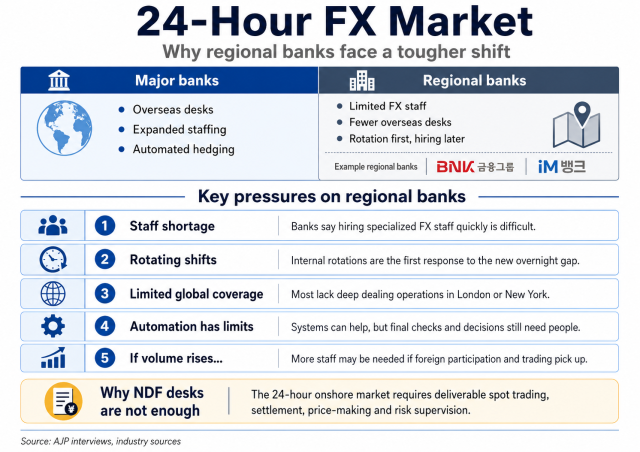
Unlike the country's largest lenders, their foreign-exchange business is centered on customer transactions, trade finance and liquidity management for local exporters and importers. Most lack extensive overseas dealing operations in financial centers such as London and New York.
"Even if we automate the process, it is ultimately people who have to look at it and make judgments," the first official said. "We need people to conduct the final checks, but that is not easy at this point."
"It is true that we are stretched compared with other banks that have branches in places such as London and New York," the official added.
Trading volumes have so far remained subdued as foreign banks appear to be observing how the new system settles in.
"So far, foreign banks are closely watching market moves after the opening, and we do not see trading volume exploding," the second official said. "But if trading volume increases later, we will have to expand the number of rotating staff or hire new employees."
The staffing challenge extends beyond banks' existing non-deliverable forward (NDF) operations.
While NDF desks can monitor offshore won movements, the new 24-hour onshore dollar-won market requires banks to support deliverable spot transactions, settlement, price-making, risk management and operational supervision throughout the trading session.
Some lenders are expected to redeploy FX derivatives dealers or rely more heavily on automated hedging systems, but bankers say additional manpower remains unavoidable.
Foreign-exchange brokers have also adjusted staffing plans, introducing overnight shifts and rotating schedules ahead of the launch.
The Ministry of Economy and Finance and the Bank of Korea said banks, securities firms, brokers and exporters had prepared for the new framework through changes to internal rules, staffing, systems and test trading.
The 24-hour regime applies to the interbank dollar-won market rather than all retail foreign-exchange services. Customer remittances, currency exchange and corporate FX transactions during overnight hours will continue to depend on each institution's staffing, systems and risk-management policies.
Market participants say the longer trading window could strengthen South Korea's case for inclusion in MSCI's developed-market index, although success will ultimately depend on offshore liquidity, tighter bid-ask spreads and sustained foreign participation rather than trading hours alone.
Copyright ⓒ Aju Press All rights reserved.
