
Journalist

Lee Hugh
=
-
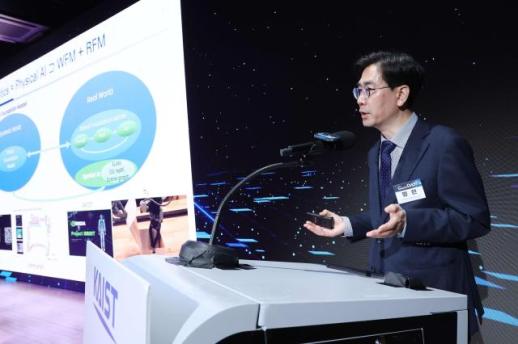 KAIST honors Professor Myung Hyun with Research Grand Prize for spatial AI robotics SEOUL, April 28 (AJP) - The Korea Advanced Institute of Science and Technology held its annual Research Day on Tuesday at its main campus in Daejeon to recognize faculty achievements and share new technical data. The event, which began in 2016, serves as the university's primary forum for highlighting academic breakthroughs and fostering a collaborative research environment, the prominent research institute said April 28. Professor Myung Hyun from the School of Electrical Engineering received the Research Grand Prize, the university's highest research honor. Myung was selected for his work on spatial artificial intelligence (AI) and autonomous robot navigation. Since joining KAIST in 2008, Myung has applied his navigation research to wheeled robots, drones, and walking platforms. His technology has won multiple international competitions and is currently being commercialized through a startup venture. "By focusing on spatial AI and autonomous movement for 17 years, I have been able to contribute to the domestic independence of mobile robot technology," Myung said. He noted that he was grateful for the chance to train the next generation of researchers. To support a more focused research environment, the university expanded its award pool this year. The number of Research Award recipients increased from two to four, and the Special Research Award was expanded to include two winners. Several other faculty members were recognized for their academic contributions. Professor Han Jae-hung, Professor Cho Byung-kwan, Professor Joseph Schiering, and Professor Lee Hyun-joo received the Research Award, while Professor Kim Sun-chang and Professor Jo Woo-young were selected for the Special Research Award. The university also presented the Innovation Award to Professor Kim Jae-kyung and the Convergence Research Award to the team of Professor Cho Him-chan and Professor Lee Jeong-yong. Other honors included the International Joint Research Award for Professor Song Ji-joon and the QAIST Creative Challenge Research Award for Professor Kim Bong-jin. The event showcased 10 representative research achievements from 2025 and 14 future technologies identified for their socioeconomic potential. These projects are aligned with national strategic technology goals in South Korea. President Lee Kwang-hyung said Research Day is an opportunity to share innovative ideas and celebrate the work of faculty. Lee stated the institution plans to continue its efforts to lead global science and technology through its research. 2026-04-28 09:51:53
 -
 Two tankers carrying 4 million barrels of Iranian oil reach Asia after transiting Hormuz; six turn back Despite a U.S. maritime blockade in the Strait of Hormuz, about 4 million barrels of Iranian crude oil transited the waterway in a single day on April 24, according to data cited by Reuters. Reuters, citing TankerTrackers.com satellite-based data, reported April 27 that two tankers bound for Asia carrying roughly 4 million barrels of Iranian crude exited the strait on April 24. By contrast, six other tankers carrying a combined 10.5 million barrels were blocked in recent days and turned back, the data showed. Four additional Iranian tankers returned empty from Asia and were last spotted near Pakistan’s coast. Iran moved to control the Strait of Hormuz immediately after the war began on Feb. 28, and the United States began a maritime blockade against Iran on April 13. Iran briefly reopened the strait April 17-18 before resuming controls, and traffic has fallen sharply from the prewar daily average of 125 to 140 transits. U.S. Central Command said April 25 that since the blockade began it has redirected 37 vessels to alternate routes. Reuters reported the U.S. military appears to have ordered some ships to turn back in the Gulf of Oman while allowing others to pass. As of April 27, at least seven ships transited the strait over the previous day, according to ship-tracking firm Kpler and satellite analytics company SynMax, but none were tankers. Most were bulk carriers; some departed Iraqi ports and one sailed from an Iranian port. Reuters said that because the U.S. military is rerouting Iran-linked ships as far as near the Strait of Malacca, it remains unclear whether the cargoes will reach buyers or be intercepted and sent back to Iran. Reuters also reported that an Abu Dhabi National Oil Co. liquefied natural gas carrier appears to have successfully transited the Strait of Hormuz. If confirmed, it would be the first known case since the war began of an LNG-laden vessel passing through the strait. There had previously been a case of an Omani carrier transiting without LNG on board. According to ICIS LNG Edge and MarineTraffic, the vessel was first detected in Gulf waters on March 30, then went dark for weeks before reappearing recently in waters west of India. In Gulf waters, some ships have also switched off location signals or transmitted false information to avoid tracking.* This article has been translated by AI. 2026-04-28 09:51:19
 -
 Pentagon says North Korean ICBMs can strike U.S., cites need for stronger homeland defense A senior Pentagon official assessed that North Korea’s intercontinental ballistic missiles have the capability to strike the United States, again citing the North’s nuclear and missile programs as a rationale for strengthening U.S. homeland defenses. According to the Senate Armed Services Committee, Mark Berkowitz, the assistant secretary of defense for space policy, appeared Monday at a Strategic Forces subcommittee hearing on the missile defense budget. In written testimony, he listed North Korea alongside China, Russia and Iran as missile threats to the U.S. homeland and allies. “North Korea poses a direct and growing threat to the U.S. homeland, forward-deployed U.S. forces, and allies with its increasing nuclear, missile, and air capabilities,” Berkowitz said. He added that North Korea’s “theater-range” missiles can reach U.S. territory and the territory of South Korea and Japan, and that North Korean ICBMs “can strike the United States.” Berkowitz made the remarks while arguing for the need for the Trump administration’s next-generation homeland defense concept known as the “Golden Dome.” The plan envisions a layered defense system aimed not only at ballistic missiles but also hypersonic weapons, advanced cruise missiles and next-generation aerial threats. He said current U.S. homeland missile defenses are limited and becoming less effective against evolving threats. “Today’s U.S. homeland missile defense is limited, and its effectiveness against increasingly advanced threats is declining,” he wrote, adding that it provides only minimal defense against hypersonic weapons, advanced cruise missiles and large-scale ballistic missile attacks. He described the Golden Dome as a concept to build a comprehensive, layered defense covering the entire United States. The hearing was held as part of the review of the fiscal 2027 National Defense Authorization request and the Future Years Defense Program. Other witnesses included U.S. Space Force Gen. Michael Guetlein, who leads the Golden Dome effort, and Missile Defense Agency Director Heath Collins. Berkowitz also said the United States would continue strengthening missile defenses in the Indo-Pacific. He said the U.S. maintains a forward-deployed, layered integrated air and missile defense network centered on Aegis destroyers, the Terminal High Altitude Area Defense system, and Patriot batteries, and would keep pushing development of an integrated air and missile defense system for Guam. 2026-04-28 09:48:20
 -
 Hanwha Life Launches External Advisory Panel to Strengthen Consumer Protection Hanwha Life said on 28 it has launched the Customer Trust+PLUS Advisory Committee, an outside-expert panel aimed at strengthening financial consumer protection. The committee will advise on issues that could infringe on consumer rights and on insurance dispute matters, bringing an independent perspective to cases the company might otherwise judge internally. Hanwha Life said it will use third-party, objective views to bolster fairness. The company said the panel is designed to go beyond case-by-case advice by reinforcing prevention-focused management in its consumer protection framework. It plans to identify potential causes of disputes consumers face in advance and link findings to institutional improvements to make protections more effective. Hanwha Life appointed five experts in insurance, consumer issues and law. Yoo Ju-sun, president of the Korea Management and Law Association, will serve as chair. Members include Ok Kyung-young, a professor of consumer economics at Sookmyung Women’s University; Jung Hye-ryeon, an associate professor in the Department of Law at the Korean National Police University; Bae Jin-cheol, an adviser at law firm KL Partners; and Han Chang-hoon, a partner attorney at law firm Yulchon. The committee will meet regularly once a quarter and select agenda items based on complaint and dispute data. Hanwha Life said it will initially focus on major complaint types, then move step by step toward reviewing structural causes and improving systems. “Based on objective and professional perspectives, we will closely identify improvement tasks that emerge in insurance practice and do our best to ensure they lead to service improvements customers can feel,” Yoo said.* This article has been translated by AI. 2026-04-28 09:39:20
 -
 South Korean Rapper Jerry.K Dies After Battle With Brain Tumor Rapper Jerry.K, whose real name was Kim Jin-il, has died after battling glioblastoma, a malignant brain tumor, for about two years. He died on the 27th, prompting an outpouring of tributes online. On social media, users posted messages such as “Rest in peace,” “I hope you’re happy there,” “My condolences,” and “I was happy to have shared this time with you.” In May, Kim told followers on his social media account that he had been “suddenly diagnosed with a brain tumor,” had undergone surgery and was recovering. “I still don’t know what all this is,” he wrote. “I hope it gets better, even little by little. Please think of me from time to time.” Born in 1984, Kim studied journalism and communication at Seoul National University. He debuted in 2001 as part of the rap duo Loquence with his high school classmate, rapper MakeSense. He later became a founding member of the hip-hop crew Soul Company and continued releasing music as a solo artist. His 2008 first full-length album, “Mawang,” used blunt language to address human nature and social issues, earning him nicknames in the hip-hop scene such as “the sharp-tongued one” and “Mawang.” In 2011, he founded the independent label Days Alive and remained active, gaining recognition for a critical perspective that examined different facets of South Korean society. A memorial altar has been set up at the funeral hall of Sinchon Severance Hospital. The funeral is scheduled for the 29th.* This article has been translated by AI. 2026-04-28 09:36:26
 -
 Won Opens Slightly Weaker as U.S.-Iran Ceasefire Talks Stall The won opened slightly weaker against the U.S. dollar as ceasefire negotiations between the United States and Iran remained stalled. As of 9:28 a.m. in Seoul on April 28, the won was trading at 1,473.5 per dollar. It opened at 1,474.1, up 1.6 won from the previous session. U.S. President Donald Trump is reviewing a new Iranian proposal, putting the deadlocked talks into a new phase. The Wall Street Journal reported on April 27 (local time) that Trump and his national security team were skeptical of Iran’s offer, which included keeping the Strait of Hormuz open and postponing discussions on its nuclear program. The dollar, which had been pressured early in the previous session on expectations of progress in U.S.-Iran war talks, rebounded in New York trading as risk appetite cooled. Oil prices also rose as uncertainty over the negotiations resurfaced. On April 27, June WTI crude on the New York Mercantile Exchange settled up 2.08% at $96.37 a barrel. July Brent crude on the London futures market ended up 2.58% at $101.69 a barrel. Min Kyung-won, an economist at Woori Bank, said steady dollar buying has continued in the local market, including demand for dividend repatriation and payments by importers. “The exchange rate is expected to face stronger upward pressure in the mid-1,470s today,” Min said. * This article has been translated by AI. 2026-04-28 09:33:53
 -
 President Lee Jae-myung vows all measures to prevent workplace deaths on Industrial Accident Workers’ Day President Lee Jae-myung said April 28 that he would use “every possible means” to ensure workplaces do not become sites of death, marking Industrial Accident Workers’ Day. In a Facebook post, Lee said he mourned “from the bottom of my heart” all workers who did not return home from their jobs. He called eliminating industrial accidents a key policy task for what he described as a “people-sovereignty government,” and said “sustainable growth based on safety” is a core principle that cannot be shaken. Lee said broad government efforts and cooperation between labor and management are beginning to show results, citing a 17.5% drop in workplace deaths in the first quarter compared with a year earlier. But he said the country still has a long way to go in the face of lives lost and the grief of families and neighbors. He pledged to tighten laws and systems so familiar tragedies are not repeated because of neglected hazards or small gaps, adding that the government would establish new standards and systems if necessary. Lee said the achievement of being the world’s 10th-largest economy cannot be a source of pride while the country carries the stigma of ranking first among OECD members in industrial accident death rates. He vowed to take responsibility so the day becomes not only one of mourning and remembrance, but also a day to reaffirm safety and talk about recovery. * This article has been translated by AI. 2026-04-28 09:33:16
 -
 Hyundai Unveils Redesigned ‘The New Grandeur’ Sedan in Major Facelift Hyundai Motor Co. on 28 unveiled the design of “The New Grandeur,” a facelifted version of its flagship sedan that the company said brings changes on the scale of a new model. First launched in 1986, the Grandeur has introduced new designs and technologies across generations and has led South Korea’s premium sedan market, Hyundai said. The newly revealed model is a facelift of the seventh-generation Grandeur, arriving about 3 years and 5 months after the current version was launched in November 2022. Hyundai said the exterior carries over the existing model’s dynamic, upscale character while refining details for more balanced proportions. The front features a longer hood, a more pronounced “shark nose” shape and a new mesh-pattern radiator grille. A slimmer, longer bezel-less seamless horizon lamp is intended to sharpen the futuristic look. A newly applied side repeater on the front fender is designed to visually connect the line running from the front to the rear. Overall length increases by 15 millimeters to 5,050 millimeters, Hyundai said, to create a dynamic yet balanced side profile. At the rear, thinner combination lamps and hidden turn-signal lamps integrated into the upper garnish are meant to reinforce a high-tech, seamless identity. Hyundai also applied a wing-type garnish to the lower bumper and expanded black trim that wraps wider across the lower body to emphasize a sportier feel. A new exterior color, “Artisanal Burgundy” in pearl and matte finishes, was inspired by traditional lacquerware, the company said. Inside, Hyundai said it retained the Grandeur’s “premium lounge” concept while expanding the sense of space. The model adopts Hyundai’s first next-generation infotainment system based on the Android Automotive operating system, called “Pleos Connect,” displayed on a 17-inch center screen. Physical buttons for key functions are placed below the screen to reduce driver distraction, the company said. Hyundai also said it added power air vents for the first time, allowing integrated control of airflow and direction through the display while concealing the outlets to enhance a premium look. Door trims use a “couch pattern” intended to improve comfort, with indirect lighting to reinforce the lounge atmosphere. Hyundai said it also applied, for the first time, a film that electrically adjusts transparency between clear and opaque states. Hyundai said it is running an “Early Pass” notification event on its official website through next month 13 to provide customers with detailed product information, the official launch schedule, and details on displays and test-drive vehicles. Among customers who sign up and later take delivery, the company said it will hold a drawing to award prizes including Bose SoundLink Home Bluetooth speakers (50 winners) and 50,000-won fuel gift certificates (100 winners). “The New Grandeur is a model newly introduced with new specifications applied across the product and details refined with precision to achieve new-car-level completeness,” a Hyundai official said. The official added that, as a flagship sedan combining “bold sculptural beauty” with a comfortable lounge feel, it will offer “a higher level of mobility experience” for customers seeking a premium vehicle.* This article has been translated by AI. 2026-04-28 09:31:54
 -
 Daewoo E&C Q1 Operating Profit Jumps 68.9% as Profitability Improves Daewoo Engineering & Construction said April 28 it posted sharply higher profit in the first quarter of 2026, citing improving margins in its building business. On a consolidated basis, revenue totaled 1.9514 trillion won, operating profit was 255.6 billion won and net profit came to 195.8 billion won. Revenue fell 6.0% from 2.0767 trillion won a year earlier. By segment, the company booked 1.2732 trillion won from building construction, 350.6 billion won from civil engineering, 284.0 billion won from plant work and 43.6 billion won from other businesses. Operating profit rose 68.9% from 151.3 billion won in the same period last year, while net profit increased to 195.8 billion won from 58.0 billion won. The company said revenue was broadly in line with market expectations, but profit measures exceeded forecasts. Daewoo E&C said profitability in the building segment improved as projects launched during a period of rising costs have gradually been completed. It added that uncertainty remains, including risks in the Middle East, but said it will continue pursuing its targets through management capabilities. New orders totaled 3.4212 trillion won, up from 2.8238 trillion won a year earlier, driven largely by domestic projects including the Busan Sajik District 4 redevelopment, Cheonan Upseong 3 A1BL and the Seoul Jangwi District 10 redevelopment. As of the end of the first quarter, the company’s total order backlog stood at 51.8902 trillion won, which it said represents about 6.4 years of work based on annual revenue. A Daewoo E&C official said the company plans to expand the share of energy infrastructure projects such as nuclear power and LNG, while broadening its portfolio through overseas urban development, data centers and urban renewal projects. The official said the company will also focus on securing large projects, including the Czech nuclear power plant, land development for the new Gadeokdo airport, the Al Faw port naval base in Iraq and an LNG facilities project in Papua New Guinea. 2026-04-28 09:27:52
 -
 KB Kookmin Bank Expands KB Hope Finance Centers Nationwide KB Kookmin Bank said on the 28th it has expanded its “KB Hope Finance Center,” which supports financially vulnerable customers seeking to get back on their feet, to major hubs nationwide. Following openings in Seoul and Incheon in February, the bank has launched additional centers in Daegu, Daejeon and Busan. To mark the expansion, an event was held on the 27th at the Seoul center on the second floor of KB Kookmin Bank’s Sangdo-dong Comprehensive Financial Center, attended by Financial Services Commission Chairman Kim Byoung-hwan, Lee Chang-kwon, head of the Future Strategy Division at KB Financial Group, and Song Yong-hoon, executive vice president of KB Kookmin Bank’s Credit Management Group, among others. The KB Hope Finance Center is positioned as a leading banking model for inclusive finance, offering debt restructuring and credit counseling services, including guidance on debt relief programs and support schemes for low-income borrowers. The bank said it has introduced an in-house “post-loan management AI agent” developed by KB Financial Group to improve efficiency. The bank also operates a “mind care counseling service” funded by KB Kookmin Bank donations in partnership with the Korea EAP Association. Through 943 affiliated counseling centers nationwide, the program provides professional psychological counseling to customers who receive debt adjustment counseling from the Credit Counseling & Recovery Service, aiming to support emotional stability and a return to daily life. The Korea EAP Association is a nonprofit incorporated association established in 2005 and described as the country’s first specialized EAP (employee assistance program) organization. A KB Kookmin Bank official said the bank hopes customers struggling with debt will receive practical help through the centers, adding that it will continue to fulfill its social responsibility through inclusive finance initiatives.* This article has been translated by AI. 2026-04-28 09:27:15