
Journalist

Lee Hugh
=
-
 Foreign and Institutional Investors Turn Net Buyers in Kospi; Retail Investors Post Record 14.7 Trillion Won Net Selling ◆Aju Economy Top News ▷Foreign and institutional investors reverse from net selling to net buying; retail investors post record 14.7 trillion won net selling -Over the past month, Kospi fund flows flipped, with foreign investors shifting from net sellers to net buyers. -Retail investors, meanwhile, have logged about 14.7 trillion won in net selling so far this month, the largest on record. -Foreign and institutional investors have focused their buying on heavyweight semiconductor shares such as Samsung Electronics and SK hynix, with net purchases topping 2.5 trillion won and 6.9 trillion won, respectively. -The move contrasts with last month’s sharp sell-off, when retail investors bought heavily; in the current upswing, they appear to be taking profits mainly in semiconductor stocks. -Some in the market expect the Kospi’s uptrend could extend further as expectations build for an improving semiconductor cycle and upward earnings revisions. ◆Key Reports ▷Mirae Asset Securities: “OCI Holdings target price raised on expectations for SpaceX cooperation” -Mirae Asset Securities raised its target price for OCI Holdings to 400,000 won from 270,000 won, citing expectations of a partnership with SpaceX and higher earnings estimates. It maintained a “buy” rating. -The firm said rising U.S. power demand could lift the value of generation assets and power purchase agreement prices, supporting both a higher sale price for OCI Energy assets and improved core earnings. -It also viewed the company’s polysilicon capacity expansion plan as a sign that cooperation with SpaceX is progressing, and cited strengths including low production costs and room to expand amid demand for non-China supply chains. -While results fell short of expectations in the near term, the firm said improvement should continue over the medium to long term on expansion and demand growth, keeping the stock as its top pick in the sector. ◆Major disclosures after the close (24th) ▷Erem decides on a 11 billion won rights offering ▷Hyosung Heavy Industries posts 152.3 billion won in first-quarter operating profit, up 48.8% from a year earlier ▷Dmoa decides on a 19 billion won rights offering ▷Woori Financial Group: “Additional acquisition of Woori Investment & Securities shares worth 1 trillion won” ◆Fund flows (as of the 23rd, excluding ETFs) Domestic equity funds: 63.5 billion won Overseas equity funds: 15.0 billion won ◆Today’s (Mon) key schedule China: Industrial profits (March); Standing Committee meeting of the National People’s Congress United States: 2-year Treasury auction; 5-year Treasury auction * This article has been translated by AI. 2026-04-27 07:27:17
 -
 Iran Foreign Minister Returns to Pakistan, Says He Delivered Specific Terms Iranian Foreign Minister Abbas Araghchi returned to Pakistan’s capital, Islamabad, on April 26, Iranian state media reported, a day after he left for Oman. According to Iran’s state-run IRNA news agency and Yonhap News Agency, Araghchi met with Sultan Haitham bin Tariq Al Said in Oman and then headed straight back to Islamabad. Back in Pakistan after one day, Araghchi met with Army Chief Gen. Asim Munir, among others. Tasnim news agency said Araghchi “delivered specific terms” for ceasefire talks. Since April 24, Araghchi has been traveling to Pakistan, Oman and Russia. Expectations rose that a second round of ceasefire talks with the United States would move forward after Araghchi arrived in Pakistan, which is acting as a mediator. But after meeting Munir and other key figures in Pakistan and conveying Iran’s views and demands on a ceasefire, Araghchi left for Oman on April 25, making it difficult to predict whether the talks with the United States would continue. 2026-04-27 06:05:47
 -
 Korea SME Agency Highlights Budget-Friendly Diet Foods at April Shopping Festival Rising prices and a weaker won have made diet-friendly meal planning more expensive for many consumers. The Korea SMEs and Startups Distribution Corp. said it is spotlighting lower-priced diet and low-sugar foods during the “April Companion Festival.” The agency, known as KODC, said Saturday the event is intended to go beyond simple discounts by giving consumers a chance to manage household spending while supporting small businesses. Among the featured products is “Dubunola” from Bijiterian. It replaces the oats typically used in granola with okara made from domestically produced soybeans, aiming to boost protein and dietary fiber. The company said one bag contains protein equivalent to three eggs and dietary fiber equivalent to six apples. Ingredients include coconut oil, peanut butter, maple syrup and honey, along with unrefined sugar, it said. Sorang introduced its “low-sugar mini pound cake,” designed for consumers who like desserts but want to avoid flour. The company said it uses almonds and grain flour instead of wheat flour and contains no sugar. It comes in eight flavors: fig, mugwort, chocolate, sesame-peanut, carrot, sorghum-chickpea, pea-black sesame and lemon-Earl Grey. Localow’s “Hottab all-purpose low-sugar gochujang” targets consumers seeking a lower-sugar alternative to traditional red pepper paste, which is typically made with grain syrup or corn syrup and contains natural sugars from peppers. The company said it replaced those sweeteners with allulose and added garlic flavor, cutting sugars by 8% compared with conventional gochujang. It said all ingredients are domestically sourced, including a fiber-rich fermented wheat ingredient from the Honam region and garlic harvested in a clean environment on Jeju Island. Sseobol Lab is offering “Diet Fairy unsweetened Greek yogurt,” made after removing 100% of whey, the company said. It said the product uses domestically produced Grade 1 milk and Danish lactic acid bacteria, with a mild, clean taste and thick texture. The yogurt is unsweetened and contains no sweeteners or stabilizers, it said, and is produced at a HACCP-certified facility under a same-day production and shipping policy. A version with 50% of whey removed is also available, it said. Hosted by the Ministry of SMEs and Startups and organized by KODC, the April Companion Festival runs through May 10 with about 33,000 small and midsize companies and small merchants participating, along with more than 200 domestic online and offline retail channels, KODC said. KODC said promotions include discounts of up to 70% on popular items such as food, household goods and fashion across more than 90 online shopping platforms, including Kakao, Musinsa and Coupang. Offline, consumers can try products at special sales events in department stores and big-box retailers and buy items at discounts of up to 90%, it said. A KODC official said the agency is also offering practical benefits to encourage participation during the event period, adding that plans include expanding discount limits for digital Onnuri gift certificates. 2026-04-27 06:04:48
 -
 Commentary: Defining the Problem Determines the Market for AI People often say, “We have the technology, but there’s no market.” That is wrong. The market is not absent; it is unseen — because the problem has not been defined. South Korea has learned to run fast on roads others built — in semiconductors, displays and batteries. It has less often created the road itself. Artificial intelligence is a roadless technology: It can detect tiny factory defects, hidden bottlenecks in logistics routes, or whether an older adult living alone took medication — areas that were hard to see and therefore rarely treated as “problems.” When AI makes them measurable, they become problems, and once they are problems, markets open. I recently met the CEO of an AI company in manufacturing. The firm proved its technology through a government project and had a model ready for the shop floor. The obstacle came next: finding factories that needed it and explaining its value in the language of the workplace — tasks it could not do alone. This is not unique. Many AI firms stall at the market’s doorstep. That is a bottleneck for South Korea’s AI industry. Policy now needs to shift from funding technology to defining problems. Economist Mariana Mazzucato called this “mission-oriented innovation policy.” “We will foster AI” is different from “We will cut emergency response time for older adults living alone by half.” The first attaches money to technology; the second attaches technology to a problem. The logic is similar to the U.S. Defense Advanced Research Projects Agency using a single autonomous-driving race to spur an industry, or the European Union aligning technology and capital under the Green Deal. The clearer the problem, the easier it is for technology to find its destination, for companies to forecast returns, and for money to move. Two steps are needed. First, set numeric targets and concentrate support on companies that can deliver. Policy should start with challenges drawn from the field — defects in semiconductor back-end processes, farmland yields, emergency response for older adults. Demand should go to the few with the capacity to solve the problem. Spread support evenly and no one grows big. Second, once companies are selected, support must be sustained. Until now, assistance has been fragmented by project and by year, failing to back growth. Computing resources, data, real-world testing, financing and overseas expansion should be linked, with support scaled up when results appear. Some countries are already producing results this way. France, through French Tech Next40/120, selects 120 scale-up companies each year for full national support and links that effort to deep-tech development through French Tech 2030. Singapore’s Enterprise SG Scale-Up has 집중 supported more than 80 companies and generated S$2.5 billion in new revenue in three years. Israel, under a national AI program, has built a dedicated supercomputer, while its Innovation Authority directly supports companies with research foundations and funding. The methods differ, but the common point is clear: pick companies that can win and back them to the end. South Korea faces the same task. To carry this approach into the field, it needs a small- and medium-sized enterprise-focused institution with both the ability to select firms and the policy tools to support them at each stage. In the end, how precisely a problem is defined determines the size of the market. Technology flows in proportion to that size, and industry grows with it.* This article has been translated by AI. 2026-04-27 06:03:55
 -
 National Nakdong River Biological Resources Institute Opens Applications for Teaching Kit Loans, Online Classes The National Nakdong River Biological Resources Institute said on the 27th it is accepting applications from schools and other educational institutions for its “teaching kit loan service” and its “online bio-environment classroom.” The program, which begins that day, is designed to expand hands-on learning by distributing teaching kits and content developed by the institute for use in classrooms and other learning sites. The teaching kit loan service provides free loans of seven types of kits focused on biodiversity and climate change for use in educational settings. The online bio-environment classroom is an integrated online-offline course that combines video content with hands-on activity packages. Applications open that day through the institute’s website reservation system. Registration for the online bio-environment classroom runs through the 31st of next month, with up to 2,000 participants accepted on a first-come, first-served basis for each program; applications will close once capacity is reached. “Through the teaching kits developed by the National Nakdong River Biological Resources Institute, children and teenagers will be able to understand the value and importance of biodiversity in an easy and engaging way,” said Yeo Jin-dong, head of the institute’s Exhibition and Education Division. He added that the institute will continue to expand educational content that can be used in schools and other learning environments.* This article has been translated by AI. 2026-04-27 06:03:06
 -
 South Korea Weighs How to Use Expected Tax Windfall: Debt Paydown, Extra Budget or Reserves South Korea is again expected to post a large tax revenue surplus this year, and the government is weighing how to use it. Options under discussion include early repayment of government bonds, drafting a supplementary budget, or setting the money aside in a fund. Some analysts say the decision should hinge on what is driving the extra revenue. The choice is complicated by competing goals: restoring fiscal soundness while also responding to economic conditions. How policymakers proceed could depend on whether the revenue increase is structural or a temporary swing in the business cycle. ◆ “Use the surplus to cut debt first”: Fiscal discipline argument One view is that the surplus should be used to repay government bonds early to strengthen fiscal health, after national debt rose during the COVID-19 response. Supporters say paying down debt while revenue is strong would preserve medium- to long-term fiscal capacity and improve the government’s ability to respond if another crisis hits. Early repayment could also signal to international credit rating agencies and foreign investors that South Korea is actively managing economic fundamentals. Compared with injecting more money into the economy, debt repayment may help restrain the money supply and contribute, at least in part, to stabilizing high inflation, proponents argue. Some analysts also warn that using surplus revenue to expand spending could amplify economic volatility. The National Assembly Budget Office said surplus revenue stemming from underestimates can lead to higher spending in the same year or the next, potentially weakening fiscal policy’s countercyclical role during an upswing. An official at the office said, “If a supplementary budget is compiled as a tool to make up for underestimated tax revenue regardless of economic conditions, the likelihood of causing economic instability increases.” ◆ “Use fiscal spending to support growth”: Active fiscal policy argument Others argue for more active fiscal intervention to boost the economy. With domestic demand weakened by the effects of high interest rates and high inflation, they say government spending is needed to lift consumption and investment. Some call for cash-type support for vulnerable groups whose real incomes have fallen due to inflation, and for small business owners hit hard by the downturn, to strengthen the social safety net. Another argument gaining traction is preemptive investment in future growth industries such as semiconductors and artificial intelligence to spur private-sector investment. In this view, fiscal spending is a key tool to cushion near-term downside risks when consumption and investment are sluggish. A third camp says the government should build reserves in a fund rather than immediately expand spending or repay debt, as a hedge against volatility. Supporters describe it as a compromise that could serve as a buffer if sharp economic shifts occur or if large resources are needed during structural reforms. Critics note that setting money aside does not reduce debt as directly as early repayment and offers less immediate stimulus than a supplementary budget, making it less attractive politically. With the three approaches competing, the government has not set a clear direction. Park Hong-geun, minister of the Office of Planning and Budget, recently told reporters the government would proceed cautiously. Park said, “If a tax revenue surplus or surplus funds occur, we will execute them in an appropriate manner in accordance with relevant laws and procedures, including the National Finance Act.” Experts advise first determining the nature of the surplus before deciding how to use it. Kim Yu-chan, a professor of business administration at Hongik University, said it is important to distinguish whether the surplus is structural or temporary. He said the current increase appears largely temporary, driven by a strong semiconductor cycle, and that it would be desirable to pair fiscal spending that helps spread growth beyond semiconductors with a reduction in the amount of government bonds originally planned for issuance.* This article has been translated by AI. 2026-04-27 05:05:55
 -
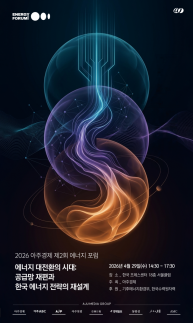 Aju Business Daily to Hold Energy Forum on Korea’s Strategy Amid Supply Chain Shifts Uncertainty is growing in the global energy market as prolonged Middle East-driven geopolitical risks continue to unsettle oil and gas supply chains, prompting countries to refocus energy security as a core national strategy. At the same time, the spread of artificial intelligence and the rise in data centers are sharply increasing electricity demand, accelerating structural change across existing energy systems. South Korea is no exception. With heavy reliance on energy imports and a manufacturing-centered industrial base, the Korean economy is particularly sensitive to shifts in global energy supply chains. That is why securing stable supplies and establishing a practical energy mix strategy spanning renewables, nuclear power and liquefied natural gas (LNG) is increasingly urgent. Aju Business Daily will hold the “2026 Aju Business Daily 2nd Energy Forum” on April 29 at the Korea Press Center in Jung-gu, Seoul. The forum’s theme is “The Era of a Major Energy Transition: Supply Chain Reshaping and Redesigning South Korea’s Energy Strategy.” Kim Hyeong-jun, a chair professor in the Department of AI Futures Studies at KAIST’s Moon Soul Graduate School of Future Strategy, is set to speak on “The Climate Crisis, Energy Security and South Korea,” outlining the importance of energy security and Korea’s response strategy amid a deepening climate crisis and expanding geopolitical risks. Next, Gwak Eun-seop, head of the Grid Planning Office at Korea Electric Power Corp., will present on “Power Demand in the AI Era and New Challenges for the Power Grid,” focusing on surging demand tied to expanding data centers, shortages in transmission networks, and solutions for stable power supply. A panel discussion will bring together experts from government, academia and industry to discuss a Korea-style energy mix strategy and approaches to energy security. ■Theme: The Era of a Major Energy Transition: Supply Chain Reshaping and Redesigning South Korea’s Energy Strategy ■Time: April 29, 2026 (Wed.) 2:30 p.m.–5:30 p.m. ■Venue: Seoul Club, 18th floor, Korea Press Center ■Host: Aju Business Daily ■Sponsors: Ministry of Climate, Energy and Environment; Korea Hydro & Nuclear Power * This article has been translated by AI. 2026-04-27 05:05:06
 -
 South Korea’s Tax Revenue Swings Raise Concerns Over Budget Forecast Accuracy National tax revenue is rising faster than expected this year, fueling expectations that the tax surplus will exceed the government’s initial forecast. Economists and budget analysts, however, warn that repeated forecasting errors could undermine confidence in fiscal management. According to the Ministry of Economy and Finance on the 26th, national tax revenue in January and February totaled 71 trillion won, up 10 trillion won (16.5%) from a year earlier. By category, income tax rose 2.4 trillion won, value-added tax increased 4.1 trillion won, and the securities transaction tax climbed 1.2 trillion won. Revenue is also coming in earlier than usual. As of February, the collection rate versus the annual budget stood at 18.2%, 1.4 percentage points above the five-year average of 16.8%. The government previously projected a tax surplus of about 25.2 trillion won compared with the main budget and used it to fund a supplementary budget. With talk of additional gains in some items, including housing holding taxes, some observers say the surplus could be larger. The concern is that tax revenue volatility has widened sharply in recent years. Surpluses reached 61.3 trillion won in 2021 and 52.6 trillion won in 2022, but were followed by shortfalls of 56.4 trillion won in 2023, 30.8 trillion won in 2024 and 8.5 trillion won in 2025. Such swings are seen as weakening predictability and transparency in fiscal operations, especially when errors run into the tens of trillions of won, reducing the effectiveness of medium- and long-term fiscal plans. Underestimating revenue can increase incentives to draft supplementary budgets, while overestimating can lead to spending cuts or additional bond issuance, potentially hurting fiscal stability. The government has emphasized that the latest supplementary budget is “bond-free” because it uses surplus revenue. Critics note that if the entire surplus is spent, less will remain as a year-end surplus that could have been used to repay government debt, producing an effect similar to issuing additional bonds in terms of fiscal soundness. The National Assembly Budget Office said both under- and over-budgeting revenue causes inefficiency and unnecessary administrative costs. It said the case, in which about 25 trillion won in revenue error emerged just three months after the fiscal year began, calls for a broader review of the tax revenue forecasting system rather than being treated as a simple miscalculation. Analysts attribute the volatility to a tax structure heavily dependent on the business cycle and asset markets. Major taxes such as corporate tax and capital gains tax are sensitive to economic conditions and asset prices, amplifying swings. Limits in forecasting methods — including repeated conservative or overly optimistic errors when incorporating economic outlooks — are also cited. Experts say institutional improvements are needed to better manage volatility, including more sophisticated forecasting models and a framework that improves predictability in medium- and long-term fiscal planning. Kim Jeong-sik, an emeritus professor of economics at Yonsei University, said accurate revenue forecasts require credible growth projections and consideration of policy variables, including tax law changes and real estate-related capital gains and holding taxes. “Because this process is also tied to the National Assembly, there are aspects that make forecasting difficult,” he said.* This article has been translated by AI. 2026-04-27 05:04:11
 -
 South Korea’s Tax Take Seen Surging Past 400T Won This Year, Possibly 500T Next Year South Korea’s government is facing a pivotal choice in fiscal policy as tax revenue is expected to far exceed earlier projections, reversing several years of shortfalls. After an estimated 25 trillion to 35 trillion won in excess revenue this year, some forecasts say national tax revenue could top 500 trillion won next year, well above the government’s initial outlook. As of the 26th, the Finance and Economy Ministry and other officials estimate this year’s national tax revenue will surpass 400 trillion won and reach about 415 trillion won, sharply higher than earlier projections. In its “2025-2029 National Fiscal Management Plan,” the government had forecast about 390 trillion won for this year and about 412 trillion won for next year, based on a conservative assumption of 4.6% average annual growth. Changing conditions are now forcing a revision. Revenue conditions have improved quickly this year, helped by a semiconductor boom, a strong stock market and a recovery in employment. When the government drafted its first supplementary budget this year, it made a 22.6 trillion won revenue adjustment, a procedure used to revise the budget when tax receipts come in higher or lower than expected. By category, corporate tax revenue was projected to rise by 14.8 trillion won, while the securities transaction tax and the rural special tax were expected to increase by 10.3 trillion won. Earned income tax was also projected to rise by 4.8 trillion won, reflecting broader gains in the tax base. With growth across major tax items now expected to be steeper than previously assumed, some observers say excess revenue this year could exceed the 25 trillion won used to finance the first supplementary budget and reach as much as 35 trillion won. Next year’s increase could be even larger. Using operating profit forecasts that reflect a “semiconductor supercycle” for major companies such as Samsung Electronics (300 trillion won) and SK hynix (198 trillion won), a simple calculation suggests corporate tax revenue from those two firms alone could generate more than 130 trillion won in additional revenue. That has fueled speculation that next year’s national tax revenue could far exceed the 412 trillion won forecast and climb well past 500 trillion won. If the unexpected surge materializes, debate is expected to intensify over how to use the windfall. Some argue it should be used to repay government bonds and strengthen fiscal soundness, saying rapid growth in national debt during years of revenue shortfalls makes this a chance to rebuild fiscal room. Others say the government should play a more active fiscal role during a period of low growth. The government has also stressed the need for spending to strengthen the growth foundation. Park Hong-geun, minister of the Planning and Budget Office, said at a news briefing on the 21st, “To raise the growth rate, the role of fiscal policy is needed,” signaling support for an expansionary stance. With the decline in potential growth becoming entrenched, the government sees fiscal spending as unavoidable for investment in new industries and structural reform. Questions remain about sustainability, however, because the revenue boom may be temporary and tied to a specific industry cycle rather than structural change. Critics note that external uncertainty remains high, including high oil prices and a weak won, and that tax receipts could still swing sharply with corporate earnings. The broad direction of fiscal management is expected to take shape at a National Fiscal Strategy Meeting in June after local elections. Chaired by the president, the meeting sets medium- and long-term fiscal policy and the basic principles for drafting next year’s budget, effectively serving as the government’s fiscal control tower. Officials are also expected to outline a more concrete plan there for how to use excess revenue.* This article has been translated by AI. 2026-04-27 05:03:19
 -
 LBS Professor Alex Edmans: Curiosity and Constant Questions Help Defeat Fake News "We need a culture where saying, 'I was wrong — I see it differently now,' is accepted and even encouraged." Alex Edmans, a professor of finance at London Business School, says resisting misinformation starts with curiosity and the habit of asking questions rather than leaning on conventional wisdom or authority. In his book <May Contain Lies> (Wisdom House), Edmans puts a wide range of sources under scrutiny — government-approved reports, papers published in scientific journals and even books endorsed by Nobel laureates. He also points to what he calls errors and exaggerations in global bestsellers, including <Outliers>. In an interview with this news organization, Edmans said Korea’s polarization and a confirmation-bias environment — where people seek out only what supports what they already believe — can be addressed by encouraging curiosity and questioning. He also said a harsh attitude toward failure can make people cling to a view once they adopt it, instead of changing their minds. "If people become more discerning, things can improve," he said. "Just being curious and asking questions can do it. In an environment that is strict about failure, once you hold a particular view, you become focused on defending it and you don’t want to change your mind." Edmans said books should not be treated as automatically trustworthy and that popularity is not proof of accuracy. "People say something is 'textbook' when they mean it’s correct, or they defer to authority by saying, 'He wrote the book on it,'" he said. "But a book isn’t that different from a long blog post. What matters is who wrote it and whether that person has expertise. Popularity is not evidence that the content is accurate — just as viral videos can be misleading." He said people should avoid settling for the most obvious explanation and instead look for alternatives by asking questions. He described confirmation bias as a tendency to accept what feels comfortable and said people should practice tolerating discomfort and challenging what they want to be true. He wrote in the Korean edition’s preface that “democracy dies when citizens stop asking questions.” "As an economist, I believe both supply and demand matter," he said. "If the public wants fake news — if citizens don’t ask questions and accept as fact only what they want to believe — then politicians, influencers and journalists will keep supplying it. The key point is that this isn’t because they are bad people. They are human, and they may lack the time or expertise to think critically and fact-check. Even busy citizens can understand the world better and make better decisions just by asking simple questions." Edmans also answered questions in writing about fact-checking and how people can avoid being misled by false information and incitement. ▷ People can be influenced more by values and ideology than by facts. How can people balance the pursuit of objective facts with value judgments? "It starts with recognizing the difference," he wrote. "Some issues have an objective truth — whether smoking causes cancer, or whether investing in a net-zero portfolio lowers financial returns. But what decision to make in a given situation is often a value judgment. Even if a net-zero portfolio doesn’t maximize returns, you might invest because you worry about climate change. Separating the two is important. If someone says, 'Net-zero investing sacrifices financial returns,' social media may try to brand that person a climate-change denier or immoral. But it’s simply a fact, without a value judgment. Acknowledging that net-zero investing has costs, while deciding you are willing to pay them because of concern about climate change, is not logically inconsistent." ▷ Your book emphasizes diversity and inclusion. Is dialogue that reaches mutual agreement really possible? "If people are open-minded, and if culture supports changing one’s view rather than saving face by refusing to admit mistakes, then agreement through dialogue is certainly possible," he wrote. ▷ Korea’s education system tends to focus on finding the right answer. As a parent, what matters most in building a child’s critical thinking? "Encourage children to ask questions," he wrote. "There are two ways. First, explicitly praise the act of asking. I often tell my son, 'That’s a good question.' Second, answer carefully even if the question is simple. Sometimes you may need paper and a pen to draw a picture, or show a real object, to answer properly." ▷ The word “common sense” is often used in politics and can change by era and context. Is it a reliable standard? "Appealing to common sense is dangerous," he wrote. "It often means personal intuition or a hunch, which can lead people to reject evidence that contradicts their instincts. For example, it may seem like giving water to a child with diarrhea will just pass through, so you shouldn’t. But experts say you must give water to prevent dehydration. Also, the 'common' in common sense can mean what everyone else thinks — a shared belief. But the wisdom of crowds is often wrong." ▷ Will advances in technology, including AI, worsen information distortion or improve it? "The internet has made it very easy for people to search for information that supports their views, regardless of whether it is true," he wrote. "Social media bears some responsibility for misleading people with posts or short videos, but the problem is that this has expanded into blogs and newspaper articles. AI is a double-edged sword. Like other tools, it depends on how it is used. Some will use AI to check or verify the other side of an argument, while others will use it to find information that reinforces existing biases." ▷ A message for Korean readers? "Fake news is a serious problem, but it is not unsolvable," he wrote. "If you keep an open mind, don’t lose curiosity, and keep asking questions, you can get a little better every day." 2026-04-27 00:04:38